Daphne Police Cpl. Jamie Huffman Earns Statewide School Safety Certification
Daphne Police Cpl. Jamie Huffman has become one of only 35 school resource officers in Alabama to earn the School Safety Specialist certification from The Alabama Association of School Resource Officers.
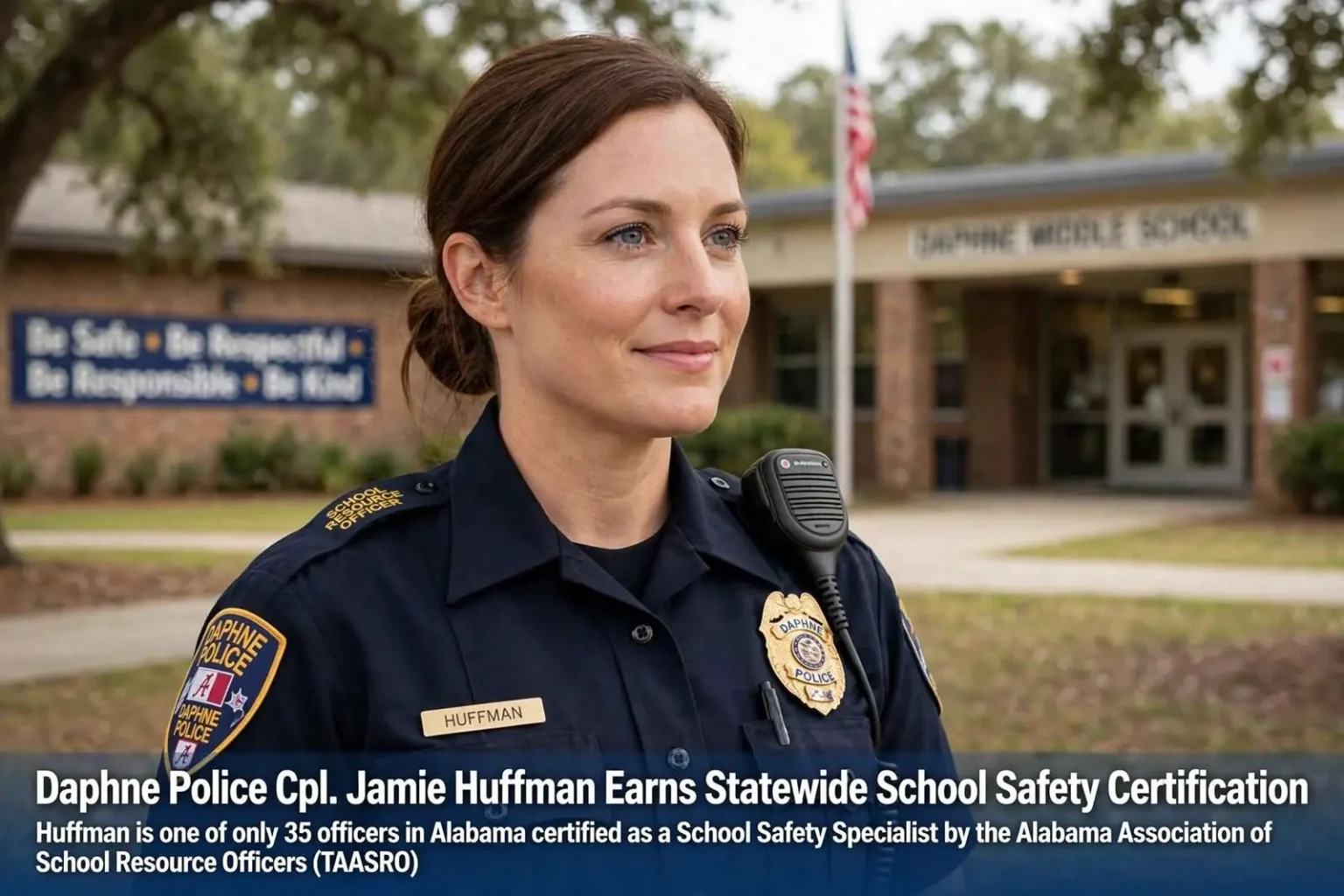
Daphne Police Department Corporal Jamie Huffman has earned certification as a School Safety Specialist from The Alabama Association of School Resource Officers (TAASRO), placing her among a small group of officers statewide to hold the distinction. Cpl. Huffman is one of only 35 school resource officers in Alabama to earn the School Safety Specialist certification, according to the Daphne Police Department.
The credential is awarded through TAASRO, the statewide organization that trains and certifies school resource officers across Alabama, and reflects specialized training in keeping school campuses safe. In a state with hundreds of school resource officers working in city and county systems, a certification held by 35 officers statewide represents the upper tier of a specialized field — officers who have gone beyond the assignment itself to complete advanced preparation in campus safety.
A record of specialized training
The School Safety Specialist certification adds to an already extensive list of credentials Cpl. Huffman holds. She is also certified as an FBI Firearms Instructor, an ALICE and ALERT instructor, and has training in Homeland Security Threat Assessment. Each of those certifications reflects a different facet of the specialized preparation school resource officers undergo to respond to a range of potential threats on campus, from active-threat scenarios to broader safety assessments.
The FBI firearms instructor credential is among the most demanding qualifications a working officer can add, requiring instructor-level training at the bureau’s standards and the ability to certify other officers in firearms proficiency. For a school resource officer, the credential matters in both directions: it prepares her own response and allows her to train colleagues — including officers who may one day respond alongside her to a campus emergency.
ALICE training — an acronym for Alert, Lockdown, Inform, Counter and Evacuate — is a widely used framework for preparing schools and law enforcement to respond to active-shooter situations, while ALERT instruction similarly focuses on emergency response protocols. Threat assessment training, meanwhile, equips officers to identify and evaluate potential safety concerns before they escalate.
The distinction between those last two matters. ALICE and ALERT prepare a campus for the worst moment; threat assessment works earlier in the timeline, giving trained personnel a structured way to evaluate troubling behavior — a student’s statements, social media activity, or the concerns of teachers and classmates — and to intervene before a situation reaches a crisis. Officers with both skill sets can operate on either side of that line.
What an SRO does all day
Behind the certifications sits a job that few residents see in full. A school resource officer in a city like Daphne is simultaneously a law enforcement presence on campus, a safety planner for school administrators, an instructor delivering safety curricula, and — in practice — an informal counselor whom students approach with problems that never generate a police report. The role rewards exactly the combination Huffman’s credentials represent: hard tactical preparation alongside the softer skills of working daily with young people.
Involvement beyond the badge
Cpl. Huffman’s work extends beyond her certifications and day-to-day duties as a school resource officer. She manages two youth mentorship programs locally, giving her a hand in shaping young people’s lives outside of a strictly law enforcement capacity. She also regularly participates with Compass II Life Services, a local organization involved in community support work.
Youth mentorship programs occupy a particular place in school policing. They give officers sustained contact with students over months rather than incidents, building the trust that makes everything else on campus work — the student who will tell a trusted officer about a threat, a weapon seen in a backpack, or a classmate in crisis. Managing two such programs means Huffman’s influence extends to students she may never meet in a disciplinary context at all.
Her work with Compass II Life Services ties her to the wider network of community support organizations that operate alongside the schools. Organizations in that mold — mentoring, life-skills and family support work — depend on volunteers who show up week after week, and a police officer’s steady participation carries weight with young people who may have little other contact with law enforcement beyond the negative kind.
The SRO assignment itself is also a selective one. Departments do not simply rotate patrol officers into schools; candidates are screened for judgment, temperament and the ability to work with minors, and the best tenure in the post for years, building relationships with administrators, teachers and families. Huffman’s longevity in the role is part of what makes the new certification meaningful — the credential certifies knowledge, but the mentorship programs and the daily campus presence reflect the accumulated trust that no course can issue.
How school policing works in Baldwin County
Daphne sits on the Eastern Shore of Mobile Bay, one of the fastest-growing corners of Alabama, and its schools reflect the growth. School resource officers here serve within a system that has expanded rapidly for decades — new campuses, growing enrollments and the safety expectations that follow from both. The SRO assignment has evolved from its early conception as a security post into a hybrid role that blends policing, education and mentoring, and the training infrastructure that TAASRO provides exists to keep that evolution deliberate rather than improvised.
TAASRO’s certification ladder gives Alabama agencies a common standard for the specialty. Officers come to the assignment from patrol backgrounds, then build school-specific training — campus law enforcement, adolescent development, emergency planning, active-threat response — through courses the association and its partners provide. The School Safety Specialist certification sits near the top of that ladder, which is why a department announces it when one of its own earns it: the credential is scarce, and its holder becomes a local resource for every campus in the city.
For the Daphne Police Department, the certification also has institutional value. A School Safety Specialist on staff can review emergency plans across the city’s schools, train fellow officers in campus response, and coordinate directly with school administrators on the assessments and drills that state requirements call for. The 35-officer statewide total means few departments can make that claim — and Daphne now can.
The dual role modern SROs play
Her combination of technical safety credentials and hands-on youth mentorship reflects the dual role many school resource officers play in Baldwin County and across Alabama — serving as both a trained safety professional prepared for emergency response and a familiar, trusted adult presence for students throughout the school year. The balance is not automatic. Officers who excel in the assignment tend to treat the mentorship side as a core duty rather than an afterthought, and departments increasingly evaluate SRO candidates with that expectation in mind.
The national conversation over school policing has sharpened that point in recent years. Districts and departments alike have examined what an officer’s presence on campus should accomplish — and the consensus that has emerged in Alabama mirrors Huffman’s profile: officers chosen for the assignment should bring both the tactical preparation for a campus emergency and the temperament to work with students every day. A certification in school safety, paired with years of mentorship work, is that profile in professional form.
Recognition and what it means for Daphne
The Daphne Police Department recognized Cpl. Huffman’s achievement, offering congratulations on the new certification as she continues her work supporting students and schools throughout the Daphne community. Department announcements of this kind serve a second purpose as well: they signal to school administrators and parents the level of preparation behind the officer they see at the campus door.
For Huffman, the certification formalizes what her assignment has long required in practice. The threat assessment training informs how she evaluates concerns brought to her by teachers and students; the ALICE and ALERT instructor credentials mean she does not merely follow the campus emergency plan but teaches it; the FBI firearms instructor certification extends her value to the officers who would respond with her. The mentorship programs and Compass II Life Services participation connect the whole package to the students themselves.
As one of 35 School Safety Specialists in Alabama, she now holds a credential that few of her peers statewide share — and in a growing Eastern Shore city whose schools define so much of daily life, the department’s investment in that level of preparation is a statement about the standard it expects for campus safety.
The certification does not change the daily rhythm of the assignment — the morning arrivals, the hallways between classes, the conversations that never become reports. It does formalize the expertise behind them, and it gives Daphne’s schools a resource that few systems in the state can claim. For the students Huffman works with, the distinction that matters most is likely the simpler one: the officer on their campus keeps training so they can keep learning in safety.