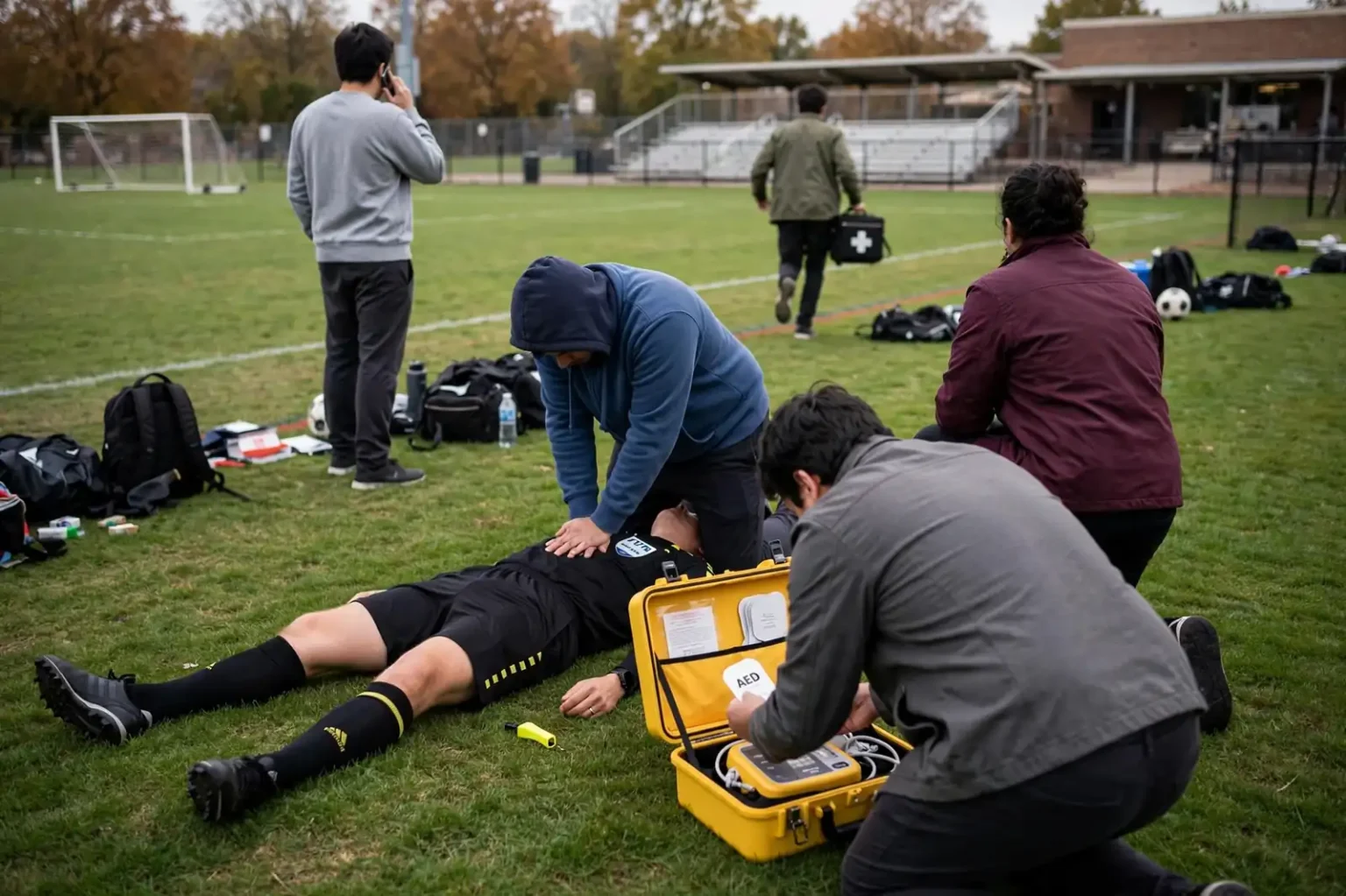
DAPHNE, Ala. — A youth soccer referee is alive after his heart stopped during a game because people on the sidelines started CPR within moments and used a defibrillator that was close at hand.
Brock Cole, who has refereed local soccer for years, collapsed in cardiac arrest in the second half of a game on Oct. 11 at Al Trione Sports Complex in Daphne. “I just immediately got light-headed… I never even got the opportunity to blow the whistle,” Cole said. “Next thing you know, you wake up, and you’re laying on the ground with all these people around you.”
Bystanders act within moments
Witnesses rushed onto the field and began chest compressions right away, while someone else grabbed an automated external defibrillator, or AED, from a nearby concession stand. Among those who responded was Dr. Christopher Malozzi, a cardiologist with USA Health who happened to be watching a game on an adjacent field.
“Everybody was doing everything exactly the way it needed to be done,” Malozzi said. “Doing CPR like it should be done and getting that AED on him and shocking him… that is probably what saved his life.”
Cole’s wife, Jolene Cole, said the quick response is the reason her husband is still here. “They didn’t stop. They didn’t wait. They reacted,” she said. “And that is the reason he’s standing here today.”
Malozzi said roughly 90% of people who suffer cardiac arrest outside a hospital do not survive, which is why help in the first minutes, before paramedics arrive, matters so much. That figure matches what the American Heart Association tells the public, as South AL News reported from the Baldwin Heart Walk: nine in 10 people who have a cardiac arrest outside a hospital do not survive, and most of the time it is because no one nearby performed CPR. The association also says immediate CPR combined with an AED can double or triple a person’s chance of surviving.
Blockages found, bypass surgery performed
After the collapse, doctors found a 75% blockage in Cole’s left anterior descending artery, often called the “widow maker” because it supplies a large share of the heart’s blood flow, along with two additional blockages. Cole had double bypass surgery and is now recovering.
Cole recently shared his story at the Baldwin County Heart Walk, and he hopes it persuades more people to learn hands-only CPR. “Learn it. It’s so important,” he said. “You can’t wait for the ambulance to get there. It could happen to anybody.”
What hands-only CPR involves
The American Heart Association teaches hands-only CPR for adults in two steps: call 911, then push hard and fast in the center of the chest until help arrives. Compressions should come at a rate of 100 to 120 per minute. The association distinguishes between a heart attack, in which blood flow to part of the heart is blocked, and cardiac arrest, in which the heart suddenly stops beating effectively. In either case, the first step is to call 911, and in cardiac arrest, starting CPR right away can make the difference.
Training resources and course sign-ups are available through the American Heart Association and the American Red Cross.
Mobile Heart Walk is Saturday
People who want to see CPR demonstrated can attend the Mobile Heart Walk on Saturday, Nov. 7, at the University of South Alabama. Activities and CPR demonstrations begin at 8 a.m., and the walk steps off at 8:45 a.m. from the Moulton Bell Tower, according to the report on Cole’s story. An earlier university announcement said the main walk would start at 8 a.m. outside the USA Mitchell Center, so participants should check the American Heart Association’s event page for check-in details. USA has set a goal of more than 20 registered teams from the university and USA Health, and individuals can register or donate online through the association’s Heart Walk site.
The Baldwin Heart Walk at OWA Parks & Resort in Foley raised a little more than $165,000 as of Oct. 24 against a goal of $210,000, with donations still being accepted for about six more weeks at that time.