Dauphin Island Beach Report Held Steady as Oil Spill Worries Lingered in June 2010
A late-June 2010 report found Dauphin Island's beaches clear, fishing good and kayaking enjoyable as the BP oil spill kept the Gulf Coast on edge.
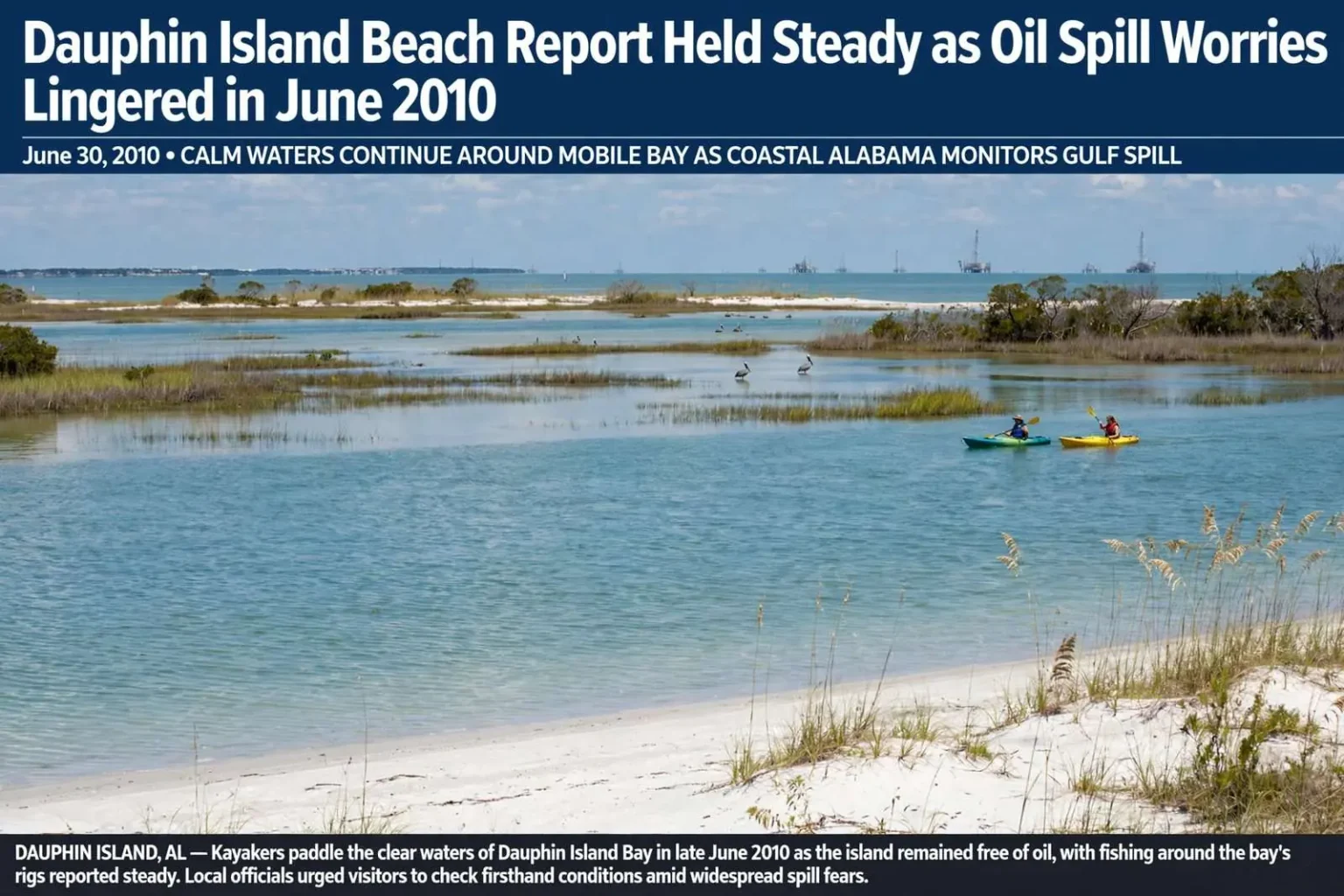
In late June 2010, with the BP oil spill dominating headlines across the Gulf Coast, conditions around Dauphin Island remained largely normal — a welcome snapshot of calm for the barrier island community at the mouth of Mobile Bay. At the time of the report, the island’s public beach, Sand Island and the surrounding waters were clear. Kayakers were still enjoying outings around Dauphin Island Bay and Federal Cut, and there was no noticeable oil odor in the area.
That snapshot mattered more than it might have in an ordinary summer. News from the Deepwater Horizon disaster — the rig that exploded that April and loosed millions of gallons of crude into the Gulf — had convinced much of the country that the entire northern shoreline was awash in oil. Firsthand reports like this one, grounded in the specific waters of coastal Alabama, told a more complicated story: conditions varied day to day and place to place, and broad stretches of the coast remained open and visibly clean even as the crisis grew offshore.
Clear water and empty boats
Fishing around the rigs in south Mobile Bay was reported to be good, with relatively few recreational boats on the water — a sign that some anglers were staying away from the coast despite the healthy bite. The mismatch between conditions and crowds became one of the defining ironies of the summer of 2010: while oil closed fishing grounds farther offshore and tarred stretches of shoreline to the west, the inshore waters around Mobile Bay continued to produce fish, and the anglers who trusted the local reports found the action as steady as any June in memory.
The rigs off south Mobile Bay have long been a fixture of the area’s fishing culture. Standing structures in the bay hold bait, bait holds trout, redfish and flounder, and locals have fished them for generations. In a summer when federal fishing closures pushed charter boats out of deeper Gulf waters, those inshore opportunities mattered more than usual — the difference between a working summer and a lost one for guides whose customers had vanished.
Kayakers, meanwhile, continued to paddle the sheltered waters of Dauphin Island Bay and around Federal Cut, the channel cut through the Sound south of the island. The bay’s shallow, protected waters make it one of the coast’s favorite paddling grounds, and the absence of any oil odor or sheen meant the summer routine continued for the families, anglers and birders who populate the island’s quiet waters.
A call to keep visiting the coast
Visitors were encouraged to keep supporting Dauphin Island, Fort Morgan, Gulf Shores and Orange Beach while monitoring changing conditions tied to the spill. The message from local observers was consistent throughout the summer of 2010: much of the Alabama coastline remained open, clean and welcoming even as cleanup crews worked offshore.
The appeal was aimed at the tourism economy’s most serious wound: not oil on the sand, but the perception of it. Coastal Alabama’s summer season depends on families who book condos in Gulf Shores and Orange Beach months in advance, rent boats out of Dauphin Island and Fort Morgan, and fill the restaurants and souvenir shops that employ thousands of year-round residents. In 2010, bookings collapsed across the coast even where the beaches stayed white — cancellations driven by national coverage rather than local conditions. Local officials, charter captains and business owners spent the summer urging travelers to check the actual conditions rather than assume the worst, and reports like the June snapshot from Dauphin Island were the evidence they pointed to.
The stakes were existential for the small communities involved. Dauphin Island, a town of barely more than a thousand year-round residents at the mouth of Mobile Bay, draws its living from visitors drawn to its public beach, its bird sanctuary, its fishing pier and its ferry connection to Fort Morgan. A lost summer threatened not just profits but the viability of businesses that had survived hurricanes for generations and could not survive being forgotten.
The anxieties beneath the calm
The June report captured an anxious but resilient moment for coastal Alabama’s tourism economy, which leaned on accurate, firsthand accounts of beach conditions to counter impressions that the entire Gulf shoreline had been fouled.
The anxiety was well founded. In the days and weeks around that report, oil did reach Alabama’s beaches — weathered tar balls and mousse washed ashore in early June, cleanup crews worked the sand at Gulf Shores and Orange Beach, and booms were strung across passes and along the barrier shoreline. Response vessels crowded the offshore waters, and fishermen signed up by the hundreds to work spill response with their own boats. What the June snapshot documented was not the absence of a disaster but the unevenness of its reach — clear water around the island on some days, contamination elsewhere, and conditions that could change with wind and current.
Monitoring became a way of life. Residents photographed the water daily, fishing forums filled with condition reports, and tourism organizations posted updates as often as the weather changed. For a coast whose economy rests on water quality, every set of eyes on the beach became part of the response.
What the moment meant
Seen from a distance, the late-June calm around Dauphin Island was a small thing — clear skies, paddlers in the bay, a good bite around the rigs. Seen from the coast, it was the argument itself: proof by ordinary example that the Gulf was not uniformly ruined, that the fish were biting and the beaches were white, and that the surest way to destroy coastal Alabama’s summer would be for travelers to stay home believing otherwise. The resilient tone of the June report — honest about the spill, insistent on the facts on the water — captured the posture the coast held through the long summer of 2010, and the reason many of its businesses and traditions emerged intact when the well was finally capped and the cleanup began to recede.
Dauphin Island’s place on the front line
Geography put Dauphin Island at the center of the spill story whether the island liked it or not. The barrier island guards the mouth of Mobile Bay, and any oil moving toward the bay’s entrance would encounter its beaches first. Sand Island, the small sand spit at the island’s eastern end, and the waters around Federal Cut became reference points that summer — places residents checked daily to gauge what was arriving and what was not. The island’s east end also holds the Audubon bird sanctuary, one of the top birding sites on the Gulf Coast, where spring and summer migrations brought pelicans, gulls and terns that stood to bear the brunt of any oil reaching shore.
The island’s role as a sentinel made local condition reports unusually credible. Unlike Chamber of Commerce promotion, a fisherman’s account of clear water around the rigs or a kayaker’s note that the bay had no odor came from people with nothing to gain and everything to lose by misreading their own home waters. Those reports circulated through the same channels anglers and travelers trusted — bait shops, forums, dock talk — and formed the baseline of truth against which the national narrative of a fouled coast was measured.
Fort Morgan, Gulf Shores and Orange Beach in the same boat
The call to keep visiting the coast named the communities that shared Dauphin Island’s exposure. Fort Morgan, the historic peninsula at the bay’s western shore, depends on the same visitors who ride the ferry across to the island; its beaches and the fortress that gives it its name remained open through much of the summer. Gulf Shores and Orange Beach, the resort cities to the east, faced the season’s test on a larger scale — high-rise occupancy, charter fleets, amusement businesses and beach services all tied to a tourist trade that the spill threatened to smother without a single drop of oil reaching their sand.
Across those communities, the summer of 2010 produced a repertoire of responses: discount promotions to refill empty rooms, marketing campaigns reminding travelers that the beaches were open, fish fry events and festivals staged to draw crowds back to the waterfront, and a stream of condition updates aimed at travel writers and potential visitors. The efforts blurred the line between civic defense and public relations, but they reflected a shared conviction that perception, once lost, is harder to clean up than oil.
The long recovery
The late-June report from Dauphin Island sits near the midpoint of that story. The well was capped in mid-July, the fresh oil stopped flowing, and cleanup operations along the Alabama coast continued for months and years afterward, with crews sifting sand, patrolling for tar balls and monitoring the marshes and sounds where weathered oil could linger. The fishing grounds that had been closed reopened in stages, and the tourists returned in growing numbers in the seasons that followed — aided by claims payments, restitution projects and marketing funded through the legal settlement that grew out of the spill.
What the June snapshot preserved was the coast’s own account of its worst summer: not denial of the disaster, but insistence on the facts on the water — clear water over the public beach, kayakers in the bay, a good bite around the rigs in south Mobile Bay, and an economy that needed its visitors now more than ever. For the communities at the mouth of Mobile Bay, that insistence was not spin. It was survival, conducted one accurate report at a time.