Dauphin Island Sea Lab Releases Findings on Stranded Mobile Bay Sperm Whale
The Dauphin Island Sea Lab released necropsy findings on a malnourished sperm whale that stranded in Mobile Bay — the first live one ever in Alabama.
What Killed the Whale in Mobile Bay
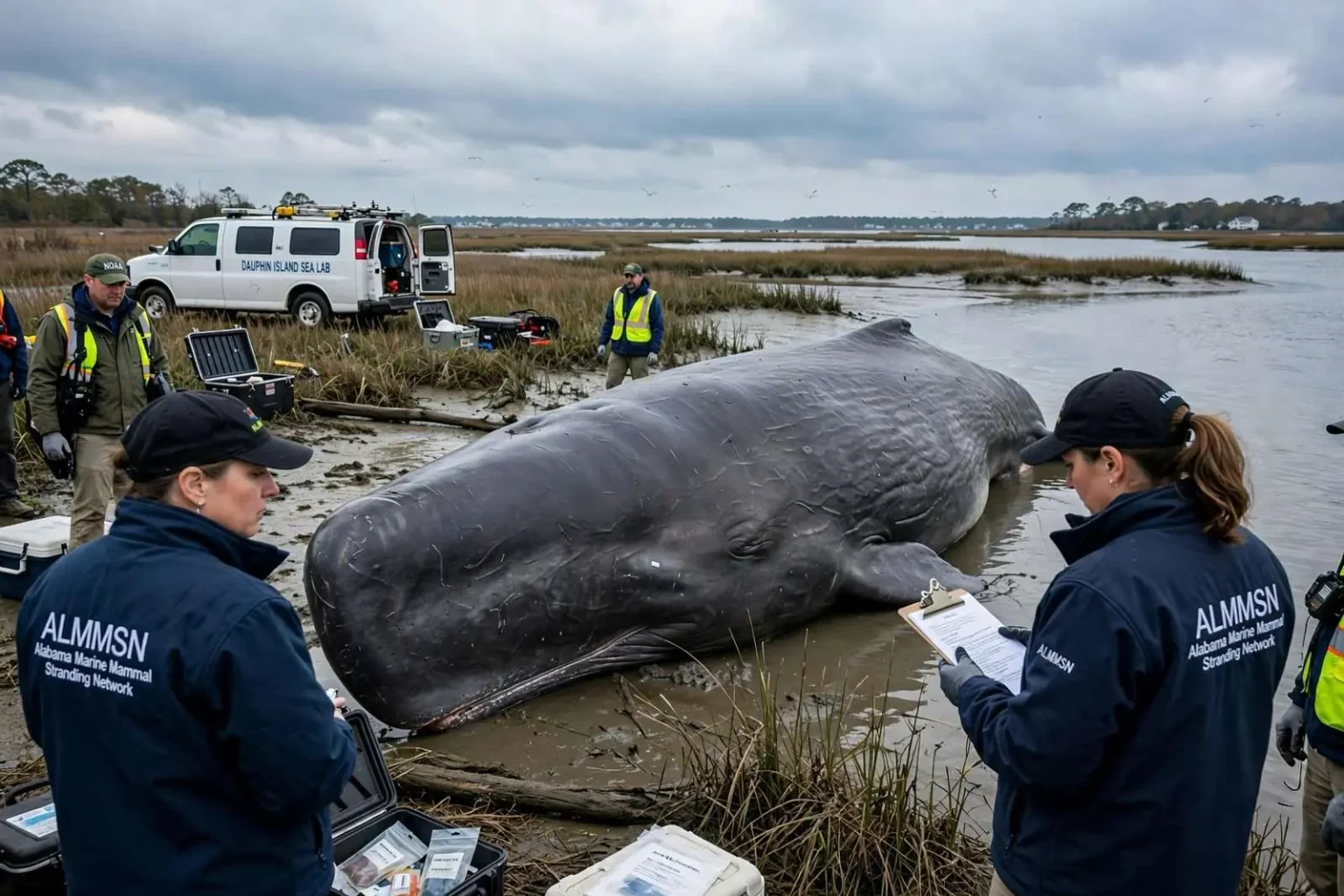
The Dauphin Island Sea Lab has released the results of the post-mortem exam of the sperm whale that stranded in Mobile Bay late last year, and the findings point to chronic malnourishment as the likely cause of the animal’s decline. The necropsy — the animal version of an autopsy — was conducted under federal permit by the Alabama Marine Mammal Stranding Network (ALMMSN) to determine why a creature that normally lives in deep ocean waters ended up inside Mobile Bay. The whale showed signs of having gone weeks or even months without eating.
ALMMSN veterinarian Dr. Jennifer Bloodgood described the animal as a young adult male more than 33 feet long and weighing over 32,000 pounds. Stranding photographs of its tail were matched by NOAA’s Southeast Fisheries Science Center to a whale previously photographed in 2012 nearly 200 miles off southwestern Florida, suggesting the animal was between 12 and 20 years old. The photo match gave researchers something rare in stranding cases: a documented sighting history that helped pin down the animal’s age and range across the Gulf of Mexico.
The necropsy found the animal in very thin condition with empty stomach chambers containing only indigestible hard parts such as squid beaks and crustacean shell fragments — the indigestible remains of meals long past, with nothing fresh behind them. Infectious disease, marine debris and trauma were ruled out as causes, though contaminant testing remains pending. The picture that emerged was of an animal whose feeding had failed somewhere in the open Gulf long before it wandered into Alabama’s estuary.
A Stranding Unlike Any Other in Alabama
The whale was first reported to ALMMSN on November 19, 2020, near Weeks Bay and stranded multiple times within Mobile Bay over the following days. Veterinarians, coordinating with NOAA’s National Marine Fisheries Service, determined that euthanasia was the most humane outcome. For the responders who worked the case across multiple strandings, the decision capped days of effort on an animal far too large to refloat and too weakened to survive release.
A Rare Visitor to the Gulf’s Shallow Waters
Sperm whales are creatures of the deep ocean, typically feeding on squid thousands of feet down far from shore. A sighting inside Mobile Bay — a shallow, heavily used estuary — is extraordinary by any measure. The species is protected under the Endangered Species Act and the Marine Mammal Protection Act, with fewer than 800 individuals thought to live in the Gulf of Mexico and only about two strandings a year on average across the region. This was the first live sperm whale ever to strand in Alabama.
The Gulf’s sperm whale population occupies a unique place in the species’ range: it is a resident population, distinct from whales in the Atlantic and the Pacific, and it concentrates in deep water off the continental shelf, often south of the Mississippi River delta. Scientists study the population precisely because it is small and localized, which makes every individual stranding a significant loss of data as well as life.
That scarcity shaped the response to the Mobile Bay case. A young adult male of more than 32,000 pounds represents years of research value, and responders treated the necropsy accordingly. Researchers collected more than 450 samples to learn more about Gulf of Mexico sperm whales — tissue for genetics, organs for health assessment, and material for contaminant analysis that will continue to yield findings long after the stranding itself.
Why the Whale Starved
Chronic malnourishment as a cause of decline raises hard questions that the necropsy alone cannot answer. A sperm whale that goes weeks or months without eating is telling researchers something went wrong in the deep waters where it feeds — possibly prey scarcity, possibly illness or injury not detectable at the exam, possibly competition or environmental change affecting squid populations. The ruled-out causes narrow the field: this was not a ship strike, not an entanglement in marine debris, not an obvious infection.
Pending contaminant testing may add a layer to the story. Sperm whales, as long-lived apex predators, accumulate pollutants in their tissue over decades, and Gulf of Mexico whales carry a documented contaminant load from decades of industrial discharge into the Gulf’s rivers and coastal waters. Whether contaminants contributed to this animal’s decline will come from the laboratory work still underway, not from the beach.
How Alabama’s Stranding Network Works
The response to the whale showcased the machinery of marine mammal rescue on the Alabama coast. The Alabama Marine Mammal Stranding Network operates under the Dauphin Island Sea Lab with federal authorization, coordinating with NOAA’s National Marine Fisheries Service on every live stranding. When the whale was first reported on November 19, 2020, near Weeks Bay, the network mobilized veterinarians, trained responders and equipment to monitor the animal through its repeated strandings inside the bay.
Euthanasia decisions in large-whale cases are made under strict federal oversight, weighing the animal’s prognosis against the safety of responders and the public. A sperm whale too weak to hold itself off the bottom of a shallow bay has virtually no chance of survival, and repeated strandings compound the internal injuries and stress of each attempt to refloat. The coordination between ALMMSN veterinarians and NOAA reflects a national protocol built over decades of marine mammal response.
The case underscores the value of quickly reporting sick, injured or dead marine mammals. Anyone who finds a stranded marine mammal in Alabama is urged to report it to the stranding network immediately rather than approaching, pushing or attempting to refloat the animal themselves. Distance matters: marine mammals are protected by federal law, and untrained intervention can injure both the animal and the well-meaning rescuer.
What the 450 Samples Will Teach
The more than 450 samples collected during the necropsy will feed research projects for years. Genetic material will clarify how this individual fits into the Gulf’s isolated sperm whale population. Reproductive and health data from a young adult male add to a thin scientific record for the species in the Gulf. Blubber and organ samples will support the pending contaminant analysis, and the stomach contents — squid beaks and crustacean fragments — offer a window into what the whale had been eating, and how long ago.
The photo-identification match adds another dimension. Because NOAA’s Southeast Fisheries Science Center could match the whale’s tail to a 2012 photograph taken nearly 200 miles off southwestern Florida, researchers gained a rare eight-year sighting interval for one individual. Those matches, accumulated across strandings, are how scientists estimate population size, survival and movement for a species that spends most of its life underwater.
The Dauphin Island Sea Lab’s Role on the Coast
The Dauphin Island Sea Lab, located on the barrier island at the mouth of Mobile Bay, serves as Alabama’s marine science education and research institution, and its stranding network is the state’s frontline for responding to dolphins, whales and other marine mammals in distress. The whale case tested that capacity at a scale Alabama had never seen: no live sperm whale had ever stranded in the state, and the animal’s size and repeated strandings demanded resources beyond a typical dolphin response.
For the Sea Lab’s scientists, the case demonstrated why the network exists. Without a trained, federally authorized response team, a stranding of this magnitude would produce nothing but a carcass. Instead, Alabama now has a documented necropsy, hundreds of research samples and a photo-identification match — scientific value salvaged from a sad outcome, and a template for whatever strands next.
Sperm Whales and the Gulf’s Deep Waters
The Gulf of Mexico’s sperm whale population makes its home over the deep waters beyond the continental shelf, where the animals dive to extraordinary depths in pursuit of squid. The population’s small size — fewer than 800 individuals — makes it a management priority for federal agencies, and each calving season and mortality matters to the population’s trajectory. Human activity in the Gulf, from shipping to seismic surveys to oil and gas operations, overlaps with the whales’ habitat, which is why scientists monitor the population so closely.
An animal from that population turning up inside Mobile Bay tells researchers something about how a deep-water whale can end up in the wrong place. Whether malnourishment drove the whale toward unfamiliar shallow waters in a weakened search for food, or disorientation preceded the starvation, remains among the questions the study of this animal cannot fully settle. What is certain is that the bay’s shallow, brackish waters offered a deep-diving squid hunter neither food nor a path back to the open Gulf.
A First for Alabama, a Lesson for the Coast
As the first live sperm whale stranding in Alabama’s recorded history, the case became a benchmark for the state’s responders and a widely followed story along the coast. The findings now released — chronic malnourishment, an empty stomach, ruled-out trauma and disease, and a body of evidence pointing to a long decline in deep water — close the clinical chapter on the animal while opening the scientific one.
The lasting message for Gulf Coast residents is practical. The public is the stranding network’s earliest warning system, and a quick, well-placed phone call is what puts veterinarians on the scene while options still exist. In this case, the report from Weeks Bay on November 19, 2020 triggered a response that gave one of the Gulf’s rarest whales a full scientific workup — and gave researchers their first close look at the species from Alabama waters.