DECA State Officer Peyton Hutton Visits Clarke County High to Talk Careers and Competition
Clarke County High School hosted DECA state officer Peyton Hutton of Demopolis High School, who spoke about the organization's opportunities in marketing, finance, hospitality and management.
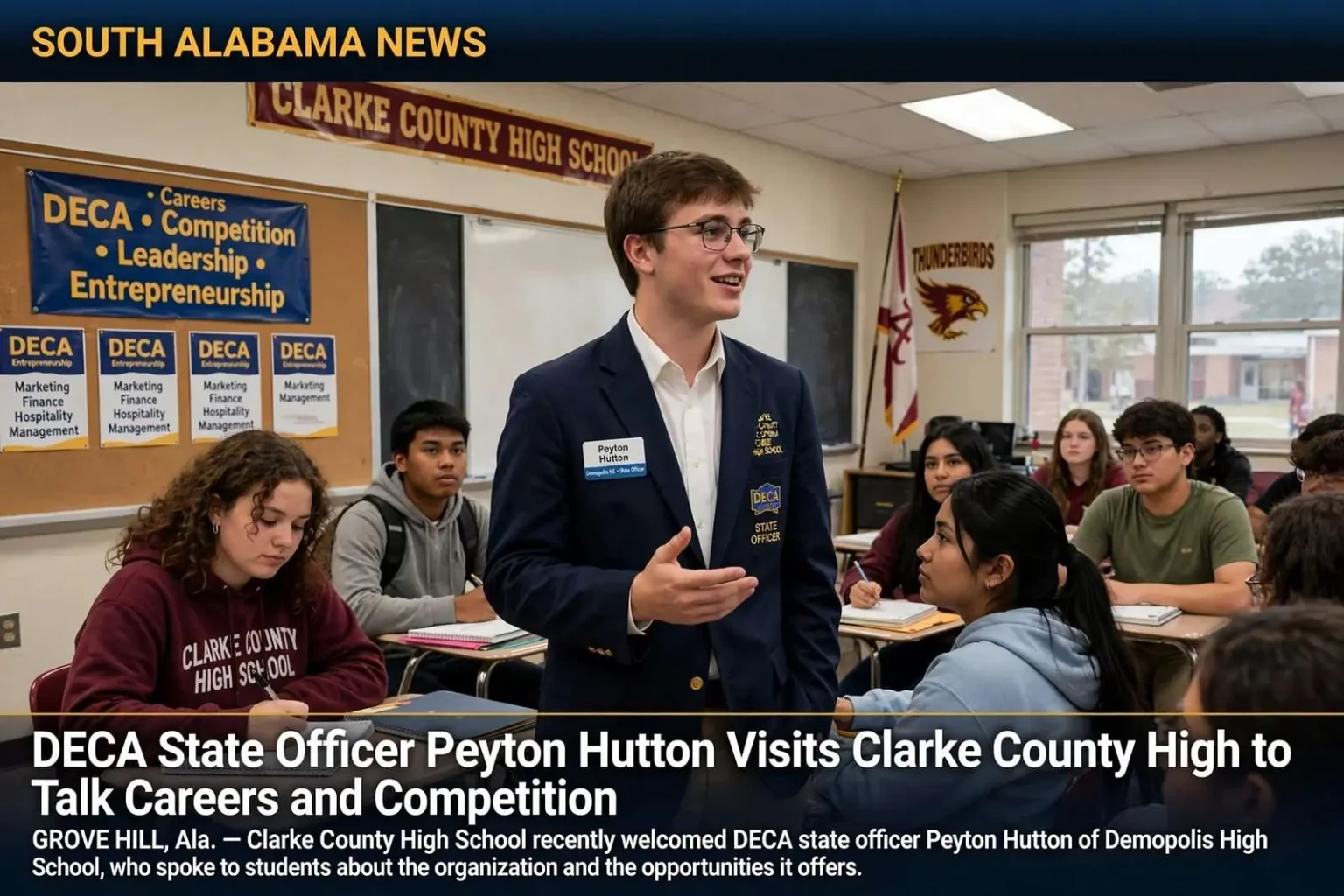
GROVE HILL, Ala. — Clarke County High School recently welcomed DECA state officer Peyton Hutton of Demopolis High School, who spoke to students about the organization and the opportunities it offers.
DECA, originally the Distributive Education Clubs of America, is an international organization that prepares high school and college students for careers in marketing, finance, hospitality and management while developing leadership and entrepreneurial skills.
Hutton was elected to his position to help guide and promote philanthropic and outreach initiatives for the statewide association.
What DECA Actually Does
For students and families unfamiliar with it, DECA is one of a set of organizations known as career and technical student organizations — groups that operate as an extension of classroom instruction rather than as extracurricular clubs in the conventional sense.
The distinction matters. A DECA chapter is typically tied to a school’s marketing, business or entrepreneurship coursework, and its activities are designed to apply what students learn in those classes. Membership is generally open to students enrolled in the associated courses.
DECA has operated since 1946 and now reports membership well into the hundreds of thousands across high school and collegiate divisions internationally.
The Competitive Events
The core of the DECA experience is its competitive event program, which is unusual in structure and is what distinguishes the organization from a general business club.
Students compete in events organized around career clusters — marketing, finance, hospitality and tourism, business management and administration, and entrepreneurship. Most events combine a written exam covering the relevant body of knowledge with a role-play component in which a student receives a business scenario, prepares briefly, and then presents a recommendation to a judge acting as a client or supervisor.
The role-play format is the element students most often describe as formative. A competitor receives a situation — a retail operation with an inventory problem, a hotel with a service failure, a company weighing an expansion — and has a limited period to analyze it and construct a recommendation. They then defend that recommendation to a judge who asks follow-up questions.
Other events run on a longer horizon. Written project categories require students to develop a business plan, execute a community service campaign or conduct a research study over the course of a school year, producing a formal document and presenting it.
Competition proceeds through district, state and international levels. The International Career Development Conference draws tens of thousands of students annually.
What a State Officer Does
Hutton’s role as a state officer involves responsibilities that extend well beyond a title.
State officers in organizations of this kind are elected by the membership at a state conference, typically after a campaign and a screening process that includes interviews and testing on the organization’s structure and purpose. Once elected, they serve a one-year term.
The work involves chapter visits of the sort that brought Hutton to Clarke County High School, presiding at state events, coordinating initiatives across chapters, representing the state association at national meetings, and — in Hutton’s case — guiding philanthropic and outreach efforts.
For a high school student, it amounts to a year of public speaking, travel, meeting facilitation and project management. Those are the skills the organization exists to develop, and officers get an unusually concentrated dose of them.
Why Chapter Visits Matter in Rural Schools
The visit itself is worth examining. A student officer traveling from Demopolis to Grove Hill to speak with students represents a specific kind of value that rural schools often struggle to provide.
Students in smaller districts frequently have fewer opportunities to encounter peers from outside their immediate community who are doing things they might do themselves. A visiting professional can describe a career; a visiting student two years older who holds a state office demonstrates a path that is visibly within reach.
Rural chapters also face practical obstacles to participation in organizations like DECA. Competition requires travel to district, state and potentially international conferences, with registration fees, transportation and lodging. Chapters in small districts have smaller fundraising bases and fewer parent volunteers. State-level outreach is part of how associations work to keep participation from concentrating in larger suburban districts.
The Career Fields Involved
The industries DECA prepares students for — marketing, finance, hospitality and management — have particular relevance along the Alabama Gulf Coast.
Hospitality and tourism constitute a major regional employer, with the beach communities of Baldwin County, the cruise and convention business in Mobile, and the restaurant and lodging sector across the region. Those industries offer genuine career ladders, and management positions in them are frequently filled by people who began in entry-level roles.
Marketing and finance similarly connect to the region’s commercial base — the port, the banking sector, healthcare systems and the retail economy.
For a student in Clarke County, exposure to those fields through DECA can shape decisions about coursework, postsecondary training and where to look for early employment.
Career and Technical Student Organizations in Alabama
DECA is one of several such organizations operating in Alabama high schools, alongside groups serving agriculture, family and consumer sciences, health science, technology and trade fields.
The Alabama State Department of Education recognizes these organizations as an integral component of career and technical education rather than as supplementary activities, which is why they are typically tied to specific course sequences and why teachers of those courses serve as chapter advisers.
The practical benefit for students extends past skill development. Participation and competitive placement in these organizations appear on college applications, factor into some scholarship considerations, and provide the kind of concrete accomplishment that distinguishes an application.
Getting Involved
Students at Clarke County High School interested in DECA should speak with their marketing or business teacher, who typically serves as chapter adviser.
Chapter activity generally begins early in the school year, with competition preparation building toward district events in the winter and the state conference in the spring.
South Alabama News welcomes news of student achievement from schools across the region.