Deepwater Horizon survivor shares his story publicly for the first time on 10th anniversary
On the 10th anniversary of the Deepwater Horizon disaster, survivor Kevin Senegal speaks publicly for the first time about the explosion and his escape.
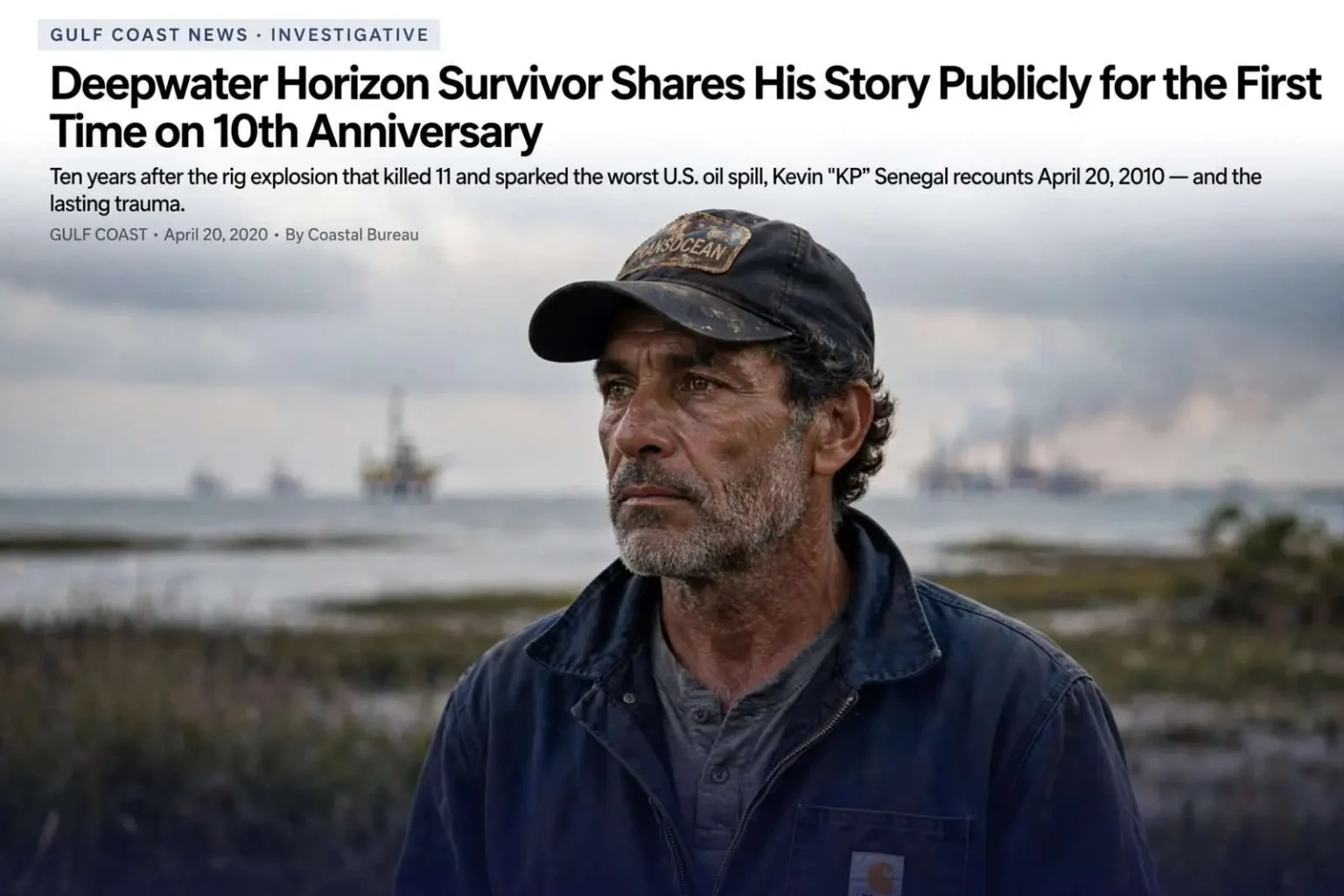
April 20, 2010 is a date Kevin “KP” Senegal says he will never forget. Ten years after the Deepwater Horizon explosion killed 11 crew members and triggered the largest marine oil spill in history, the survivor is telling his story publicly for the first time. Senegal was on board the Transocean-owned, BP-operated rig on the first day of his shift when he noticed a sheen on the water that looked like oil. He went inside to tell a coworker what he had seen. Moments later, everything exploded.
The rig, drilling an exploratory well more than 40 miles off the Louisiana coast in the Gulf of Mexico, had been the scene of routine work that Tuesday evening, much of it connected to temporarily sealing the well so it could be revisited later. Whatever Senegal spotted on the surface of the water in those final minutes, the cascade of failures that followed would claim the lives of 11 workers, injure dozens more, sink the massive platform in flames and set off an environmental disaster that would foul Gulf waters and shorelines for months.
“All we could do was say, this is it, it’s over! The floor left my feet. It shook you from wall to wall, you had to hold on,” Senegal recalled. He and others near him reached an outside deck as the rig burned. Several tried to reach the most intense part of the fire to help anyone they could. “The minute everybody was trying to try to save somebody, the heat was so hot, you couldn’t take three steps towards that fire,” he said.
Ninety-Six Hours That Changed the Gulf
Senegal’s first day on the job ended in a fight for survival that unfolded in minutes. Workers who made it off the platform faced a choice that no training drill fully prepares anyone for: leap from the burning structure into the dark Gulf waters below, or crowd onto life rafts and hope the release mechanisms worked. The blast had knocked out much of the rig’s power, leaving parts of the platform in darkness and making it difficult to know who else had made it out.
The group Senegal was with made it onto a life raft with what he estimated as 60 to 80 other crew members. As they neared safety, a cable snagged the raft. Senegal freed it, and they floated to safety. Survivors were eventually pulled aboard response vessels and ferried to shore, many arriving with burns, broken bones and the first stirrings of an injury that would prove harder to treat: the psychological weight of what they had just lived through.
Eleven men never left the rig. Their deaths, in the years since, have been marked in memorial services across the Gulf Coast, and their names became the human measure of a catastrophe that is otherwise discussed in barrels spilled and dollars lost. For the survivors, anniversaries of the explosion have a way of reopening the experience, which is one reason so many have preferred to speak about it only privately, if at all.
Senegal’s decision to tell his story on the 10th anniversary puts him in a small company of rig workers who have spoken openly about the disaster. The accounts of men who were on the platform that night have mattered not just for history but for the record: federal investigators and courts spent years reconstructing the timeline of the disaster, and the recollections of workers on deck that evening formed part of the public understanding of how quickly an industrial operation can turn lethal.
An Oil Spill Unlike Anything the Gulf Had Seen
The explosion was only the beginning. With the rig on the seafloor and the wellhead unsealed, crude oil poured into the Gulf of Mexico for 87 days before the well was finally capped. By the time the flow stopped, the spill had released millions of barrels of oil into open water and carried it toward the coasts of Louisiana, Mississippi, Alabama and Florida. Barrier islands and beach towns on the Alabama coast, from Dauphin Island to Gulf Shores and Orange Beach, saw tar balls and oil sheens wash ashore through the summer of 2010, and fishing grounds across the central Gulf were closed.
The economic fallout reshaped the region for years. Seafood harvesters watched their waters close. Tourism along the Gulf Coast, the lifeblood of coastal towns in Alabama and the Florida Panhandle, collapsed during the height of the season as travelers canceled reservations. BP, facing a wall of claims from businesses and individuals, eventually paid out billions of dollars in settlements covering economic losses, environmental restoration and penalties, in what became the largest settlement of its kind in U.S. history.
For rig workers like Senegal, the aftermath took a different form. Cleanup crews, response workers and injured survivors filed their own claims, and medical settlements were negotiated to cover care for a range of conditions tied to the disaster. Money flowed through a succession of claim funds and court-administered programs, but no settlement structure could fully account for injuries that did not show up on an X-ray.
A Decade Later, the Wounds Remain
A decade later, Senegal says he is thankful to be alive but still living with the aftermath. He shakes daily and says he still sees smoke. He received a settlement to help with medical bills and legal fees, but he says the trauma still affects his ability to hold a job, leaving him struggling financially.
His experience mirrors what researchers studying disaster survivors have documented for years: the physical injuries from an explosion heal far faster than the invisible ones. Post-traumatic stress among Deepwater Horizon survivors has been the subject of ongoing study, with survivors reporting flashbacks, nightmares, anxiety and difficulty working years after the event. For workers whose livelihoods were tied to offshore drilling, returning to the water, or even to any industrial job site, can carry a weight that outsiders do not easily see.
The financial strain compounds the psychological toll. A settlement that looked sufficient in the months after the disaster can be exhausted by years of medical care, interrupted employment and the ordinary costs of life. Survivors who can no longer work steady jobs, or who find that their symptoms make them unable to take the offshore work that once paid their bills, often have nowhere to turn but the same companies they hold responsible for what happened to them.
“BP promised me that I would never have to worry again in life,” Senegal said. “They told me they were going to take care of me for the rest of my life and I’ll be alright. Now I need BP to reach out again because I feel it didn’t pay the expense of my trauma.”
What the Decade Since Has Brought
The 10th anniversary arrives at a moment when the Deepwater Horizon disaster has faded from daily headlines but remains embedded in the Gulf Coast’s economy, laws and memory. Offshore drilling continues in the Gulf, but under rules that were overhauled after 2010, with tougher well-design requirements, stricter oversight of the cementing and testing work that preceded the Macondo blowout, and new expectations for how companies demonstrate they can contain a runaway well. The disaster also produced the RESTORE Act, which directed the bulk of the Clean Water Act penalties paid by BP toward environmental and economic restoration in the Gulf states, including Alabama.
Along the Alabama coast, restoration money has funded projects ranging from beach and dune restoration to oyster reef construction and coastal habitat acquisition, an attempt to convert penalty dollars into lasting ecological and economic recovery. Tourism, which cratered in the summer of 2010, long ago rebounded, and the white-sand beaches of Gulf Shores and Orange Beach again draw crowds every season. Scientists continue to study the spill’s lingering effects on deep-sea ecosystems, fish stocks and dolphin populations, work that has shown recovery in some places and persistent damage in others.
For the families of the 11 men who died, no settlement or restoration project supplies what was lost. Annual memorial services on the anniversary, held in communities across the Gulf Coast, remain the emotional center of the disaster’s remembrance. The men are remembered not as casualties of an industrial accident but as fathers, sons and brothers whose deaths changed safety rules that had stood for years.
Why Survivors’ Stories Still Matter
Stories like Senegal’s serve a purpose beyond commemoration. The human record of the Deepwater Horizon is what keeps the disaster from becoming a series of statistics: barrels spilled, days capped, dollars paid. When a survivor describes the floor leaving his feet, or the heat that stopped rescuers three steps from the fire, the scale of the event becomes something a listener can actually feel.
They also matter for the workers still carrying the disaster with them. Survivors who speak publicly make it easier for others to acknowledge injuries that carry stigma, particularly psychological ones. The community of rig workers, cleanup workers and coastal residents affected by the spill is large, scattered across Louisiana, Mississippi, Alabama and Florida, and the long-term health study launched after the disaster has followed thousands of them in an effort to understand what a decade in the aftermath looks like.
Senegal’s message to BP is, in the end, a simple one: that the account is not settled. The company has paid tens of billions of dollars in clean-up costs, penalties and compensation, and has said the settlement process resolved its obligations. For the man who spent his first day on the rig fighting for his life on a burning deck in the middle of the Gulf, the ledger still reads differently. Ten years on, he is alive, he is thankful, and he is still asking to be made whole.
His story, told now for the first time, joins the permanent record of April 20, 2010 — a date the Gulf Coast marks every year, and one that Senegal, like the other survivors, says he will never forget.