Defense Lawyer Moves to Seal Filing in Ex-Sheriff’s Sgt. Holifield Federal Fraud Case
A new attorney for former Mobile County Sheriff's Sgt. Daniel Holifield asked a federal judge to seal a filing that references potential cooperation and uncharged individuals.
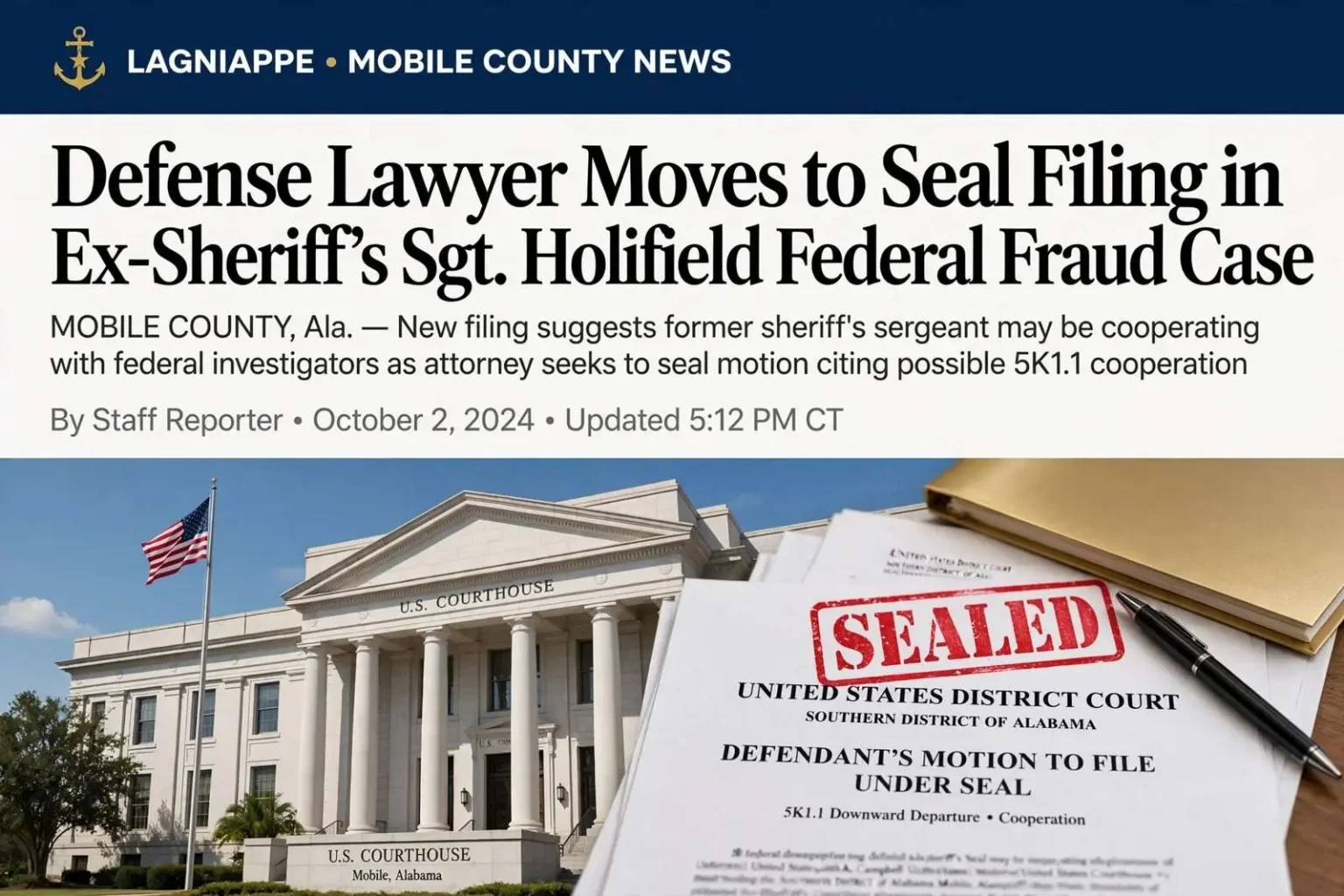
MOBILE COUNTY, Ala. — A new court filing in the federal fraud case against former Mobile County Sheriff’s Office sergeant Daniel Holifield suggests he may be providing — or seeking to provide — information to investigators about possible criminal conduct by people who have not been charged in his case.
The development adds a fresh layer to one of the more closely watched public-corruption cases in recent Mobile County memory, and it underscores the federal government’s interest in pursuing not only the named defendant but potentially anyone who helped him move money through sheriff’s office and county commission accounts.
New Attorney, Sealed Motion
Defense attorney Dennis Knizley filed a notice of appearance Monday to represent Holifield, who had previously been represented by the Federal Public Defender’s Office. Later the same day, Knizley asked a federal judge for permission to file a motion under seal, and prosecutors did not oppose the request. The switch in counsel, paired with the same-day sealed filing, is unusual and points to active negotiations between the defense and the U.S. Attorney’s Office.
According to the motion, the sealed filing involves a potential “5K1.1 downward departure, or a substitute thereof,” and refers to possible criminal conduct by people who are “not a part of this case at this time.”
Under federal sentencing guidelines, a 5K1.1 motion allows a judge to reduce a defendant’s advisory sentencing range when prosecutors determine the defendant gave substantial assistance in the investigation or prosecution of someone else. Such motions are common in federal financial-crime cases and are often kept from public view while the related investigation continues.
The filing does not say Holifield has been promised a reduced sentence, does not identify anyone who may be under investigation, and does not indicate that new charges have been filed. It argues that making the information public could affect the government’s prosecution of others involved in the matter. Such sealed filings are typically reviewed line by line by the presiding judge before being placed under seal, to balance the defendant’s interest in cooperation against the public’s right to know.
The Federal Charges
Holifield, a former sergeant and fleet manager with the Mobile County Sheriff’s Office, faces a 14-count federal indictment charging 10 counts of bank fraud, one count of money laundering and three counts of tax evasion.
Federal prosecutors allege he used duplicate vendor payments and insurance reimbursements involving the sheriff’s office and the Mobile County Commission to route money into his personal accounts. The indictment cites roughly 80 transactions totaling about $236,332 in deposits, plus approximately $74,356 from 18 insurance reimbursement checks. The charges are allegations, and Holifield is presumed innocent unless proven guilty.
The case has been followed closely inside county government because it touches both the Sheriff’s Office and the Mobile County Commission. Internal controls at both bodies have come under renewed scrutiny, and auditors are expected to recommend additional review steps when the case wraps.
Separate State Cases Pending
The federal case is not the only legal exposure Holifield faces. A Mobile County grand jury indicted him in August 2025 on 13 counts of theft of property and possession of forged instruments tied to allegations involving impounded vehicles and forged documents. A separate three-count indictment later charged first-degree theft of property by deception.
State prosecutors have moved more slowly than federal counterparts, but they have kept their own docket active. Convictions on either the federal or state charges could be used by prosecutors to strengthen arguments in the other forum, and the defense is now effectively coordinating strategy across two parallel tracks.
Monday’s request seeks to keep the details of the sealed filing out of public view while the federal case continues. A decision on whether the filing remains under seal rests with the federal judge handling the case. Whatever the judge decides, the request itself has confirmed publicly — for the first time — that cooperation with investigators is at least under active discussion.
Court watchers say the coming weeks will likely be telling. If the sealed motion remains under seal and prosecutors do not seek additional indictments soon, the case may be wrapping toward a plea. If new charges are filed against other individuals in Mobile County, it will suggest the cooperation has produced actionable information.
Why Cooperation Motions Are Often Kept Sealed
Federal courts typically require that motions tied to ongoing investigations be filed under seal so that the targets of those investigations are not tipped off. Judges often review the proposed filings line by line before placing them under seal, balancing the defendant’s cooperation interest against the public’s right to know. In financial-crime cases like Holifield’s, sealed filings have become a routine — if rarely discussed — part of the process.
What the Rest of the Case Looks Like
Beyond the sealed filing, Holifield’s federal case is moving through standard pretrial motion practice. The defense is expected to file challenges to specific counts of the indictment, and prosecutors are likely to oppose those motions. The case is unlikely to reach trial before next year, but the cooperation discussion has accelerated the timeline in ways that suggest a plea or a sentencing recommendation may come sooner than originally expected.
What Happens at Sentencing
If the case proceeds to sentencing without a cooperation agreement, Holifield will face a federal guidelines range that reflects the dollar amounts alleged in the indictment, the number of fraud counts, and the tax-evasion counts. Defense attorneys typically argue for the lower end of the range, while prosecutors push for enhancements tied to abuse of public trust. Whether a 5K1.1 motion is ultimately filed will likely depend on whether the cooperation produces actionable information against other individuals.
How Internal Reviews Typically Proceed
While the federal case moves through the courts, internal reviews at the Sheriff’s Office and the Mobile County Commission are likely to look at the procedures that allowed the alleged conduct to happen. Internal audit teams typically focus on segregation of duties in accounts payable, on oversight of insurance reimbursements, and on the review process for duplicate vendor invoices. Changes to those procedures can take months to roll out, and they often become the basis for civil settlements even after the criminal case concludes.
What the State Indictments Mean in Practice
The state indictments against Holifield add a parallel track to his legal exposure. State charges are typically prosecuted in Mobile County Circuit Court, and they carry their own sentencing range that is independent of the federal guidelines. Defense attorneys often try to resolve state and federal charges together to limit total sentencing exposure, and prosecutors sometimes coordinate sentencing recommendations across the two forums. Whatever happens in the federal case, the state indictments will remain pending until they are resolved, dismissed or otherwise disposed.
How the Public Is Likely to Learn More
Public access to the sealed filing will depend on how the judge rules on Knizley’s request, and on whether prosecutors later file public motions tied to the same cooperation. Even if the filing remains under seal, related public motions are likely to surface over the coming months, and they may provide indirect clues about what the cooperation involves. Local media and court-watchers will be monitoring the docket closely, and any new public filings are likely to draw significant attention in the local news cycle.
What Local Defense Attorneys Are Watching
Local defense attorneys who handle federal cases in Mobile say the Holifield sealed filing is the kind of motion that occasionally surfaces in financial-crime prosecutions, particularly when the government is pursuing a larger network. They note that sealed filings are not uncommon in cases involving public officials, and they expect the court to weigh the defendant’s cooperation against the public’s interest in transparency. Whatever the judge decides, attorneys say, the case is a reminder that federal sentencing is heavily influenced by cooperation — and that the choice to cooperate or not can dramatically change the outcome.
How the Case Could Affect Other Public Corruption Inquiries
Prosecutors and investigators across Alabama have been watching the Holifield case closely because it touches procedures common to many local governments — vendor payments, insurance reimbursements and routine financial oversight. The eventual outcome, including any cooperation that produces additional indictments, is likely to inform how similar cases are pursued elsewhere in the state. Several Alabama district attorney’s offices have opened their own reviews in recent months, and federal partners have indicated they are willing to coordinate on cases that meet federal thresholds.
How the Case Has Drawn Attention to Internal Controls
The Holifield case has prompted renewed attention to internal financial controls at agencies across Mobile County. Auditors reviewing the sheriff’s office and the Mobile County Commission have pointed to gaps in the way vendor payments and insurance reimbursements are reviewed, and they have recommended additional checks. Several of those recommendations are expected to be adopted over the coming year, regardless of how the criminal case is resolved. Local government finance officers say the case has become a cautionary tale in training sessions for new employees, particularly around the importance of segregation of duties.
The cooperation filing builds on a significant shift in the case earlier in August: Holifield notified the court on Aug. 10 that he intends to plead guilty to one count each of bank fraud, money laundering and tax evasion. He had been indicted in May on 14 federal charges — 10 counts of bank fraud, one count of money laundering and three counts of tax evasion — over an alleged scheme to divert approximately $310,688 in county vendor and insurance payments into his personal bank accounts between 2021 and 2023 while he served as the sheriff’s office fleet manager.
U.S. Magistrate Judge Katherine P. Nelson granted the request to seal the motion and continued the case to the November criminal term of court. The filing does not identify the people under scrutiny or describe the alleged conduct beyond the reference to uncharged individuals.
The federal case grew out of Holifield’s 2023 arrest on allegations that he stole overtime pay and impounded vehicles — an investigation that has since widened into the broader bank fraud and money laundering prosecution.
Court filings show Holifield filed notice that he intends to plead guilty to three of the 14 federal counts: one count each of bank fraud, money laundering and tax evasion. Prosecutors allege he diverted approximately $310,688 in vendor and insurance payments into his personal bank accounts between 2021 and 2023, submitting duplicate vendor invoices to both the Sheriff’s Office and the Mobile County Commission so vendors were paid once and the duplicates landed in his accounts. The indictment cites about 80 transactions involving 11 vendors and companies totaling $236,332 in deposits, plus roughly 18 insurance checks worth $74,356.
The specific counts cover the bookends of the scheme, according to the indictment: the bank fraud charge involves an $8,051 check deposited into a Wells Fargo account in April 2021, the money laundering count stems from a $15,487.88 deposit in March 2023, and the tax evasion count alleges he filed an amended 2023 return in July 2024 reporting $179,729 in taxable income while knowing his actual income was higher. A plea agreement with the Department of Justice had not been filed with the court as of the notice, leaving the fate of the remaining 11 federal counts unclear. The notice came the morning before a pretrial conference before U.S. Magistrate Judge Katherine P. Nelson.