
Defense Seeks New Trial for Mobile Neurosurgeon Convicted of Murder
Lawyers for ex-neurosurgeon Jonathan Nakhla, sentenced to 25 years in a Mobile student's death, seek a new trial over a juror residency claim.
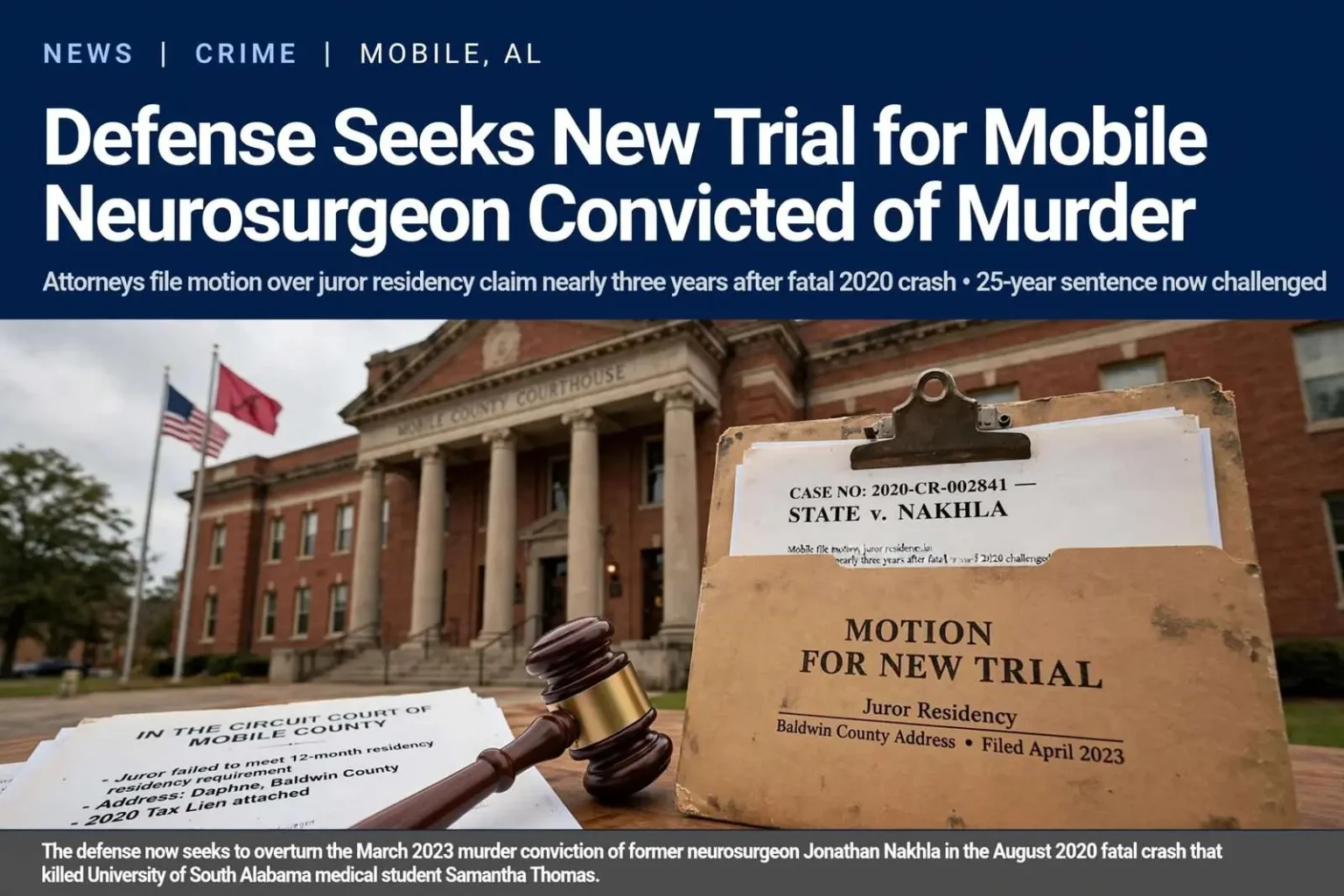
Attorneys for Jonathan Nakhla, the former Mobile neurosurgeon convicted of murder earlier this year in a fatal 2020 crash, have filed a motion seeking a new trial, according to court documents. The filing sets up the next phase of a case that has moved through Mobile County’s courts for nearly three years and that ended, for now, with a 25-year prison sentence.
Nakhla was found guilty in March for the death of Samantha Thomas, a University of South Alabama medical student, in a crash that occurred in the early hours of August 1, 2020. He was initially charged with manslaughter, a count that was upgraded to murder in September 2021 — a prosecutorial decision that signaled the state’s view that the circumstances of the crash rose to the level of depraved-heart murder rather than ordinary criminal negligence.
After a trial that began February 27, 2023, a jury deliberated one day before convicting him, and on April 20 he was sentenced to 25 years in prison. The quick deliberation followed weeks of testimony, and the sentence fell at the lower-middle range of what Alabama law allows for a murder conviction, where the standard sentencing range runs from 10 years to life.
The case drew unusual public attention in Mobile because of who stood accused. Nakhla practiced as a neurosurgeon, one of the most specialized and high-stakes professions in medicine, and the fall from operating room to defendant’s bench gave the proceedings a profile few local criminal cases receive. Thomas, meanwhile, was a medical student at the University of South Alabama — a young woman training for the same profession whose life ended in a late-night collision on a Mobile roadway.
Juror Residency Question
The new-trial motion rests on a claim that one juror did not meet the requirement of living in Mobile County for the 12 months before and during the trial. Juror residency is a foundational qualification in Alabama criminal procedure: the state’s statutes require that trial jurors be inhabitants of the county in which the case is tried, and a seated juror who does not meet that threshold can become grounds for a new trial if the issue is preserved and proven.
Defense attorneys point to service attempts by Mobile County Sheriff’s deputies at a Mobile address in 2023, when the woman was reportedly never present; a deputy later documented that she had moved. Service attempts and the notes deputies leave behind — no answer, address vacant, moved — are routinely used in litigation to establish where a person actually lived at a given time, and the motion treats the deputy’s documentation as evidence that the juror’s connection to her listed Mobile residence had already ended by the time the trial began.
The motion also cites a 2020 state tax lien filed against the juror listing an address in Daphne, in Baldwin County, along with a 2021 notice sent to that same address. Together, the defense argues, the records sketch a picture of a juror living across Mobile Bay — in a different county and a different judicial circuit — during the period the qualification rule covers.
Baldwin County sits just across Mobile Bay from Mobile County, connected by the Bayway and the Bankhead Tunnel routes through the city, and its fast-growing communities of Daphne, Fairhope, and Spanish Fort have absorbed thousands of former Mobile residents over the past two decades. The boundary matters in court: a prospective juror who lives in Baldwin County is not eligible to serve on a Mobile County trial jury, and attorneys in both criminal and civil cases routinely strike or challenge panel members whose addresses raise doubt.
The burden now sits with the defense to show more than paperwork. Courts generally require a concrete demonstration that a juror was actually disqualified — and sometimes that the juror answered dishonestly during voir dire — before tossing a verdict. The prosecution will have the opportunity to respond to the motion with its own evidence about where the juror lived and whether the issue was raised or discoverable at trial.
Prosecutors Respond
Mobile County District Attorney Keith Blackwood said the filing is not unusual. “A motion for a new trial isn’t uncommon but we are confident the conviction will be upheld,” Blackwood said. His office’s response frames the motion as routine post-conviction procedure — a step defense attorneys in serious felony cases take as a matter of course, and one prosecutors see regularly in cases that end in substantial prison terms.
Blackwood’s confidence rests on the record built during the trial itself. Weeks of testimony preceded the verdict, and the jury’s one-day deliberation suggested a panel that found the state’s evidence overwhelming. A motion for a new trial is decided by the same trial judge who presided over the case, giving the court — already familiar with every witness and exhibit — the first say on whether the residency claim warrants setting aside the verdict.
Even if the trial court denies the motion, the argument is preserved for the next level. Post-trial motions like this one are a prerequisite step in Alabama’s appellate process: a defendant must raise issues in the trial court before an appellate court will consider them, so filing the motion now keeps the juror-residency claim alive through an eventual appeal to the Alabama Court of Criminal Appeals.
In a statement, Christiana Hoff, Thomas’s stepmother, dismissed the motion as frivolous, saying the jury unanimously convicted Nakhla after weeks of testimony and asserting that he was driving at excessive speed while intoxicated at the time of the crash — allegations prosecutors presented during the trial. Her statement captures the family’s view that the paperwork challenge cannot outweigh what the jury actually heard in the courtroom.
For the family, the motion reopens wounds at what was supposed to be the end of the legal process. Victims’ relatives in high-profile cases often describe post-conviction motions as a second trial by paperwork — months of filings and hearings that stand between the verdict and the start of the sentence in practical terms, since defendants typically remain free on appeal bonds while such motions and the appeals that follow are decided.
What Comes Next
The timetable from here follows a familiar arc in serious Alabama felony cases. The trial judge will consider the new-trial motion through written briefing and, if needed, a hearing at which the juror, the deputies involved, or records custodians could testify. A denial would send the case to the appellate courts, where the residency question would be reviewed on the record the trial court builds now.
Appellate review of juror qualifications tends to turn on narrow, factual questions: what the juror said during jury selection, what evidence exists about her actual residence during the relevant 12 months, and whether the defense could have discovered the issue before trial. Alabama appellate courts have overturned verdicts on juror-eligibility grounds in the past, but they have also upheld convictions where the evidence of disqualification was disputed or the challenge came too late.
Whatever the outcome, the motion extends a case that has already spanned nearly every stage of the Mobile County court system — from the initial manslaughter charge filed after the August 2020 crash, through the September 2021 murder upgrade, the February 2023 trial, and the April 20 sentencing. Nakhla’s conviction stands unless a judge decides the jury that delivered it was, on paper at least, one member short of lawful.
For Mobile’s legal community, the case is also a reminder of how much in a criminal trial depends on the jury pool itself. Hundreds of Mobile County residents pass through the jury assembly room each term, and the qualification rules that screen them — residency, citizenship, age, and the absence of disqualifying records — are the invisible infrastructure beneath every verdict. This motion asks a judge to decide whether one paperwork trail was enough to undermine all of that work.
The residency dispute also illustrates a broader shift in how post-trial challenges are built. Where such motions once relied on investigators knocking on doors, the modern file is assembled from public records — tax liens, court notices, lease filings, utility connections — that can be pulled and cross-referenced months after a verdict. The documents cited in Nakhla’s motion, a 2020 lien and a 2021 notice pointing to Daphne, are typical of that method: paper trails created for entirely unrelated reasons, repurposed as evidence of where someone actually lived.
The prosecution’s counter, when it comes, will likely lean on the presumption that jurors are qualified. Alabama law starts from the position that a seated juror meets the statutory requirements unless shown otherwise, and trial judges routinely defer to the jury selection process unless the challenger produces clear evidence. Records showing mail delivered to a Baldwin County address, prosecutors may argue, do not by themselves prove the juror lived there during the trial year — people receive notices at old addresses, hold mail in transitions, and maintain ties on both sides of the bay.
In the meantime, the case holds a place in Mobile’s public consciousness that few criminal dockets occupy. It involves a well-known surgeon, a promising young medical student, and a set of allegations — speed and intoxication on an early August morning — that touched on questions of accountability the community followed closely from the first crash report through the verdict. Each new filing now arrives into an audience already familiar with the broad outlines of the story, and the new-trial motion will be read not as legal arcana but as the latest turn in a case the city has watched for three years.
Until the motion is decided, the legal posture remains what it has been since April 20: a conviction, a 25-year sentence, and a defense now arguing that the process that produced them rested on a jury that was never fully lawful. The trial judge’s ruling — likely months away — will determine whether the case moves to the appellate courts on that question, or whether the verdict stands as the final word.


