Deputies Search for 2 Metro Jail Inmates Who Left Work-Release Jobs
MCSO is searching for James Elmore and Luella Powell, two work-release inmates who left their jobs June 6 and never returned to jail.
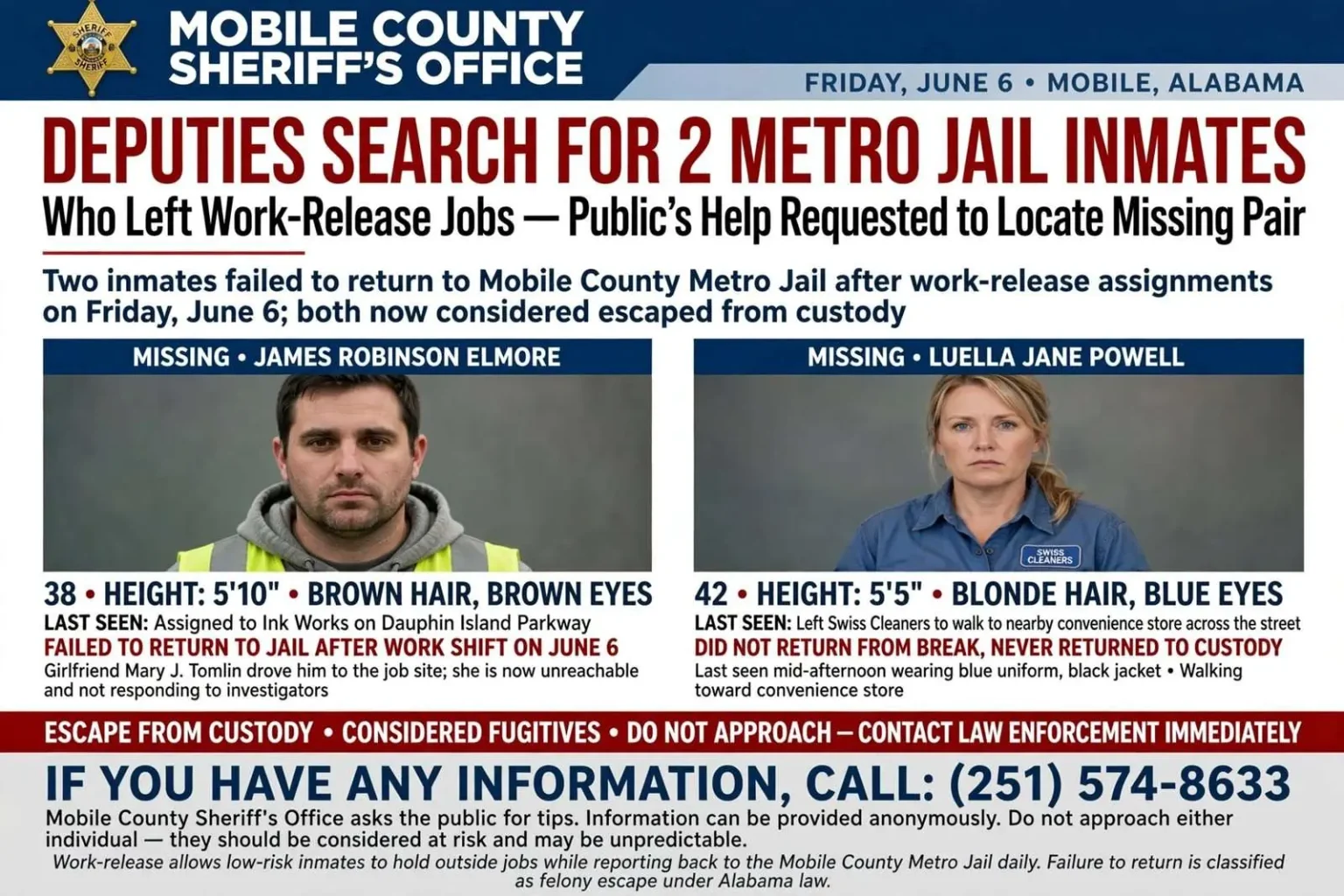
The Mobile County Sheriff’s Office is asking for the public’s help locating two inmates who walked away from their work-release assignments on Friday, June 6, and never returned to the Mobile County Metro Jail. Deputies identified the missing inmates as James Robinson Elmore and Luella Jane Powell, both of whom had been participating in the jail’s work-release program, which allows qualifying inmates to hold outside jobs during the day while returning to custody each evening. Neither inmate reported back as required that day, prompting deputies to open escape investigations and begin circulating their descriptions throughout Mobile County.
The first case involves Elmore, who had been assigned to a job at Ink Works on Dauphin Island Parkway. According to investigators, Elmore failed to return to custody at the end of his workday. Deputies said the circumstances of his disappearance took an additional turn when they learned how he had traveled to and from the job site. His girlfriend, identified as Mary J. Tomlin, had driven him to the work-release job that day, according to the sheriff’s office. When deputies attempted to follow up, Tomlin stopped answering her phone, and her current whereabouts have not been publicly confirmed. Investigators have not said whether she faces any charges, but her disappearance from contact has become a point of interest in the case.
The second case involves Powell, who was working at Swiss Cleaners the same day. Deputies said Powell told staff at the business that she was stepping out to walk across the street to a convenience store to get something to eat. She never came back from that short trip. Her assignment, like Elmore’s, ended with a failure to return, and the sheriff’s office began treating her absence as an escape from custody rather than a simple tardiness. The two cases were announced together, though deputies have not suggested the two inmates left custody together or coordinated their departures in any way.
How work release works in Mobile County
Work-release programs are a long-standing feature of county corrections in Alabama. They are designed to let inmates who meet strict eligibility standards, typically those serving time for nonviolent offenses and considered low-risk, keep jobs with local employers while serving their sentences. Participants generally turn over a portion of their wages to cover room and board at the jail, court-ordered obligations, and family support, with the remainder saved for their release. In exchange, inmates report back to the facility at set times, usually at the end of each shift, and any failure to return is classified as escape or absconding, a serious offense that can add years to a sentence.
The Mobile County Metro Jail on Ridgeway Drive in downtown Mobile houses inmates awaiting trial and those serving sentences for the sheriff’s office, Mobile police, and other municipal agencies across the county. Because work-release participants move between the jail and job sites throughout the community, the program depends heavily on trust and accountability. When a participant fails to return, the sheriff’s office must notify the employer, document the escape, and begin efforts to locate the individual, often with help from area law enforcement agencies and the public.
Dauphin Island Parkway, where Elmore had been assigned, is one of the major commercial corridors in south Mobile County, running from thecity’s core toward the communities along the route to Dauphin Island. The corridor includes a mix of small businesses, service companies, and retail shops that have historically participated in jail work-release programs by providing jobs to eligible inmates. Swiss Cleaners, Powell’s assignment, is among the local service businesses that have partnered with the program over the years.
What happens when an inmate walks away
When a work-release participant fails to return to the jail, the case is handled as an escape from custody under Alabama law, which is a felony carrying its own potential prison term in addition to any remaining sentence. Deputies typically begin by contacting the employer, reviewing the participant’s last known movements, and checking with family members and known associates. Information about the escape may be shared with other law enforcement agencies in the region, since people who abscond from county programs are sometimes located elsewhere in the state or across the state line in neighboring Mississippi or Florida.
The sheriff’s office also relies on tips from the community. In cases like these, where the individuals had been living and working in the Mobile area while in custody, the people most likely to see them are often acquaintances, coworkers, or neighbors who recognize their names or faces from news coverage. That is why the department publicized the cases and published a direct tip line rather than relying solely on routine patrol work to find the pair.
Why the girlfriend’s disappearance matters to investigators
Deputies noted that Tomlin drove Elmore to his job the day he disappeared and has since stopped answering her phone. In escape investigations, transportation is frequently a central question, because a participant who walks away from a job site generally needs a ride to get any meaningful distance. Authorities did not say whether Tomlin is considered a suspect, a witness, or someone who may have left the area on her own. Until she makes contact or is located, her absence remains an open thread in the case, and investigators have encouraged her or anyone who has spoken with her to come forward.
For the employers involved, a walk-away creates its own complications. Businesses that accept work-release inmates do so with the understanding that the sheriff’s office screens participants and remains responsible for custody. A failure to return can prompt a review of how the participant was supervised during the workday, though employers are generally not held responsible when someone leaves mid-shift. Program administrators regularly remind supervisors to report any unusual behavior immediately, since early notice can make the difference in locating someone while they are still close to the job site.
What residents can do
The sheriff’s office asked anyone with information about the whereabouts of Elmore or Powell to call (251) 574-8633. That number reaches the department’s main line, where callers can be routed to investigators working the cases. Officials urge residents not to approach or attempt to detain either individual themselves. People who abscond from custody may be anxious and unpredictable, and encountering them can be unsafe, particularly in isolated areas.
Instead, deputies recommend noting the location, time, direction of travel, vehicle description if one is involved, and any other details that could help officers respond quickly. Callers who wish to remain anonymous can ask that their information be kept confidential, and tips that lead to the capture of an escapee are treated as a meaningful contribution to public safety in the community. Information about either inmate, even a sighting from days earlier, can help investigators reconstruct movements and narrow the search.
The two cases serve as a reminder that work release, while beneficial to inmates preparing for reentry and to employers needing workers, carries risks that require constant vigilance from the sheriff’s office and the public alike. Each failure to return is investigated as a serious offense, and each capture depends in part on alert residents who recognize the people described in these bulletins and pick up the phone.
Broader context: walk-aways and public awareness
Walk-aways from work-release and similar supervised custody programs are not unusual in south Alabama, and sheriff’s offices across the region have developed routine procedures for handling them. Bulletins describing the missing inmate, the job site, the direction of last known travel, and any associated vehicles or contacts are typically distributed to patrol deputies, shared with municipal police departments, and released to local news outlets and social media. In dense population corridors like west Mobile, Prichard, Saraland, and the Tillmans Corner area, a former inmate can blend into daily life quickly, which is why timely public notification matters so much to the eventual outcome.
Residents of neighborhoods near work sites are often the best early source of information. A person seen loitering near a business after hours, walking along a rural road far from any bus line, or asking for a ride without explanation may stand out to someone who has read the sheriff’s bulletin. Deputies stress that even fragmentary details, a partial license plate or a sighting several hours old, can be combined with other reports to establish a pattern and focus the search where it is most likely to succeed.
For the two named individuals, the consequences of the June 6 walk-aways will follow them regardless of how the search ends. An escape charge is prosecuted separately from the underlying sentence, and a conviction can convert a short jail term into a substantially longer prison stay. Until they are back in custody, however, the sheriff’s office considers both Elmore and Powell fugitives, and the investigation remains active. Anyone with information is encouraged to call (251) 574-8633 and speak with deputies about what they know.