
Deputies Seek Woman Who Posed as HR Staff to Scam Mobile Walmart Out of $1,800
MCSO seeks a woman posing as an HR employee who scammed a Moffett Road Walmart out of $1,800. Tips: 251-574-8633.
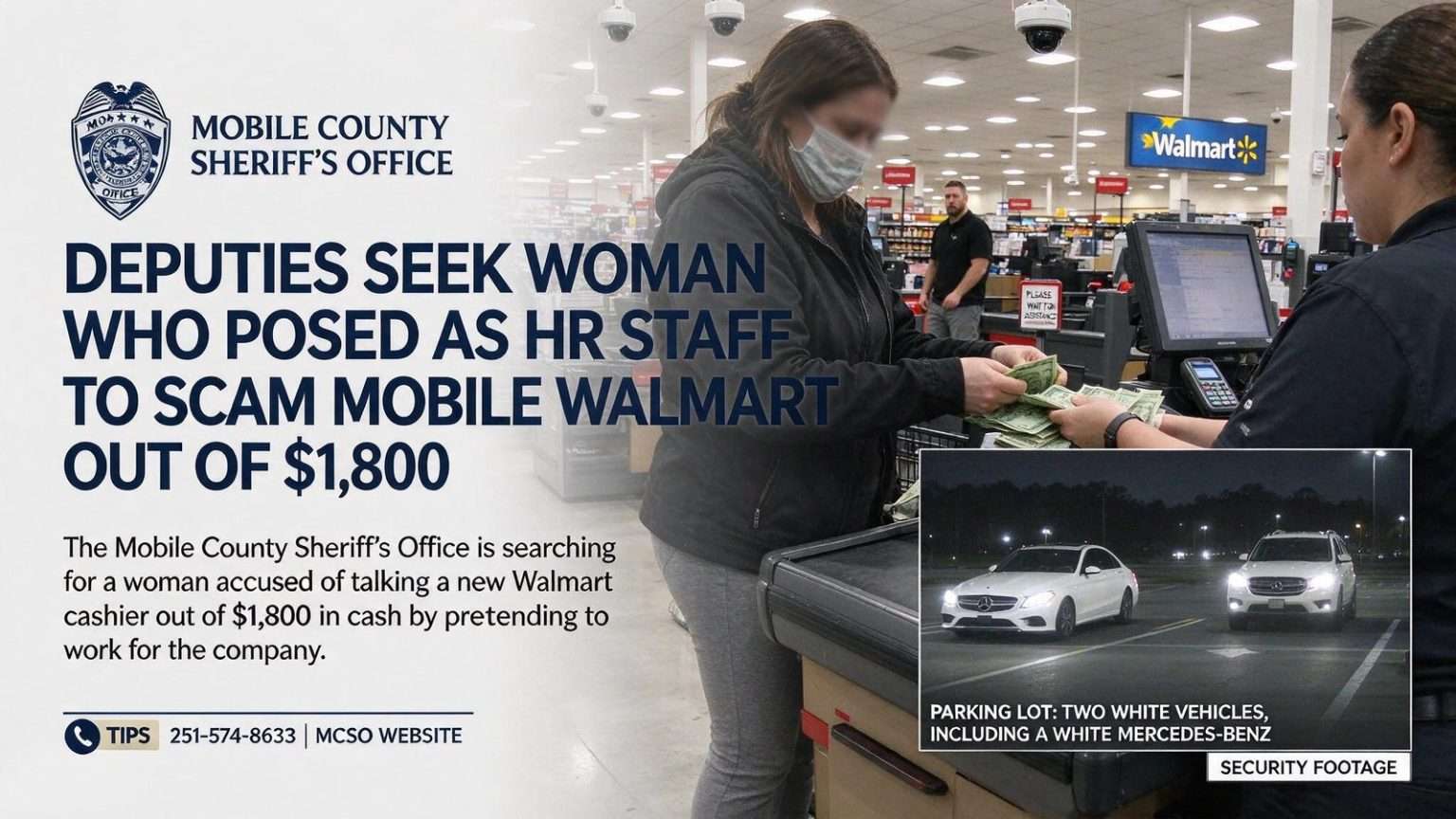
MOBILE, Ala. — The Mobile County Sheriff’s Office is searching for a woman accused of talking a new Walmart cashier out of $1,800 in cash by pretending to work for the company. The scheme, captured on the store’s own security system, targeted an employee too new on the job to recognize that no legitimate human resources representative conducts cash transactions at the register. Investigators released the footage in hopes that someone in the Mobile area recognizes the woman and her male companion.
According to the sheriff’s office, the woman walked into the Walmart at 7855 Moffett Road and told a newly hired cashier that she was with the human resources department and needed change for a large bill. The store sits along Moffett Road — U.S. 45 — in northwest Mobile, one of the busiest retail corridors in that part of the city. The approach exploited the most vulnerable moment in any employee’s tenure: the early weeks, when procedures are still unfamiliar and the instinct to defer to corporate authority is strongest.
The exchange was caught on the store’s overhead camera, which shows the woman counting cash and chatting with the cashier before walking away with $1,800 — leaving the register $125 short. The camera detail matters for investigators, because it documents not just the transaction but the demeanor of the suspect, who chatted casually while handling the cash. The shortfall in the register gave store officials a concrete loss figure to report to deputies.
Store video shows the woman arriving in a black jacket and gray pants with her face partially covered by a mask. A man in a black shirt and gray pants follows close behind her. The partial face covering shows the pair took some precaution against identification, though body type, clothing, gait and behavior on camera all remain useful to investigators and to members of the public who may recognize the suspects.
Parking lot footage later captured the pair leaving in separate white vehicles, one of them a white Mercedes-Benz, according to deputies. The two-vehicle exit suggests a level of coordination, with a getaway car staged while the suspect conducted the scheme inside. Vehicle descriptions — particularly a distinctive white Mercedes-Benz — often prove decisive in cases like this, since witnesses and other cameras frequently capture the same vehicles elsewhere.
How the Scheme Works
The ruse described by investigators is a classic social engineering play that has targeted retailers across the country for years. The scammer poses as a manager, corporate employee or asset protection officer, approaches a cashier who is new enough to be unsure of protocol, and requests cash in the form of change for large bills or small bills. The transaction sounds official enough in the moment that an untrained employee hands over the drawer’s cash before anyone questions the request.
Retailers train employees to refuse exactly this kind of transaction, and the training has become more explicit as the scam has spread. Legitimate corporate staff never need to exchange money at a register; cash office procedures handle any currency movement, always with documentation and dual verification. Stores post reminders at registers and in break rooms, and loss prevention staff drill new hires on the rule that any request for cash from someone at the counter is a scam, no matter who claims to be asking.
New employees are the preferred target for a reason. A cashier in the first weeks of the job has not yet absorbed every policy, feels pressure to appear competent, and hesitates to challenge someone claiming corporate authority. Scammers exploit that gap between genuine politeness and internalized procedure, and they often choose busy times of day when supervisory staff are occupied and the register is flush with cash.
The $1,800 taken in this case represents a meaningful loss for the store, but the scheme’s broader cost comes in its repetition. The same ruse has been documented at big-box stores, grocers and chain restaurants across Alabama and the Gulf South, and each success encourages the next attempt. Stores that publicize incidents — and prosecutors who file theft and impersonation charges when suspects are caught — raise the risk side of the equation.
What Happens Next
Investigators are asking anyone who recognizes either suspect or has information about the scheme to call the Mobile County Sheriff’s Office at 251-574-8633 or submit a tip through the MCSO website. Anonymous tips are accepted through the same channels, and even partial information — a name, a vehicle tag, a place where the suspects have been seen — can move the investigation forward. The released images and vehicle descriptions give the public specific things to look for.
The choice of Walmart as a target also reflects the scale advantage big-box stores offer a scammer. A store of that size keeps substantial cash across multiple registers, employs enough new hires at any given time that an unfamiliar face at the counter draws little attention, and bustles with enough customers that an extended conversation at a register looks ordinary. Those same qualities that make a supercenter efficient also create the openings that social engineers look for.
Loss prevention teams in the Mobile area track these incidents across stores, since the same crews often hit multiple locations along the I-65 and U.S. 45 corridors before moving on. When one store releases camera images, investigators at neighboring retailers compare notes on any similar attempts. That coordination, combined with public tips, is frequently what turns a single scam report into an identification.
Under Alabama law, taking money through deception rather than force or stealth falls under theft by deception, a charge that rises with the value of the property involved. An $1,800 loss places the alleged offense in felony territory, and impersonating a company representative during the scheme can add to the legal exposure. Prosecutors in Mobile County have handled similar retail-fraud cases, and convictions typically turn on the surveillance footage and transaction records that stores maintain.
The legal exposure can grow with each additional incident connected to a suspect. Multiple theft cases from different stores can be consolidated or charged separately, and a pattern of impersonation strengthens the state’s case by showing intent rather than mistake. That is one more reason deputies publicize each incident quickly — every store that recognizes the suspects from a published image is a potential additional count, and every warning issued to store managers is a scheme that fails.
A Warning for Retail Workers Across the Gulf Coast
The case carries a lesson for every cashier, stocker and new hire in the region, not just at the store on Moffett Road. Employees who receive any request for cash — from a customer, a caller, or someone walking through the door claiming corporate affiliation — should stop the transaction and call a supervisor immediately. No legitimate exchange of register cash happens without a manager present, documented paperwork, and verification through the store’s own chain of command.
Mobile County deputies have warned about similar schemes in the past, including phone-based versions in which callers claiming to be executives direct store managers to wire cash or hand over card numbers. The variety targeting cashiers remains the most common, because it requires no technology — just confidence, a plausible story and an employee who has not yet learned to say no. Loss prevention professionals urge stores to make the refusal rule a first-day lesson rather than a later module of training.
The presence of the second suspect, the man in the black shirt and gray pants who followed the woman into the store, is a reminder that these schemes are often two-person operations. One suspect conducts the conversation while the other watches the floor, monitors the reaction of staff and stands ready to intervene if the scheme begins to collapse. Both individuals described by deputies could face the same charges if identified and arrested.
For shoppers who were in the store that day, even incidental recollections can help: who was at the nearby registers, what vehicles were in the lot around the time of the incident, whether anyone noticed the white Mercedes-Benz leaving. Retail fraud investigations typically advance through exactly that kind of community input, pieced together with the store’s camera system.
Store managers across Mobile County received the same implicit message from the case: review register training with every new hire, remind staff that corporate representatives never exchange cash at the counter, and make sure supervisors know to respond quickly when an employee asks whether a request is legitimate. Those few minutes of reinforcement cost nothing and close the exact door this pair walked through.
Anyone with information is asked to contact the Mobile County Sheriff’s Office at 251-574-8633 or through the tip submission page on the agency’s website. The investigation remains open, and the sheriff’s office has not ruled out additional incidents connected to the same pair. Until the suspects are identified, deputies are counting on the public’s eyes — and on the next new cashier, somewhere along the Gulf Coast, recognizing the scam before the drawer comes open.


