DeSantis announces $1,000 bonuses for Florida teachers and principals
Gov. Ron DeSantis announced $1,000 bonuses for Florida teachers and principals as part of $765 million in education funding, with minimum pay up to $46,000.
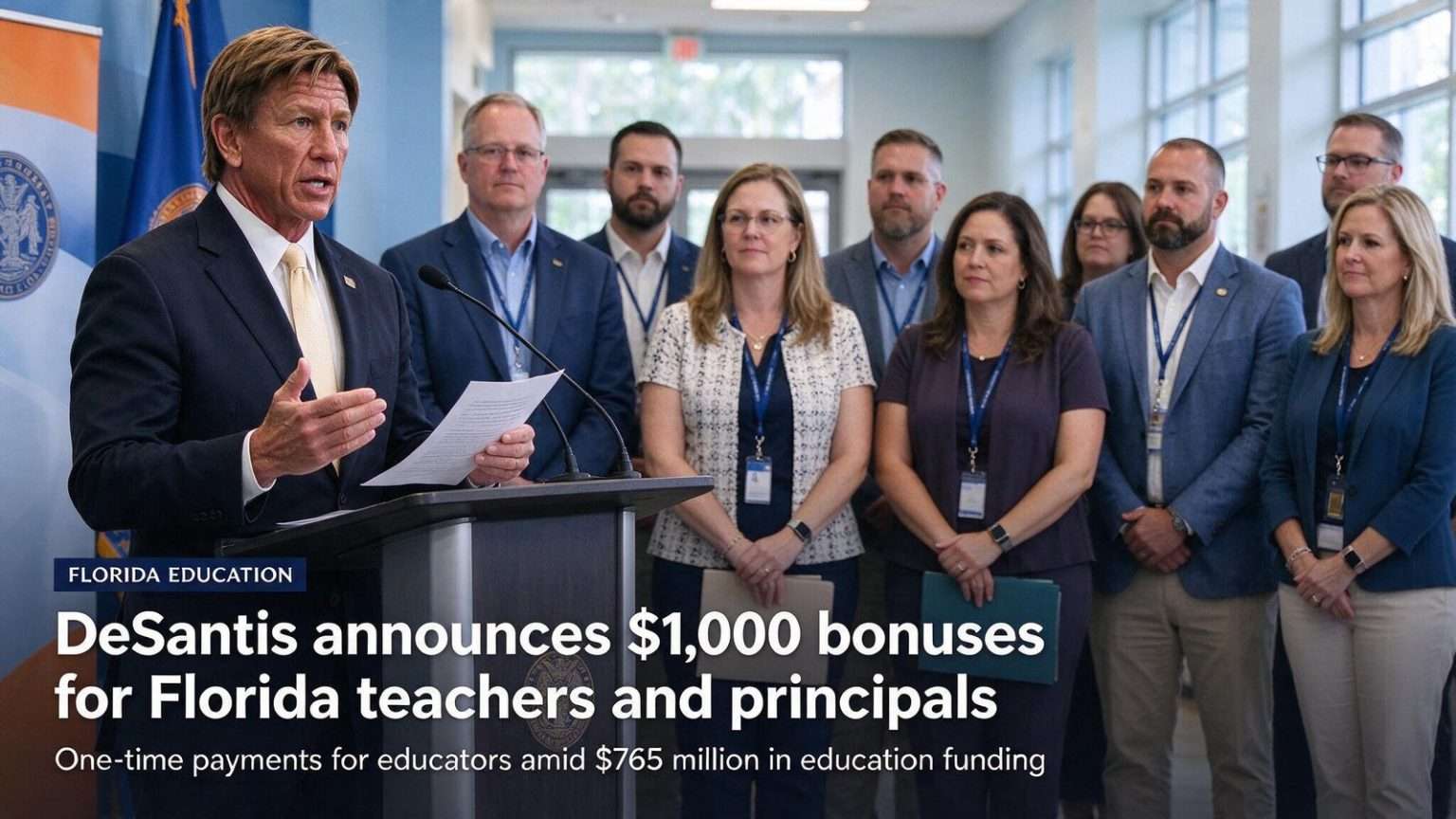
Gov. Ron DeSantis announced Wednesday that Florida teachers and principals will receive $1,000 bonuses, with the money expected to go out this summer after the budget is signed in the coming weeks. The announcement puts a direct payment in the hands of virtually every public school educator in the state and marks the second time in a month that the governor has aimed one-time bonuses at a workforce that carried Florida through the pandemic.
The announcement came alongside $765 million in total education funding. That includes $550 million to keep raising minimum teacher salaries and $215 million to provide $1,000 disaster-relief payments to every eligible public school principal and teacher in the state. The structure matters: the $550 million continues a recurring salary initiative that began the previous year, while the $215 million in bonus payments is a one-time injection — recognition money rather than a permanent pay raise, and easier to fund in a single budget cycle.
Three weeks earlier, DeSantis had announced $1,000 bonuses for Florida first responders. Paired together, the two announcements sketched a political argument as much as a policy one: the workers the state counted on during the pandemic — deputies, firefighters, paramedics, teachers — would be the ones honored first when the budget allowed. For educators who had spent a year teaching through closures, quarantines, and remote instruction, the gesture was recognition of a year like no other.
What the money does
The largest piece — $550 million for minimum teacher salaries — continues the state’s push to lift starting pay into competitive territory. Florida’s teacher pay had lagged the region and the nation for years, and the prior year’s salary initiative made raising the floor a statewide commitment. The new funding keeps that commitment funded, allowing districts to continue moving their salary schedules upward rather than absorbing a one-year bump and stalling.
The $215 million bonus program is broader in its reach. By including every eligible public school principal and teacher, the state makes the payment nearly universal across the profession — not a selective award tied to test scores or evaluations, but a flat acknowledgment of service during the pandemic years. One-time payments draw fair criticism for not compounding into retirement or lifetime earnings, but they also avoid the structural cost that permanent raises carry, which is precisely why legislatures reach for them in strong budget years.
DeSantis was joined by teachers, principals and superintendents from Baker, Sarasota and Okaloosa counties. The choice of counties told its own story: Baker and Okaloosa sit in the Panhandle, the region battered by Hurricane Michael and Hurricane Sally, while Sarasota anchors the Gulf Coast’s southwest. The “disaster-relief” framing of the bonus payments ties the educator payments to the same resilience theme the state applied to first responders — workers who held communities together through storms and a pandemic at once.
The salary numbers behind the announcement
Over the past year, Florida’s minimum teacher pay rose by an average of $6,000, from $40,000 to $46,000, and 68 of the state’s 74 school districts — about 92 percent — now start teachers at $40,000 or more. Those numbers represent the most concrete outcome of the salary initiative: a state that had become known for near-bottom starting pay moved, in a single year, to a new floor that changed the first-year math for new teachers in nearly every county.
The distribution across districts also matters. Florida’s 74 districts range from Miami-Dade’s enormous system to small rural counties where a handful of teachers staff entire schools. Raising the minimum in a small district costs comparatively little; raising it statewide, uniformly, requires the state to put real money into the formula so that property-poor counties can compete. The $550 million continuation is aimed at exactly that gap, keeping the floor from eroding as the memory of the first year’s push fades.
Teacher pay has practical stakes beyond recruitment banners. Florida has struggled for years to fill classrooms with certified teachers, particularly in special education, science, and math, and districts along the Panhandle have competed with neighboring states for a thin candidate pool. Starting salary is the most visible lever a state can pull, and the movement from $40,000 to $46,000 as a minimum is designed to change the first impression Florida makes on education graduates deciding where to begin a career.
Schools, the pandemic, and the politics of staying open
“While most other states locked down their schools, Florida followed the science and opened our schools for in-person instruction, five days a week,” DeSantis said, crediting educators for the state’s approach during the pandemic. The claim compressed the governor’s entire pandemic-era education position into a single sentence: Florida kept classroom doors open when much of the country operated remotely or in hybrid schedules, and the teachers who staffed those classrooms did the heavy lifting.
The politics of that position were national news throughout the pandemic. School closures became one of the most argued-over questions in American public life, and Florida’s early commitment to in-person instruction — pressed by the governor over the objection of some district leaders and unions — became a defining marker of his administration. The bonus announcement let DeSantis connect that policy directly to the people who executed it, praising educators while renewing the argument with other states in the same breath.
For educators themselves, the record was more mixed than the rhetoric. Teaching in person through a pandemic meant masks, distancing where possible, constant quarantines, and the strain of serving students who had fallen behind — all under the same scrutiny teachers always face, amplified. The $1,000 payment lands as a token of appreciation in a profession where such tokens have been rare; whether it changes retention or morale depends on what the state does in the budgets that follow.
What it means for the Panhandle and the Gulf Coast
The superintendents and educators standing with the governor came from counties where the state’s investment lands hardest. Okaloosa County, anchored by Fort Walton Beach and the Eglin Air Force Base corridor, and rural Baker County, north of Jacksonville, represent the smaller districts where a $40,000 minimum changes a salary schedule dramatically rather than marginally. Sarasota County, meanwhile, has long been one of the state’s better-funded systems, and its presence at the announcement signaled that the salary push reaches the districts that least need help as well as the ones that need it most.
The Panhandle’s recovery years give the “disaster-relief” label real weight there. Hurricane Michael destroyed or damaged schools across Bay, Gulf, and surrounding counties in 2018, and the region spent years rebuilding classrooms while absorbing displaced students and staff. Hurricane Sally hammered the Pensacola area in 2020. Panhandle teachers have worked through two disasters and a pandemic in the span of three school years — a sequence that makes a $1,000 payment feel modest, and also genuinely earned.
For Alabama readers across the state line, the announcement carries its own relevance. Mobile and Baldwin County districts compete with Florida Panhandle schools for the same teaching talent, and a Florida minimum of $46,000 raises the stakes in that competition. Teacher pay is a regional labor market on the Gulf Coast, and salary movement in one state ripples directly into the hiring seasons of the other.
The summer timeline
The money’s path runs through the standard budget process: legislative passage, the governor’s signature in the coming weeks, and then disbursement over the summer. A summer timeline matters to how educators experience the payment — arriving before the new school year, it functions as both a back-pay acknowledgment of the year just finished and a small buffer before the next one begins. Districts will handle the mechanics, identifying eligible employees and processing payments through the same payroll channels that distribute every other state allocation.
Eligibility details — which classroom personnel qualify as “teachers,” how charter schools are treated, what “eligible” excludes — will be settled in the budget language, as they were in the first responder program that preceded this one. Such details rarely make the announcement and always matter in the payroll office; educators with questions about their own status will find the answer in the implementing documents once the budget is signed.
What the announcement settles is the headline: Florida’s public school teachers and principals will get $1,000 bonuses this summer, layered on top of a second consecutive year of minimum-salary investment that has already lifted starting pay by an average of $6,000 statewide. Whether the combination is enough to change the state’s teacher-shortage math will be measured in the fall’s vacancies and the years’ retention numbers — but for one summer at least, the state’s educators are being paid a compliment in the most literal way available.