Dinner & a Movie: Lamb Tagine and ‘Prisoners’
This week's Dinner & a Movie sets a fragrant North African lamb tagine over couscous against 'Prisoners,' a tense psychological thriller about two families and a desperate search.
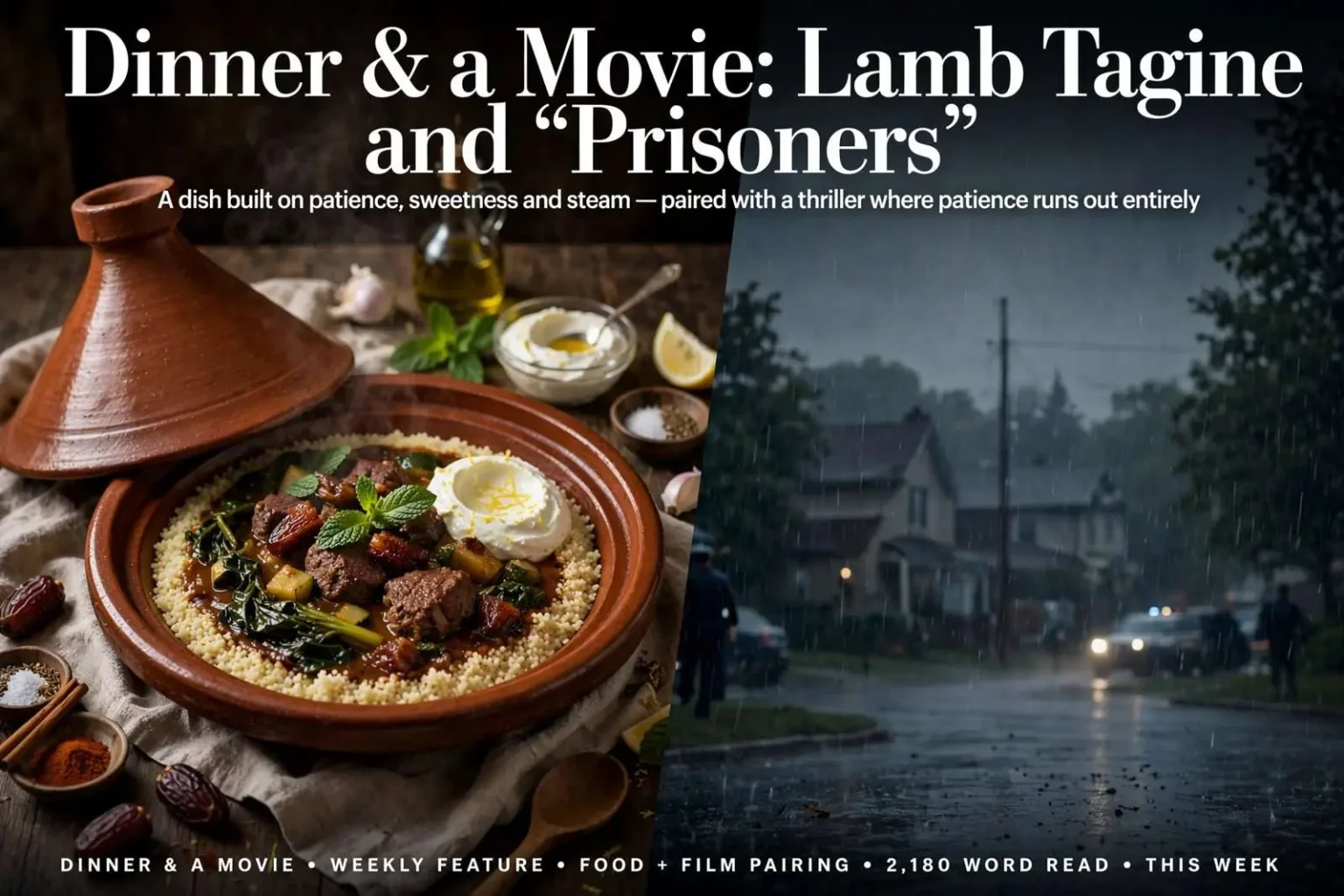
This week’s Dinner & a Movie trades Gulf Coast seafood for the warm spices of North Africa, pairing a fragrant lamb tagine over couscous with a psychological thriller that is anything but comfortable viewing. It is an intentional contrast: a dish built on patience, sweetness and steam, served alongside a film about what happens when patience runs out entirely. The combination makes for a full evening — one that starts in the kitchen with an hour of quiet cooking and ends in a theater with your pulse up and your assumptions tested.
In the Kitchen: Lamb Tagine
A tagine is, strictly speaking, the conical clay pot of Moroccan cooking, but the word has come to mean the slow-simmered stew itself, and a heavy skillet or Dutch oven does the job perfectly well at home. What defines the dish is the spice blend and the layering: aromatics cooked down to a dark paste, meat browned into that paste, then fruit, greens and time. Gather about 10 ounces of ground lamb (mix in beef if you like), three-quarters of a cup of couscous, four cloves of garlic, a lemon, a zucchini, half a bunch of Swiss chard, a bunch of mint, a few Medjool dates, tomato paste, two teaspoons of ras el hanout and a quarter cup of labneh.
Ras el hanout is the engine of the recipe. The name means roughly “head of the shop,” and it is the spice merchant’s signature blend — typically cumin, coriander, cinnamon, ginger, paprika, turmeric, cardamom and a dozen quieter notes, varying by seller. Two teaspoons sounds modest, but the blend blooms in hot oil and tomato paste, and it perfumes the whole dish. If your market carries it in bulk, buy a small amount fresh; the blend fades faster than single spices. Labneh, the thick strained yogurt that finishes the plate, is increasingly easy to find alongside the hummus in better grocery stores, and plain Greek yogurt thinned with a squeeze of lemon is a workable stand-in.
Prep comes first, and it goes quickly. Mince the garlic and lemon zest; separate and chop the chard leaves and stems; dice the zucchini; pit and chop the dates; pick the mint leaves. Keep the chard leaves and stems in separate piles — they go into the pan at different times, and the stems need a head start. The dates do more than add sweetness: as they simmer, they partly dissolve into the sauce, giving it body and a dark, fruity depth that balances the earthiness of the spice blend.
Cooking the Dish
Start with the couscous, which is nearly effortless and rewards a little care. Cook the couscous with half the garlic in a little olive oil and water, then fluff with lemon zest, lemon juice and a drizzle of oil and keep it warm. Toasting the grains briefly in the oil before the water goes in gives them a nuttier flavor and keeps them distinct rather than sticky. The lemon zest folded in at the end is worth the extra minute — it lifts the whole plate and echoes the squeeze of lemon that finishes the stew.
Now the tagine base. In a large pan, cook the chard stems and remaining garlic until they soften, then stir in the ras el hanout and tomato paste and let the mixture cook until it turns dark red. That step matters more than it looks: tomato paste that is merely warmed tastes raw and sharp, while paste cooked in oil until it darkens and begins to stick turns sweet and concentrated, the foundation of a sauce that tastes like it simmered for hours. Brown the ground lamb in the spiced paste, breaking it up as it cooks so every bit of meat takes on color, then add water, the dates and the chard leaves and simmer to your preferred thickness. The greens will wilt into the sauce and the dates will soften and blur into it.
Finish with labneh and a squeeze of lemon. Serve over the couscous, garnished with mint, and don’t skip the mint — the cool, green freshness against the warm spice is what makes the plate feel finished. It goes well with a glass of red wine; something medium-bodied and fruity, like a Grenache or a lighter Syrah, stands up to the spice without fighting it. The dish is warming and aromatic, with the dates and labneh softening the spice, and it reheats gracefully the next day, when the flavors have had a night to marry.
A few practical notes for the home cook. Ground lamb cooks faster than stew cubes, so the whole dish comes together in well under an hour — a genuine weeknight meal dressed in weekend clothes. If your family is wary of chard, the stems cook down sweet like a mild celery and the leaves taste like a richer spinach; most skeptics never notice them in the finished sauce. And if you want more heat, a pinch of crushed red pepper with the spice blend works, but taste first: a good ras el hanout already carries a gentle warmth of its own.
At the Movies: ‘Prisoners’
From the kitchen to the theater, and from warmth to dread. Director Denis Villeneuve’s “Prisoners” opens on two families sharing a Thanksgiving dinner when their two young daughters vanish. It is a deliberately ordinary beginning — casseroles, borrowed chairs, two fathers comparing their fortunes in the deadened voice men use for such things — and Villeneuve lets the domestic calm sit on screen just long enough for the disappearance to shatter it completely. In the hours after the girls go missing, the film becomes a procedural, and then it becomes something harder to watch.
As the police investigation stalls, a father played by Hugh Jackman takes the search into his own hands, and his primal desperation drags the story into very dark territory — including the kidnapping and torture of the prime suspect. The man he holds is a young man with the mind of a child, found wandering the neighborhood in a borrowed RV, and Jackman’s character — a survivalist handyman with a basement full of supplies — decides that waiting for the law is a luxury his daughter cannot afford. What follows is a sustained, uncomfortable examination of what a decent man does when every institution he trusts fails him, and the film refuses to let either the character or the audience off the hook.
Around that central horror, the movie builds a dense, rain-soaked police story. Jake Gyllenhaal plays the detective leading the case, a lifer with a tattooed neck and a childhood in the system, whose instinct tells him the grieving father has crossed a line he cannot uncross. Melissa Leo and Maria Bello play the two mothers, unraveling in opposite directions; Paul Dano plays the suspect; Terrence Howard is the second father, torn between loyalty and conscience; and Viola Davis, in a small but essential role, carries the other family’s private reckoning. The cast is deep, and every one of them is asked to play fear rather than heroism.
The acting and direction are excellent, and the film is gripping if genuinely depressing. Villeneuve — whose later work would take him from the drug-war epic “Sicario” to “Arrival” and “Dune” — shoots the story in a perpetual gray drizzle, and his Pennsylvania-exurbs setting feels close enough to home to unsettle. Roger Deakins’s cinematography makes even daylight look like the hour before a storm. This is craft of a high order in service of a story that never once tries to comfort you.
Our Verdict
Our verdict: a firm two thumbs up, with the caution the film has earned. “Prisoners” contains sustained menace, implied and on-screen violence against a captive, and a moral darkness that some viewers will rightly want to know about in advance. It is the kind of story that leaves you asking what you would do in the same situation — and it is honest enough not to pretend the answer would be pretty. Viewers who prefer their thrillers with an exit ramp should think twice; viewers who want a film that takes its audience seriously will find one of the best of its year.
It is also, it should be said, a detective story with real integrity. The clues are planted fairly, the resolution grows out of what we have seen rather than out of a late twist, and Gyllenhaal’s detective is given the kind of patient, dogged competence that makes the ending land. The film’s length — well over two hours — is earned by the patience of its storytelling rather than padded.
Why This Pairing Works
On the surface, a Moroccan stew and a kidnapping thriller have nothing to do with each other. But there is a logic to the pairing. The tagine is a dish about transformation — raw ingredients, hard spice and patience becoming something sweet and cohesive — and “Prisoners” is a story about what happens when patience is abandoned: what a man becomes when he refuses to let time and process do their work. Eat first, watch second, and the contrast does its own quiet commentary.
Practically speaking, the schedule works too. The tagine comes together in under an hour and holds happily on the stove, which leaves time for the movie without a rushed dinner. And if the film leaves you in need of decompression, there are worse remedies than a second helping of couscous and a glass of that Grenache while the credits roll. Cook it, watch it, and let us know what you would have done in Keller Dover’s basement — though we suspect you already know your answer is more comfortable than you would like it to be.