Dinner and a Movie: A Colonoscopy Reminder and ‘The Big Wedding’
A Mobile couple's Dinner and a Movie column turned into a good-natured public-health nudge about colon cancer screening, paired with a review of the star-studded comedy The Big Wedding.
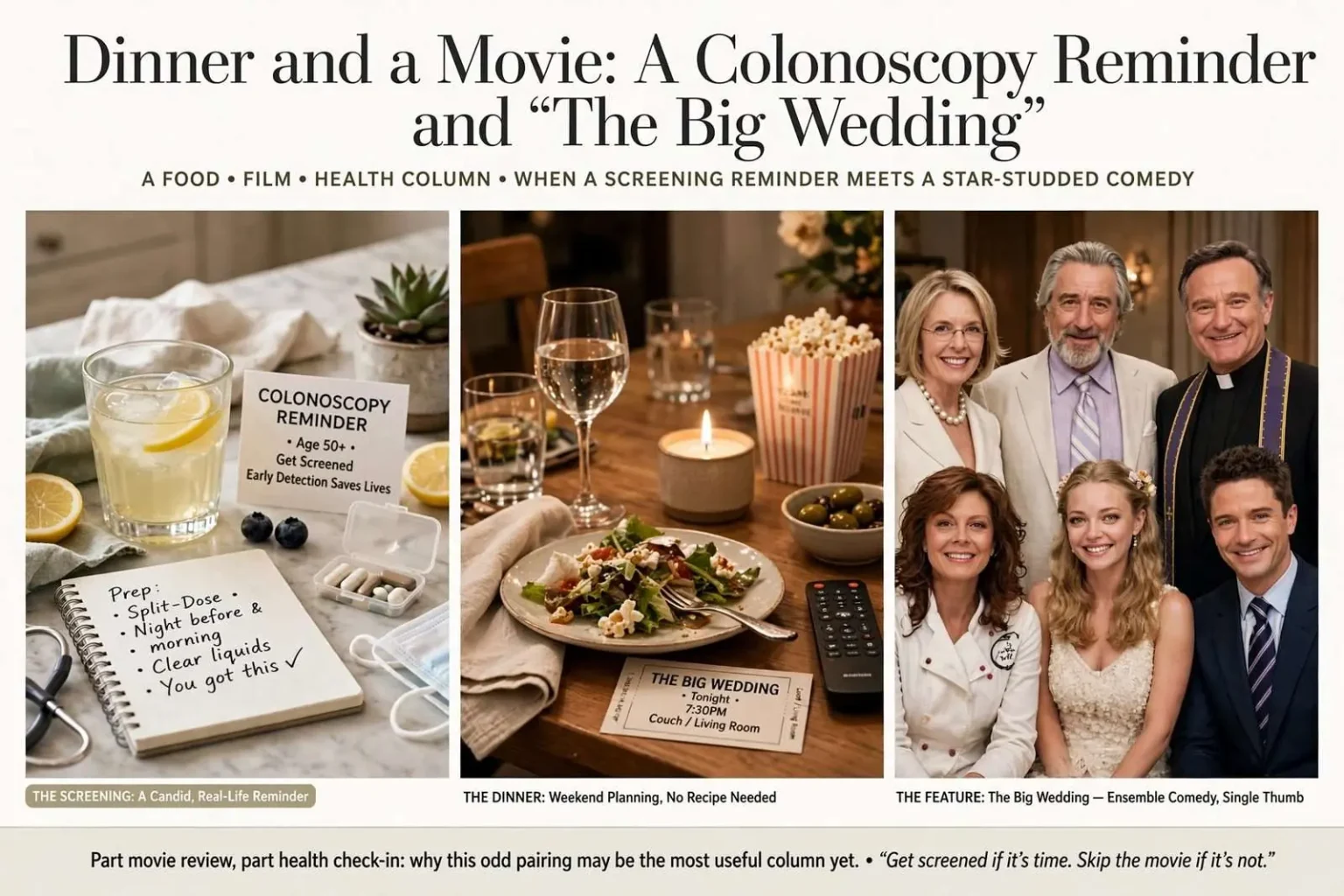
Not every installment of a food-and-film column goes down as smoothly as a good meal, and this one carried an unusual side dish: a public-health reminder. In place of a recipe, the writer offered a candid, humorous account of preparing for a routine medical screening, and paired it with a review of a star-heavy comedy. The combination made for one of the stranger menus the column has ever served, but both halves of it came with a point worth taking home.
The column’s usual rhythm pairs something to cook with something to watch, an easy formula built for weekend planning. This installment bent the formula toward real life, using the writer’s own appointment calendar as the ingredient list. The result was part movie review, part gentle nudge from someone who had just been through a procedure most readers know they are supposed to schedule and most readers put off.
An unglamorous but important menu
One of the doubtful joys of turning 50, the writer noted, is the recommended colonoscopy, and he had just completed his second. The milestone birthday that brings AARP mail also brings the screening recommendation that gastroenterologists repeat to every patient who crosses the threshold. His second time through, he reported, was easier than his first, which will come as comfort to anyone staring down the initial appointment.
The procedure itself, he assured readers, was painless, since patients are sedated. Most people who have had one describe it the same way: you arrive, you nap, you wake up, and the whole thing is over before you have formed a coherent thought about it. The dread, almost universally, is misplaced. It attaches to the wrong end of the experience.
The preparation, as anyone who has done it knows, is the hard part. A day of clear liquids and a thorough cleansing of the digestive tract is the price of admission, and no amount of humor fully redeems it. The writer worked through the ordeal with the same self-deprecating tone he brings to kitchen failures, which is arguably the only tone that suits the subject.
He credited a local gastroenterologist with a split-dose approach, taken partly the night before and partly early the next morning, that made the ordeal more bearable than the older method of downing everything at once. The split-dose method has become the preferred practice in gastroenterology circles, improving the quality of the examination while sparing patients the worst of the single-dose marathon. Practical advice like that, delivered from one patient to another, is the kind of service a column can offer that a medical brochure cannot.
Setting the jokes aside, he delivered the real point of the column plainly: if you are 50 or older, get screened. Caught early, he wrote, colon cancer can be cured, and a screening could save your life. It was a message worth more than any recipe. Colorectal cancer is among the most preventable of major cancers precisely because screening can catch it before it becomes dangerous, which is why doctors keep repeating the advice and why this column repeated it too.
The feature presentation: The Big Wedding
For the movie, the couple chose The Big Wedding, a lighthearted comedy jammed with stars but, in their view, disappointingly thin on plot. The film arrived as the kind of ensemble comedy that studios assemble around a marquee cast, betting that familiar faces will carry an evening. In this case the bet bought a pleasant enough night at home, if not a memorable one.
The premise had drawn them in: an adopted young man, played by Topher Grace, persuades his divorced parents, played by Robert De Niro and Diane Keaton, to pretend they are still married in order to appease his conservative future mother-in-law, with De Niro’s girlfriend, played by Katherine Heigl, going along with the ruse. It is a classic farce setup, the sort of lie that must be maintained through a wedding weekend while complications multiply. On paper, with that cast, it looks like a sure thing.
From there, the writer felt, the film wandered without ever quite arriving anywhere. The plot threads multiply but never tighten, and the comedy leans on situations the cast cannot quite redeem. He judged the acting stronger than the material, and noted a deep supporting cast that included Amanda Seyfried, Susan Sarandon, Ben Barnes and Robin Williams, the last of whom appeared in a small, restrained role as the family priest. Seeing Williams in a quiet comic part is one of the film’s small pleasures, a reminder of how much control he could bring to even a minor role.
The irony of a movie about a staged family reunion, watched by a couple who spend their columns celebrating actual family dinners, was not lost on the writer. The film’s families pretend to be whole for an audience of wedding guests; the column’s families gather around a table with no pretense at all. One is a farce, the other a habit, and the column has always suggested the habit is the better entertainment.
The cast list alone made the film one of the more heavily promoted comedies of its season, and trailers leaned hard on the novelty of seeing De Niro and Keaton paired as a bickering ex-couple. Audiences who came for that pairing got it, the writer allowed, just not much around it. The supporting cast was given scraps: Seyfried as the frazzled bride, Sarandon as the sharp-tongued interloper at the edges of the ruse, Barnes as the groom caught between families. Each actor lands a moment or two, and then the script moves on before any of it can accumulate into a character.
The verdict from the couch
The lesson, he concluded, was an old one: a crowd of stars does not guarantee a good movie, and great actors cannot paper over a weak story. Ensemble comedies live and die on the script, because star power can deliver a laugh but not a reason to care. The Big Wedding had the faces and never found the story, and no performance in it could change that arithmetic.
If you have had a long week and want an undemanding romantic comedy, he offered, this might be your film. Otherwise, you could safely pass. There is no shame in a movie that merely fills an evening, and the column has always treated a low-stakes movie night as a legitimate pleasure. The couple gave it a single thumb up, a gentle verdict for a breezy night in.
A single thumb is the column’s way of saying the movie did its job without distinction: nothing to warn anyone away from, nothing to rush toward. Paired with a good dinner, it would pass unnoticed in the best sense. Paired with a movie calendar full of stronger options, it is an easy skip.
Pairing the two halves of the column
The unusual pairing of screening reminder and movie review turned out to fit together better than expected. Both messages, at bottom, are about taking care of yourself before problems grow: schedule the test you are avoiding, pick the movie that will actually make the evening pleasant. Neither piece of advice is complicated, and both are easier to follow this weekend than readers might think.
For readers who came for the recipe and stayed for the movie, the column’s detour into medical advice was an uncharacteristic but useful one. The writer’s account of his own screening stripped away the awkwardness that keeps people from booking the appointment, and his review saved everyone else the trouble of finding out about the film the hard way. That is two acts of service in one installment, which is more than most columns manage.
The next installment will presumably return to the kitchen, and the movie queue, with something more conventional on the menu. But this edition’s odd pairing may prove the most memorable: a reminder that the most important thing on some weekends’ to-do list is not dinner or a movie at all, and a verdict that saves you ninety minutes for the things that matter. Get screened if it is time, skip the movie if it is not, and pass the recipe when the next one arrives.
It is also worth noting what the single thumb does not mean. The column does not reserve its lower verdicts for bad movies so much as for forgettable ones, and The Big Wedding landed squarely in that second category. A bad movie at least generates conversation on the drive home; a forgettable one generates a quiet evening and a clean kitchen afterward, which is not the worst outcome for a weeknight. Readers choosing between this and another hour of television should weigh accordingly.
The column will keep pairing food with film in the weeks ahead, and the writer promised to return the recipe slot to its rightful place next time. Anyone who put off scheduling a screening until this column nudged them should consider the detour worthwhile, and everyone else can take the movie advice and move on. Either way, the table is set, the projector is warmed up, and the next installment is already in the oven.