Disgraced Priest Alex Crow and Teen Return to Mobile County; DA Closes Investigation
Suspended priest Alex Crow and a former McGill-Toolen student returned to Mobile County; the DA closed the investigation citing insufficient evidence.
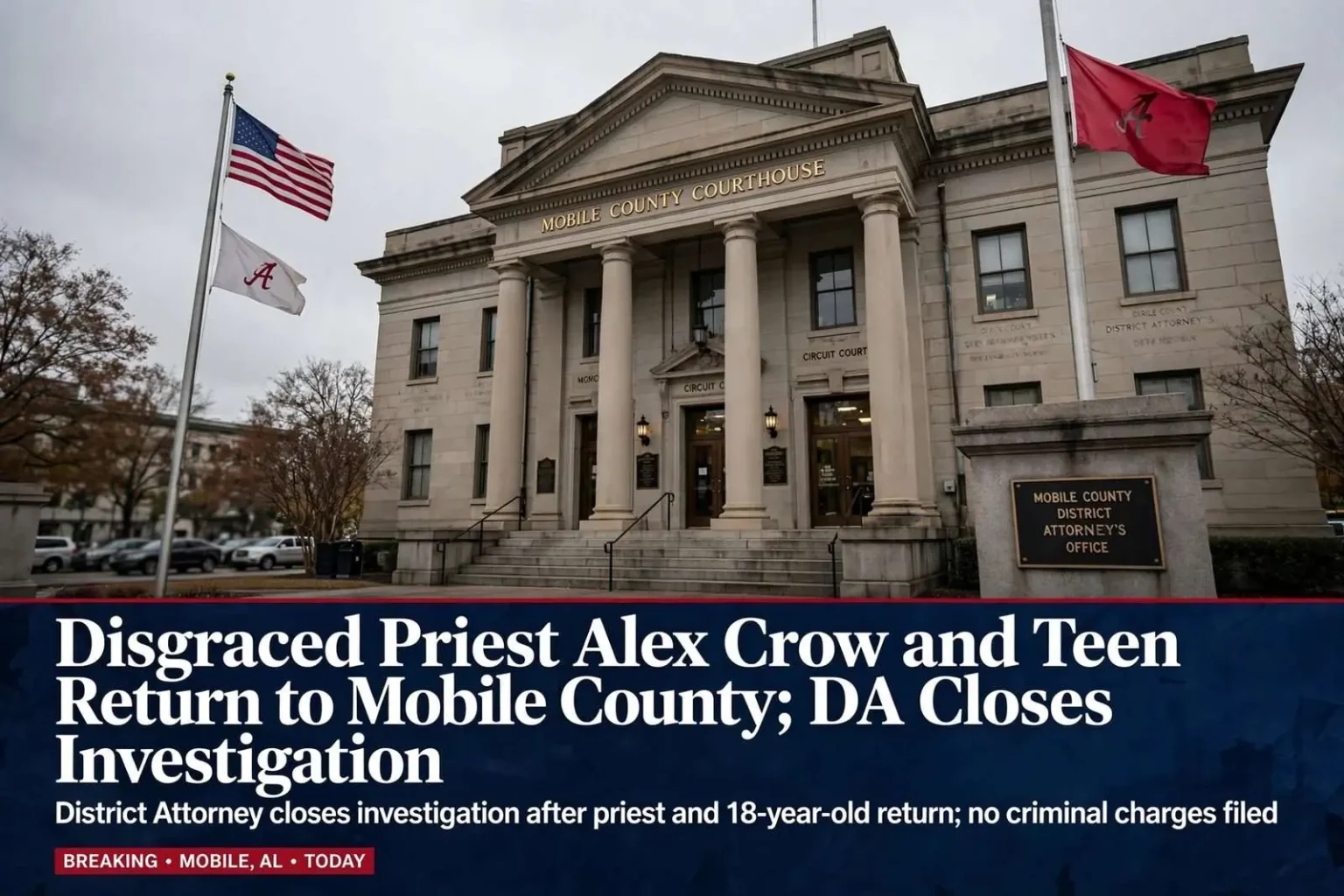
A suspended Catholic priest who left the country with a teenage girl earlier in the year is back in the Mobile area, according to the attorney for the girl’s parents, and the Mobile County District Attorney has closed its investigation into the disappearance that drew international attention to the city’s Catholic community. The return of Alex Crow and the young woman ended months of questions about their whereabouts, but it produced no criminal charges, a result the District Attorney’s Office said flowed directly from the evidence, and the absence of it.
Crow is accused of grooming a 2023 McGill-Toolen Catholic High School graduate and taking her to Italy with him. Before leaving the country, Crow left a letter with the Archdiocese of Mobile saying he would never return to America. The Mobile County Sheriff’s Office later released a note and a Valentine’s letter from Crow to the former student that offered some insight into his thinking, documents that became the most widely examined artifacts of a case that unfolded across two continents.
What the District Attorney Found
In a statement, the DA’s office said it was asked by the Archdiocese to investigate the circumstances around the sudden disappearance of an 18-year-old McGill-Toolen graduate and a 30-year-old priest. The request set the boundaries of the inquiry: prosecutors were examining what happened, whether any crime had occurred, and whether the evidence supported charges against the priest whose departure had upended two families and a school community.
While the young woman was missing, investigators interviewed more than 30 witnesses and reviewed thousands of pages of documents from the Archdiocese and their own inquiry. The scope of the work reflected the unusual nature of the case, which required investigators to trace finances, communications and travel records across international lines while coordinating with the Archdiocese’s own internal review of one of its priests.
When the young woman and Crow returned, prosecutors subpoenaed her to determine what happened. She appeared in good health and said she was safe, but attended with an attorney and declined to answer questions. Without her account, the office said it lacked sufficient admissible evidence to charge a crime, and the investigation is closed.
“I will not answer any questions about a private relationship between two now-adults,” the DA wrote, saying doing so would undermine the office’s integrity. The statement drew a deliberate line between the public’s intense curiosity about the case and the office’s obligation to base charging decisions on evidence that can be proven in court, not on inference or reputation.
The Archdiocese Response
The Archdiocese of Mobile said it was relieved to learn of the pair’s return, while stressing that Crow has been removed from ministry and his priestly faculties suspended. In the language of the Catholic Church, the suspension of faculties means a priest may no longer function publicly as a priest, whatever his ordination status, and the measure is among the most serious canonical penalties a diocese can impose short of laicization.
He is barred from celebrating Mass, visiting school grounds or leading any church ministry. Anyone who sees Crow doing so is asked to contact the Archdiocese at 251-434-1587. The Archdiocese framed the restrictions as permanent for the foreseeable future and asked the community that knew Crow, including the parishes and schools where he served, to report any violation rather than treat it as a private matter.
The Archdiocese said it has no information indicating Crow committed a crime, but pledged to cooperate with law enforcement. That position, offered while the District Attorney’s investigation was still open, mirrored the structure of the entire case: a church conducting its own accountability process, a prosecutor conducting a criminal one, and the two institutions sharing information without either pretending to speak for the other.
A Case That Gripped Mobile
McGill-Toolen Catholic High School sits in the heart of Mobile, and its graduates form a network that runs through the city’s parishes, businesses and public institutions. The disappearance of a recent graduate alongside a priest assigned to the city’s Catholic community therefore landed with unusual force, and the case drew coverage far beyond south Alabama as the details of the departure, the letters and the flight to Italy became public.
The documents the Sheriff’s Office released gave the public its only direct window into Crow’s reasoning. The note and the Valentine’s letter, written in the idiom of a man justifying his own choices, circulated widely and were dissected for what they revealed about how the relationship had developed and how Crow understood his own standing in the Church. Investigators treated them as evidence; the public treated them as revelation.
Grooming, the accusation at the center of the case, describes a process by which an adult in a position of trust gradually builds an inappropriate relationship with a young person, testing boundaries and isolating the target over time. In a school and parish setting, the pattern typically involves small privileges, private communication and the slow normalization of contact that would once have been unthinkable. Prosecutors and dioceses watch for precisely this pattern, which is why the Archdiocese’s investigation ran parallel to the criminal one even before any charges were contemplated.
The decision to close the investigation without charges rested on the structure of the evidence itself. Prosecutors concluded that whatever the circumstances of the relationship, they lacked admissible testimony or physical proof that a specific crime had occurred, and the young woman’s refusal to answer the subpoena’s questions left the central account untold. The DA’s statement acknowledged what many in the community found difficult to accept: that the office could know what the public believes happened and still lack the evidence the law requires.
The return itself resolved the question that had driven the search. When Crow and the young woman resurfaced in the Mobile area, the missing-person dimension of the case ended, and the attorney for the girl’s parents confirmed her presence locally. For the parents who had spent months without knowing where their daughter was, the confirmation brought relief of a kind, though the family’s account of the relationship and Crow’s conduct remains outside the public record.
For the Archdiocese of Mobile, the case joins a broader era in which American dioceses operate under scrutiny of how they screen, supervise and discipline clergy. The speed with which the Archdiocese referred the matter to the District Attorney’s Office, released its cooperation pledge and imposed canonical penalties reflected the accountability framework the American church has adopted since its abuse scandals, under which a priest accused of serious misconduct is removed from ministry while facts are established, not after.
Crow’s future in the priesthood is, in practical terms, already decided by the suspension of his faculties, even though the canonical process that could end in formal laicization unfolds separately and more slowly. The restrictions barring him from Mass, school grounds and ministry are enforceable against him indefinitely, and the Archdiocese has asked the community to make sure they are. Whatever the District Attorney’s file now holds, the Church’s own accounting continues, and the number attached to it, 251-434-1587, remains the line to call if the suspended priest appears where he is no longer welcome.
Italy figured in the case from its earliest days, both as the destination Crow chose and as the reason the disappearance acquired international reach. A priest and a teenage graduate arriving from Alabama attracted attention in the communities where they stayed, and the trail that Mobile County investigators followed ran through a country whose cooperation with American investigators, while routine in criminal matters, becomes complicated when no charges have been filed and no crime can yet be named.
The letters Crow left behind were studied for their timing as much as their content. A letter delivered to the Archdiocese before departure, announcing that he would never return to America, functioned simultaneously as a resignation and as an attempt to control the story of why he was leaving. The later note and Valentine’s letter to the young woman suggested a man aware that his choices were being judged and determined to frame them in his own words, in a register that struck many readers as more about self-justification than affection.
For the District Attorney’s Office, the case tested the boundary between public expectation and prosecutorial restraint. The office had interviewed more than 30 witnesses, assembled thousands of pages of documents and secured the return of both people at the center of the case, and it then declined to charge. The DA’s refusal to narrate the private life of two adults was presented not as evasion but as a principle: an office that discusses cases it cannot prove, on the strength of evidence it cannot use, trades away the credibility that charging decisions depend on.
The closure of the criminal investigation does not foreclose every avenue. Civil remedies, church disciplinary processes and the ongoing obligations of the Archdiocese all operate by different standards than criminal prosecution, and the Archdiocese’s cooperation pledge remains in force should new information emerge. What has ended is the formal search for answers from the state’s criminal apparatus, leaving the community that watched the case unfold to absorb an outcome that satisfied no one entirely but reflected the evidence as the office found it.