Mobile Renamed Dixie Street for a Civil Rights Pioneer and Druggist
The Mobile City Council voted in July 2007 to rename Dixie Street for Dr. James H. Finley, an early civil rights leader whose drugstore chain served the city's Black community for decades.
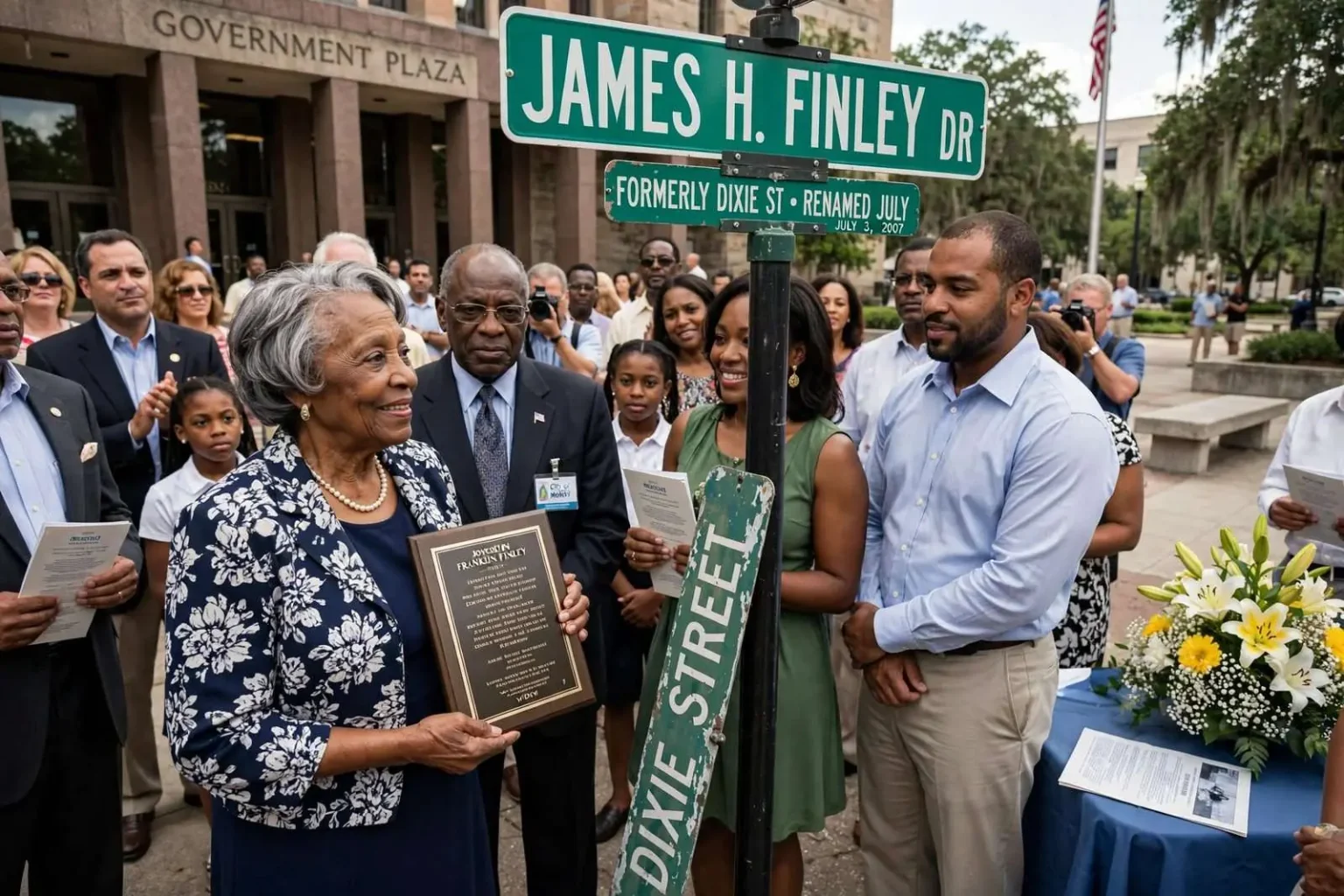
On Tuesday, July 3, 2007, the family of Dr. James H. Finley gathered at the Mobile City Council meeting for a vote that changed a street sign and, with it, the way a piece of the city describes itself. The council approved renaming Dixie Street as James H. Finley Drive.
Finley’s widow, Joycelyn Franklin Finley, accepted the resolution declaring the change along with a ceremonial street marker. A formal sign dedication was planned.
Council chambers in Government Plaza see a steady rotation of proclamations and resolutions, but few carry the weight of a permanent name change. Renaming a street requires the assent of the council and, in most cases, the backing of the families and neighbors who will live with the new name on every envelope and address sign — which is why the chamber filled with Finley family members on that summer afternoon, and why the vote drew applause rather than the usual procedural quiet.
Who Finley was
Finley was an early civil rights leader in Mobile and a businessman whose work touched the daily life of the city’s Black neighborhoods. He opened Finley’s Drug Store No. 2, the first in what became a chain of Finley drugstores.
The site of the original store was slated to be memorialized as part of the Mobile African-American Heritage Trail, a project then taking shape to mark the places where the city’s Black history was made.
In the Mobile of Finley’s era, a drugstore was far more than a corner shop. It was a soda fountain and meeting place, an employer of pharmacists and clerks at a time when segregated job markets restricted Black professionals, and a front-office headquarters for community causes. The men and women who owned such stores were often the same people who underwrote civil rights organizing, posted bail, lent meeting space and used their standing with city officials to press for change — all while running businesses that had to survive in the same economy they were trying to reform. Finley’s stores sat squarely in that tradition, and the “No. 2” in the name of his first location tells its own story of a man who planned from the start to build more than one.
The chain that grew from it made the Finley name a fixture across Black Mobile, familiar to generations of families who filled prescriptions, bought school supplies and caught up on neighborhood news at the counters. That everyday familiarity is part of why the street renaming resonated: countless Mobilians had a memory attached to a Finley storefront.
The weight of the old name
The exchange of one name for another carried its own meaning. Dixie Street, like hundreds of streets, schools and parks across the South, bore a name that celebrated the Confederacy and the order that followed it. Replacing it with the name of a Black physician-businessman who worked to dismantle that order was not a neutral act of municipal housekeeping, and no one at the council meeting pretended otherwise.
Mobile made the change well before the national wave of Confederate monument and place-name reconsiderations that followed 2015 and 2020. In that sense the 2007 vote reads now as an early local step, taken quietly, at the request of a family and with the council’s assent.
Cities across the South spent the following decade and more wrestling publicly with exactly this question — whether names on maps are mere labels or endorsements, and who bears the cost of changing them. Mobile’s answer in 2007 sidestepped the polarized national framing that came later. There was no referendum, no litigation, no months of public hearings; there was a family’s request, a council vote and a marker. The contrast is instructive for anyone studying how communities handle contested memory: sometimes the change that endures is the one made deliberately and locally, before the cameras arrive.
The heritage trail
The African-American Heritage Trail effort placed the renaming in a broader project of public memory. Mobile’s Black history is deep and, for much of the 20th century, poorly marked: the Africatown community founded by survivors of the last known slave ship to reach American shores; the churches and lodges of the old Davis Avenue business district, itself later renamed for Martin Luther King Jr.; the schools, the pharmacies, the funeral homes and the newspapers that sustained a community under segregation.
Adding Finley’s name to a street, and a marker to the site of his first store, extended that map by one more entry.
Heritage trails work by stitching such places together — a marker here, a renamed avenue there — until residents and visitors can follow the story on foot. Africatown anchors the narrative at one end, the product of a history that has gained wider national attention in recent years as the remains of the ship that carried its founders were documented in the waters north of the city. Davis Avenue’s business district anchors another stretch, its lodges and storefronts remembered as the commercial spine of Black Mobile before the district’s decline and its rebaptism for Dr. King. A pharmacy site, a church, a school: each addition turns scattered landmarks into a legible route through the city’s past, and gives teachers a field trip and families a reason to tell stories that might otherwise fade.
The trail’s designers have long argued that public memory in Mobile had been uneven — that the city’s plaques and monuments told some stories in bronze while leaving others to family albums. Projects like the Finley marker are how that balance gets corrected, one site at a time, usually with the same quiet, locally rooted process that marked the street renaming itself.
A small ceremony, a long record
City council resolutions of this kind rarely make more than a paragraph in the record. But for the Finley family, seated in the chamber on a July afternoon in 2007, the vote was the formal recognition of a life spent building institutions in a city that had not made that easy. The street sign that came down said Dixie. The one that went up said James H. Finley Drive.
Every driver who now turns onto the street passes a name that outlasted the man, and every address printed with it repeats the story a little further. That, in the end, is what a renaming is for — not to erase the past, but to decide which part of it a city chooses to honor.
The economics behind a store like Finley’s deserve attention too. In the segregated South, Black consumers were often able to shop in white-owned establishments but rarely able to work in them, and credit, insurance and wholesale supply were controlled far from their neighborhoods. A Black-owned drugstore broke that pattern on every front: it trained and employed licensed professionals, circulated money within the community, and demonstrated in practical terms that Black enterprise could compete at scale. Chains like the one Finley built were proof-of-concept for a broader argument about economic citizenship, and their owners carried that credibility into boards, fraternal organizations and civic campaigns across the city.
Pharmacists themselves occupied a special niche in the professional life of Black Alabama. Licensing required formal education at a time when the state’s professional schools closed their doors to Black students, so early Black pharmacists trained out of state or at one of the few programs that would admit them, returning home with credentials that commanded respect across color lines. Their stores became anchors — the place where a coach, a teacher, a pastor and a longshoreman stood in the same line — and their owners frequently served as informal bankers and employment brokers for the neighborhoods around them. It is no coincidence that so many civil rights efforts in Southern cities listed a drugstore among their early meeting places.
The 2007 vote also fit into a long Mobile tradition of remembering through names. The city’s map carries the signatures of mayors, physicians, educators and shipbuilders on avenues and schools, and each addition tells later generations what the council of a given era valued. By writing a Black pharmacist and civil rights leader into that map — on a street that had carried a Confederate-era name — the council of 2007 quietly updated the roster. The ceremonial marker Joycelyn Franklin Finley accepted that day did the explanatory work a street sign cannot, fixing in bronze the story of the store, the chain and the man behind both.
What the change meant locally
For the neighborhood around the renamed street, the practical effects were modest — new signs, updated addresses, a period of adjustment on mail routes. The symbolic effects were not. Residents who had lived under the old name described the change in the language of belonging: their part of the city now carried a name chosen by and for the community, honoring someone whose story was their own. Civic groups took up the dedication as a celebratory occasion, and the planned formal unveiling gave the family a moment that councils’ routine resolutions seldom provide — a public, deliberate act of remembrance rather than a line item in the minutes.