Documentary ‘A Place at the Table’ Screens at the Crescent Theater to Benefit Bay Area Food Bank
The Crescent Theater screens the hunger documentary A Place at the Table March 15-20, with a March 19 benefit for the Bay Area Food Bank and a local food.
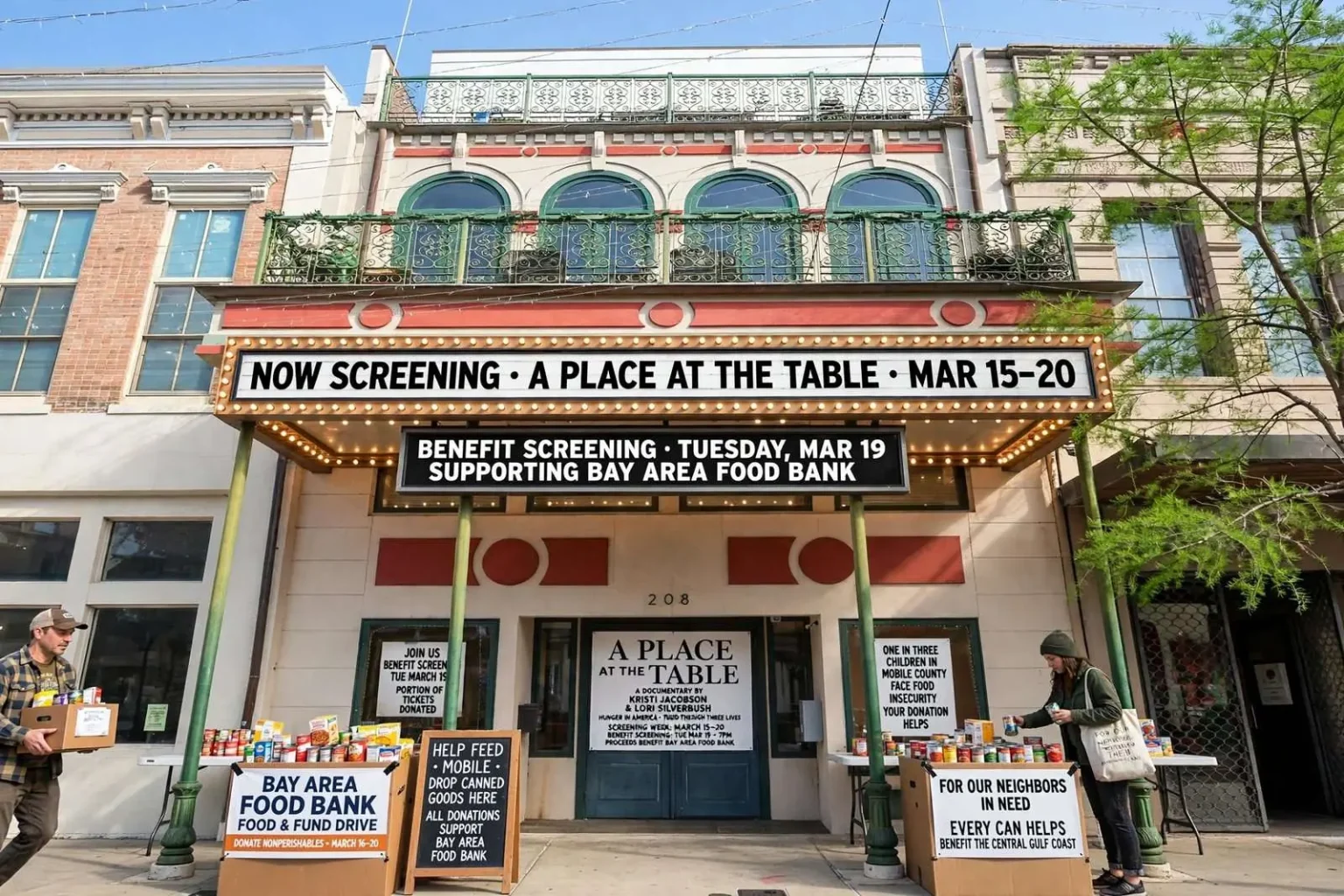
The Crescent Theater hosts the documentary A Place at the Table from March 15 through March 20, with a special benefit screening on Tuesday, March 19, that supports the Bay Area Food Bank. The run pairs a hard look at American food insecurity with a local food and fund drive collecting nonperishable donations for neighbors in need, turning a week of screenings into a working benefit for the Gulf Coast’s hungry.
The scheduling gives the documentary a full six-day run at the independent theater in downtown Mobile, an unusually long window for a single documentary title and a sign of the partnership behind the booking. Each screening carries the film’s national argument into a community where the problem it describes is measurable in local statistics, and the Tuesday benefit adds a direct funding channel to the food bank that serves the region.
A National Problem, Told Through Three Lives
Directors Kristi Jacobson and Lori Silverbush examine hunger through the stories of three Americans struggling to put food on the table: a single Philadelphia mother working to build a better life for her children, a Colorado second-grader who often relies on friends and neighbors for meals, and a Mississippi second-grader whose asthma is worsened by the empty calories her hardworking mother can afford. The three portraits, drawn from very different regions, make the same point from different angles: hunger in America is rarely about a total absence of food, and usually about the absence of nutritious food within reach.
The Philadelphia mother’s story follows the arithmetic of the working poor, where a job and a full bus of effort still leave the grocery budget short by the end of the month. The Colorado second-grader’s dependence on friends’ dinner tables shows how children absorb the shortfall, and the Mississippi student’s asthma, aggravated by cheap calories that crowd out nutrition, illustrates the medical costs of a diet built on what the budget allows rather than what the body needs.
The film weaves in perspective from experts including sociologist Janet Poppendieck, author Raj Patel and nutrition-policy leader Marion Nestle, alongside activists such as Top Chef’s Tom Colicchio and Oscar-winning actor Jeff Bridges. The expert voices place the three families inside a national system, tracing how farm policy, food pricing, school meals and assistance programs shape what lands on American tables, while the celebrity advocates carry the message to audiences who might not otherwise seek out a policy documentary.
That combination of intimate storytelling and structural analysis is the documentary’s method. The families give the audience faces and stakes; the experts explain why the shelves empty out month after month; the advocates press the case that the situation is a choice the country could make differently. Released to wide attention, the film became one of the most discussed documentaries about American hunger of its decade.
Local Hunger, Local Response
The issue hits close to home in Mobile. Roughly one in three children in Mobile County is food insecure, unsure of where the next meal will come from. That figure places the county among the harder-pressed areas of a state that has consistently ranked near the top of national food insecurity measures, and it means the film’s statistics have faces in every school classroom across the county.
During the Crescent’s Tuesday showing, the theater will donate a portion of ticket sales to the Bay Area Food Bank, and a food and fund drive runs from March 16 through March 20. The drive accepts nonperishable donations from moviegoers throughout the run, collecting shelf-stable goods that food banks prize precisely because they store well and stretch across the weeks when donations slow.
The Bay Area Food Bank, based in Theodore, distributes food through partner agencies across the central Gulf Coast, supplying pantries, shelters, churches and school programs from Mobile into the Florida Panhandle. For an organization of that scale, a week of community donations and a share of a downtown theater’s ticket sales translate into meals distributed through the network of local agencies that feed Mobile County’s food-insecure families every day.
The documentary makes the case that hunger carries real economic, social and cultural costs for the nation, but that it could be solved if the public decides, as it has before, that making healthy food available and affordable serves everyone’s interest. The argument draws on history: earlier generations decided that school lunches, food assistance and nutrition programs were worth funding, and the film presses the question of whether the current generation will renew that commitment.
The costs the film catalogs are not abstract. Hungry children learn less and miss more school; diet-related illness drives medical spending; workers who cannot count on adequate nutrition earn less and miss more days. The film’s experts argue that these costs already appear in every community’s budget and every employer’s payroll, paid quietly and constantly, while the alternative, solving hunger directly, remains politically unmade.
Why a Theater Run Matters
Documentaries about hunger face a distribution dilemma: the audiences most moved by the subject are often the ones already engaged with it. A week at a neighborhood theater reaches past that circle, mixing benefit-goers with regular movie audiences who bought a ticket for the evening and leave with the county’s statistics and a collection bin in the lobby.
The Crescent Theater itself has been part of downtown Mobile’s cultural fabric as an independent venue, the kind of single-screen house that programs films larger chains pass over. Hosting a benefit run for the food bank fits the venue’s profile, and the March 15-20 window places the screenings at the start of spring, when school meal gaps and seasonal demand stress the region’s food assistance network.
Local donations collected during the run help close the gap when other resources run short. Food banks operate on that margin: federal commodities and large donations provide the base, and community drives fill the seasonal gaps when shelves thin before the next supply arrives. A can of vegetables dropped in a theater lobby travels a short distance to a pantry shelf, and the timing of this drive, mid-March, lands in one of the leaner stretches of the food bank calendar.
The film’s three families give Mobile audiences a mirror for the county’s own numbers. One child in three in Mobile County lives with food insecurity, and behind that statistic are second-graders relying on neighbors’ dinner tables, mothers calculating calories against budget and asthma aggravated by the cheapest food available, the same patterns the documentary follows in Philadelphia, Colorado and Mississippi. The distances between those places are large; the grocery-store arithmetic is the same.
For the Bay Area Food Bank, the visibility may matter as much as the donations. Benefit screenings introduce new donors to the organization’s work, and the portion of ticket sales plus the drive’s collections arrive with an audience that has just spent an hour inside the problem. That conversion of awareness into support is the quiet business model of every hunger-relief organization, and a week of screenings at a downtown theater is one of the more direct versions of it.
The run closes on March 20, and the drive with it, but the need the film documents continues past the credits. The county’s one-in-three statistic does not expire at the end of a theater engagement, and the food bank’s shelves will be restocked by this week’s collections only to be drawn down again by the families who depend on them. The film’s central claim, that hunger ends when the public decides it should, remains the work between the screenings.
The Film’s Policy Argument
A Place at the Table arrived amid a national conversation about food policy that had been building for years. The directors spent considerable time with their three subjects, and their decision to structure the film around children was deliberate: childhood hunger carries consequences that compound across a lifetime, affecting development, health and school performance in ways researchers can measure. The film cites the correlations between food insecurity and academic outcomes, making the classroom the place where hunger’s costs become concrete.
Marion Nestle’s appearance connects the film to the nutrition-policy establishment, where her work on food marketing and industry influence made her one of the field’s most cited voices. Janet Poppendieck’s scholarship on school food and emergency food systems gives the documentary its institutional history, explaining how charity became the nation’s stopgap response and why experts argue it cannot substitute for policy. Raj Patel’s global perspective places American hunger inside the economics of the food system itself.
Tom Colicchio’s involvement brought the culinary world’s platform to the subject, and his advocacy for school food standards continued after the film’s release. Jeff Bridges, whose long association with hunger-relief organizations predates the documentary, supplied the star credibility that opened doors for the film’s publicity campaign. The mix of experts and advocates was calculated to move the film from festival acclaim into public conversation.
The documentary’s title works on two levels: a place at the table describes both the family dinner where a child’s seat is guaranteed and the policy table where decisions about food are made. The film’s argument is that ordinary Americans have been excluded from the second table, leaving the rules of food pricing and assistance to interests that profit from the status quo, and that changing those rules requires the kind of public decision the country has made before.
Food Insecurity on the Gulf Coast
Mobile County’s one-in-three statistic reflects a broader Gulf Coast pattern. The counties along the coast rank among the region’s highest for child food insecurity, driven by wages that trail the national average, seasonal employment in tourism and shipping, and rural stretches where grocery stores are scarce. The Bay Area Food Bank’s service territory spans that landscape, from urban Mobile neighborhoods to small towns across the state line in Mississippi and Florida.
The organization’s network of pantries and feeding programs operates year-round, and community drives like the Crescent’s March collection feed into that ongoing distribution. Nonperishable donations, canned proteins, grains, shelf-stable staples, stock the shelves that families reach when paychecks and benefits run out before the month does.
For Mobile audiences, the film’s week at the Crescent offered both an education and an errand: a ticket that contributes to the cause and a can or two for the lobby bin. The pairing of documentary and drive made the film’s argument actionable in the simplest way available, and the March 19 benefit screening put the theater’s own receipts behind it, a percentage of every ticket that night flowing directly to the food bank that turns donations into meals across the central Gulf Coast.