Local Government Houston County
Dothan Magnet Plant Deal Brings $1.8 Billion Investment and 700 Jobs to the Wiregrass
Niron Magnetics will build a $1.8 billion factory at Dothan's Westgate Super Site, with up to 700 jobs and production of rare-earth-free magnets expected to begin in 2029.
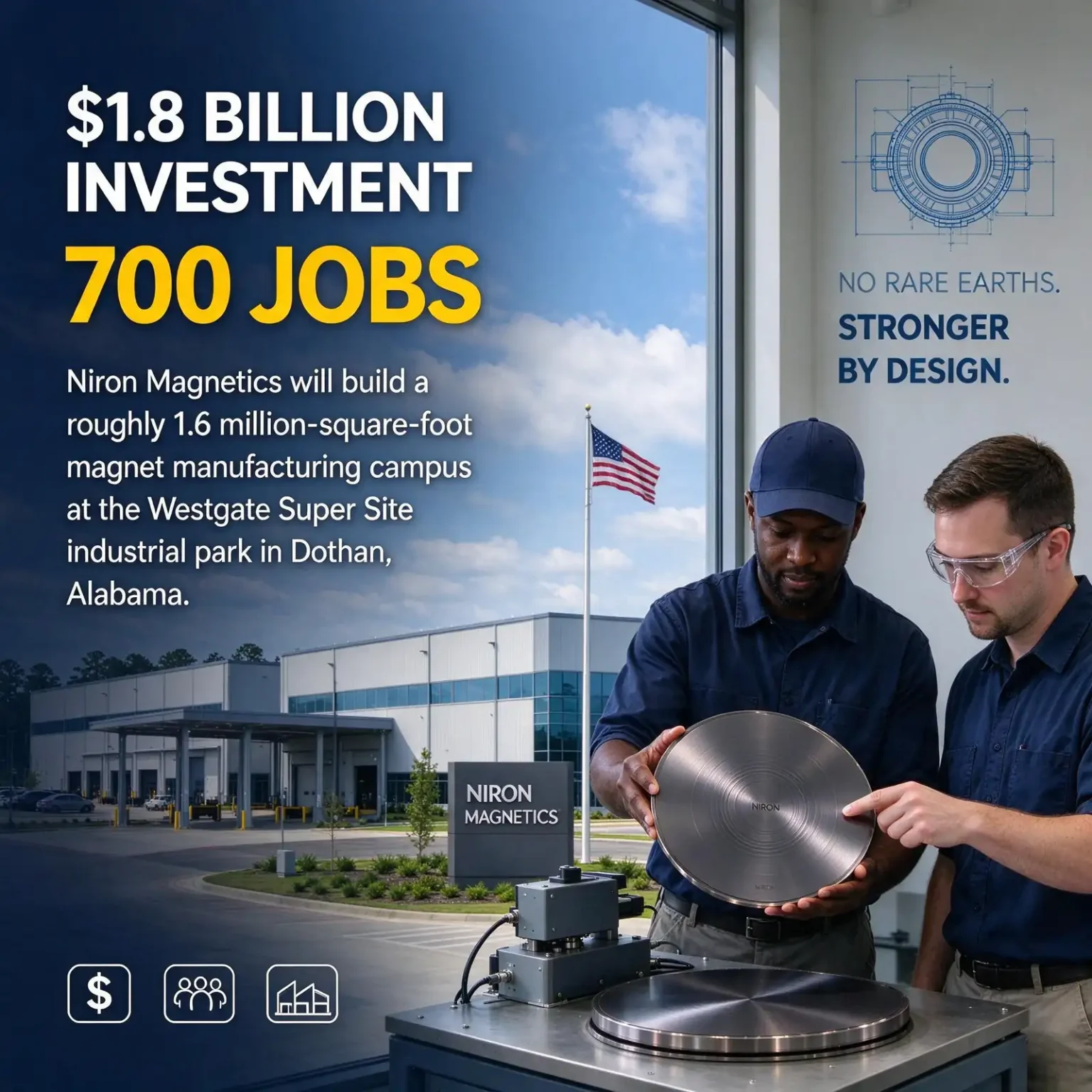
DOTHAN, Ala. — A Minnesota company that makes permanent magnets without rare earth elements has selected Houston County for a $1.8 billion factory, a decision that state and local leaders are calling a turning point for the Wiregrass. The planned Dothan magnet plant, to be built by Niron Magnetics at the Westgate Super Site industrial park, is projected to employ 700 people within five years and to turn out 10,000 tons of magnets annually once it reaches full operation.
The project was unveiled Friday, Nov. 20, at a gathering inside the Dothan Opera House, where the governor’s office, the Alabama Department of Commerce, city and county officials and company leadership shared the stage. Representatives of Alabama Power, Southeast Gas and CSX also took part in the event.
City leaders described the investment as the biggest economic development win the city has ever recorded. Company executives said Alabama won out over sites in 22 states during a search that began in April.
Key Facts at a Glance
- Company: Niron Magnetics, headquartered in Minneapolis and founded in 2013
- Investment: $1.8 billion
- Jobs: up to 700 positions, expected within five years, which state officials describe as high-paying
- Location: Westgate Super Site industrial park in Dothan, a 446-acre property served by a CSX rail line
- Size: a campus of roughly 1.6 million square feet
- Output: about 10,000 tons of magnets per year
- Timeline: construction expected to begin in 2028, with production to follow in 2029
- Site selection advisor: Savills
What It Means for Dothan and the Wiregrass
For a region whose economy has long been tied to agriculture, health care, retail and military-related employment tied to the nearby Army aviation post, a plant of this scale represents a different kind of opportunity. Seven hundred manufacturing jobs would be a significant addition to the local workforce, and officials expect the effect to spread beyond the factory gates as suppliers, contractors and service businesses respond to the new demand.
Speaking for the city, local officials told the crowd that the project would allow local families to build their futures at home while working with leading-edge technology. They said a company of this kind lifts not only the city but the surrounding region and the state as a whole, bringing fresh capital, job opportunities and added vitality to the local economy. They also argued that when a firm like Niron chooses a community, other companies pay attention, and they stressed that the magnets produced in Dothan would be made by Wiregrass workers.
The Alabama Department of Commerce said the plant would generate hundreds of quality career opportunities and give the region new momentum. The department described the decision as a milestone in the state’s push to recruit next-generation manufacturing and to shore up the domestic supply chains behind advanced manufacturing, vehicle production and national security.
The governor’s office framed the announcement as further evidence that Alabama can compete for the most transformative industries in the world, calling it a major win for the Wiregrass and for the state’s expanding manufacturing sector.
Blue Cross and Blue Shield of Alabama also voiced support for the effort. The insurer said that creating more quality jobs in rural parts of the state is one of the most reliable ways to keep rural hospitals and health care providers on solid footing, a view it noted is shared by incoming state leadership.
What Niron Magnetics Makes
Permanent magnets are the quiet workhorses of modern technology. They hold a magnetic field without needing a constant supply of electricity, which makes them essential in electric motors, generators, speakers, sensors and countless other devices. The strongest commercial magnets in use today are typically neodymium-based and depend on rare earth elements, a group of metals that are difficult and costly to mine and refine.
Niron takes a different approach. The company builds its magnets from iron nitride, a compound made from iron and nitrogen, both of which are plentiful and available domestically. Niron says it was the first company in the world to bring a high-performance permanent magnet free of rare earth elements to commercial production, and it pitches its technology as a scalable and cost-competitive substitute for conventional neodymium magnets.
The company’s products already serve customers in artificial intelligence infrastructure, the automotive sector, industrial equipment and consumer electronics. Company leadership listed a wide range of end uses for magnets that would come out of the Dothan facility, including:
- Data centers and AI computing infrastructure
- Aerospace and defense systems
- Cars and other vehicles
- Robotics and factory automation
- Audio equipment
- Thermal management systems
Niron has also said its broader materials work could lead to new products for machines that rely on motion, as the company expands its manufacturing base.
A National Supply Chain Question
Much of the significance attached to the project comes from where magnets are made today. Roughly 90 percent of the world’s production of rare-earth magnets takes place outside the United States, leaving American manufacturers dependent on foreign suppliers for a component found in everything from electric vehicles to defense hardware.
State officials and company leaders said a large domestic source of magnets that avoids rare earth materials altogether could reduce that vulnerability. They pointed to automotive manufacturing, advanced technology and defense as strategic industries likely to benefit. At the announcement, company leadership asked listeners to picture magnets built in Dothan, by Dothan residents, ending up in vehicles, sound systems, motors and defense equipment across the country.
How the Company Grows
The Dothan campus will be the second high-volume factory in Niron’s network. The company is preparing to open its first large-scale plant in Sartell, Minnesota, in 2027. That facility is designed to make up to 1,500 tons of magnets a year.
The Alabama plant would dwarf that figure. At a projected 10,000 tons per year, Dothan’s output would be more than six times the capacity planned for Sartell, signaling the role the Wiregrass site is expected to play as the company moves from early production toward mass manufacturing.
Niron leadership said Alabama treated the company’s success as its own throughout the process and stood out from the first conversation. The company thanked the state Commerce Department and local partners in Dothan and Houston County for their work during site selection, and said it is proud to make Alabama home to its high-volume magnet operation and looks forward to growing with the community.
Years of Groundwork at Westgate
The Westgate Super Site did not become a contender overnight. Assembling and preparing the 446-acre property took several years of work by the City of Dothan, Houston County, the Industrial Development Board of the City of Dothan and the Dothan Area Chamber of Commerce. Their goal was to give the Wiregrass a shovel-ready location large enough to compete for major industrial recruitment, the kind of prospect that often rules out communities lacking big, prepared tracts of land.
The state helped through both of its main industrial site development programs:
- SEEDS: In 2024, local partners received money from the Site Evaluation and Economic Development Strategy program, known as SEEDS, to help buy land and develop the property. The program is designed to help communities ready industrial land that meets the expectations of high-impact projects.
- Growing Alabama: Money from the Growing Alabama Tax Credit program followed. That program uses private investment to pay for improvements to publicly owned property and to increase the number of prepared industrial sites across the state.
Rail access was another selling point. The property sits along a CSX line and, in late 2025, earned Platinum designation under the railroad’s CSX Select Site program, a certification meant to show prospective industrial users that a site is ready for rail-served development.
The Commerce Department credited the partnership between state and local governments for the result, saying that Dothan, Houston County and their partners understood the value of investing in their own community and that their work is now paying off for the region.
Incentives Not Yet Detailed
State commerce officials referred to an incentives package during the announcement but did not disclose its value or terms. Alabama commonly offers economic development incentives such as tax abatements and job-related credits to large projects, and the specific commitments for Niron may become clearer as local agreements move forward.
What Happens Next
The project now enters a long planning phase. Under the company’s timeline, crews would break ground in 2028, and the first magnets would come off the Dothan production lines in 2029. Hiring is expected to ramp up over the following years, with the full workforce of up to 700 projected within five years.
Meanwhile, Niron’s Minnesota plant is scheduled to open in 2027, giving the company time to refine its high-volume production methods before the larger Alabama campus comes online.
For Dothan residents, the coming years are likely to bring questions about workforce training, housing and infrastructure as the region prepares for one of the largest employers it has ever recruited. Local leaders said the announcement reflects years of preparation, and they expect it to draw new attention to the Wiregrass from other companies weighing where to expand.
About Dothan
Dothan is the seat of Houston County and the largest city in the Wiregrass, a region that stretches across southeast Alabama and into neighboring parts of Georgia and Florida. The city sits near the point where the three states meet and serves as a regional hub for shopping, medical care and transportation. Long known for its peanut farming heritage, Dothan has in recent years worked to broaden its economic base, and the Westgate Super Site was developed with that aim in mind.