
Downtown Mobile Alliance Unveils New Brand at 20 Years as Strong Towns’ Marohn Calls for Starter Housing
The Downtown Mobile Alliance unveiled a new brand and website at its 20th-anniversary luncheon, where Strong Towns founder Charles Marohn urged Mobile to pair its new arena with entry-level housing near downtown.
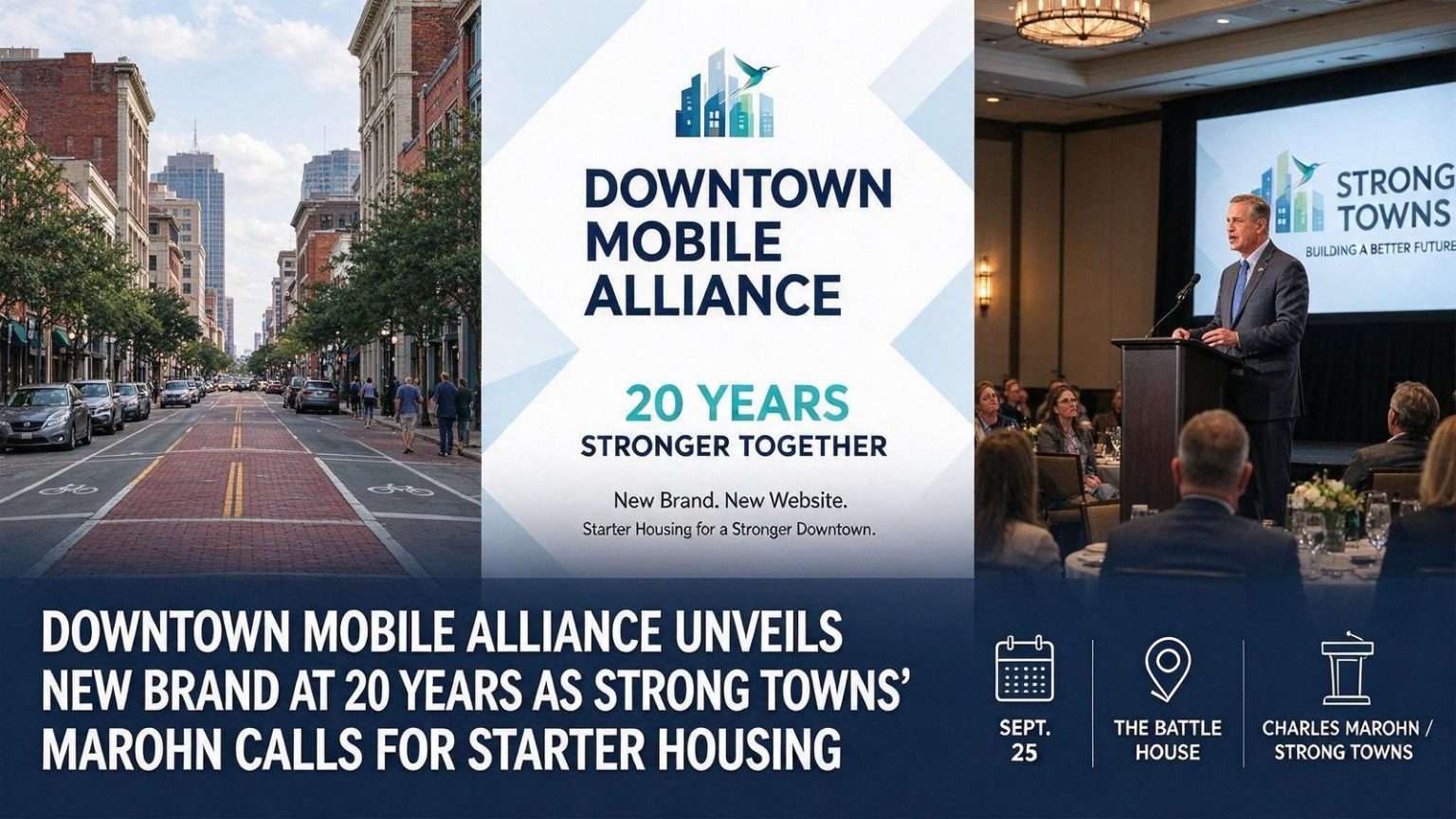
MOBILE, Ala. — The Downtown Mobile Alliance marked its 20th anniversary Thursday by unveiling a new brand and website, while its keynote speaker, Strong Towns founder Charles Marohn, told the crowd that downtown’s next chapter depends on building more housing that working people can afford.
The alliance revealed the new identity at its annual luncheon on Sept. 25 at The Battle House Renaissance Mobile Hotel & Spa, an event billed as a celebration of two decades of progress in the city’s urban core and a look at what comes next.
A New Look at 20 Years
The new brand was developed with Hummingbird Ideas, a downtown business and alliance partner. Alliance leaders said it is meant to create a more consistent experience across the organization’s events, communications and promotion of downtown.
“It’s more than a new look,” Downtown Mobile Alliance Chair-Elect Gracie Gartman said. “It’s a new way of telling the story of our downtown.”
Alongside the brand, the alliance launched a redesigned website intended to make it easier for residents, visitors, businesses and property owners to find information on downtown events, businesses and resources.
Twenty years is a meaningful interval for a downtown organization. The Downtown Mobile Alliance has operated through a recession, a pandemic, substantial private investment in the urban core and several shifts in redevelopment strategy. A rebrand at that mark is usually less about design than about restating what the organization is for, and alliance leaders said the new identity is meant to carry its work into the next 20 years.
Safety, Art, Traffic and Development
Downtown Mobile Alliance President and CEO Fred Rendfrey used the meeting to highlight the group’s recent work in four areas he described as central to its mission.
“Public safety, public art, traffic improvement and development are hallmark tactics and platforms” for the organization, Rendfrey said.
He pointed to several examples now underway:
- A police walking beat that puts officers on foot in downtown
- A safety hub for officers working downtown
- Street conversions changing downtown traffic patterns
- The Dearborn Place subdivision, a new residential development near downtown
The street conversions are part of the City of Mobile’s downtown street optimization effort, which has been converting a group of one-way streets inside the Henry Aaron Loop, including St. Anthony, St. Joseph, Warren, Dearborn, Bayou and Scott streets and part of North Jefferson Street, to two-way traffic. The roughly $4 million program also adds marked on-street parking, bike lanes and four-way stops in place of many signals, with the aim of making the central business district safer and more welcoming for people on foot, on bikes and in cars. The plan grew out of work the alliance began in 2020 with urban planner Jeff Speck.
Marohn: ‘So Much Energy’
Marohn, a civil engineer and land-use planner, is the founder and president of Strong Towns, a nonprofit that argues the standard American development pattern of wide roads, separated uses and heavy infrastructure serving low-density growth produces long-term public costs that the resulting tax base cannot cover. The organization favors incremental, mixed-use development of the kind that historically shaped downtowns, on the grounds that it generates more value per acre and needs less public infrastructure to serve.
He told the audience he has watched Mobile’s downtown change over a decade of visits.
“This is my third time speaking here and being in the downtown, and you can see over the last decade, the transformation,” Marohn said. “That transformation comes about because of focus, because of hard work and a lot of people who really care about this place.”
He said the city has “so much energy.”
The Housing Challenge
Marohn’s central message was that downtown’s long-term success will depend on whether housing keeps pace with growth, particularly as Mobile prepares for major projects such as its new downtown arena.
He said neighborhoods near downtown offer a chance to add entry-level housing, so the people who work in and patronize downtown businesses can live close by.
“In Mobile, there’s a ton of opportunities for us to build entry-level housing for people,” Marohn said. “We can build it in neighborhoods where housing is needed, we can build it at price points that people can afford, and we can do it in a way that actually makes the neighborhoods better places to live for everybody.”
Having residents nearby, he said, cuts commuting and brings more life to the area.
“If you have them living six blocks away in a nice starter house that they can afford, all of a sudden they’re the customer, they’re the employee, they’re part of the whole area,” Marohn said. “It makes everything safer, it makes everything more fun. It just makes the place work.”
That argument lines up with a core Strong Towns idea: that small-scale housing such as starter homes, duplexes and small apartment buildings, added gradually to existing neighborhoods, can make a city both more affordable and more financially resilient.
The Arena as a Catalyst
Marohn called the arena a potentially catalytic investment, but said large projects need to be paired with development that strengthens the surrounding neighborhoods.
“If you’re really committed to making it work out, it’s got to be joined with a strategy of filling in those gaps, making the area around downtown successful too,” he said.
The city’s new arena, Regions Arena, is being built on the site of the former Mobile Civic Center. The roughly $300 million project will seat up to 10,000 and is expected to open in early 2027, with the city targeting the 2027 Mardi Gras season. It will be managed by Oak View Group in partnership with Live Nation and is designed to host concerts, family shows, sporting events and conventions.
Marohn’s point is a familiar one in urban planning circles: arenas and stadiums tend to draw crowds on event nights, but the neighborhoods around them thrive only when people live, work and shop there the rest of the week.
About the Downtown Mobile Alliance
The Downtown Mobile Alliance is a nonprofit organization that works to promote and improve downtown Mobile. It manages the downtown business improvement district, supported by an assessment on downtown property owners, and focuses on cleanliness, safety, marketing, events and economic development in the city’s historic core.
Over the last two decades, downtown Mobile has seen new restaurants, residences and hotels, renovated historic buildings and a steady calendar of events. The alliance’s leaders said the new brand and website are intended to help tell that story as the organization begins its next 20 years.
Event details
- What: Downtown Mobile Alliance annual luncheon and 20th anniversary celebration
- When: Thursday, Sept. 25
- Where: The Battle House Renaissance Mobile Hotel & Spa
- Keynote: Charles Marohn, founder and president of Strong Towns
- Highlights: New brand, developed with Hummingbird Ideas, and a redesigned website