
Downtown Mobile Alliance Offers $3,000 Micro-Grants for Artists to Turn Utility Boxes Into Art
The Downtown Mobile Alliance's MOB-ilize Fund offers $3,000 micro-grants for Mobile artists to turn utility boxes into public art.
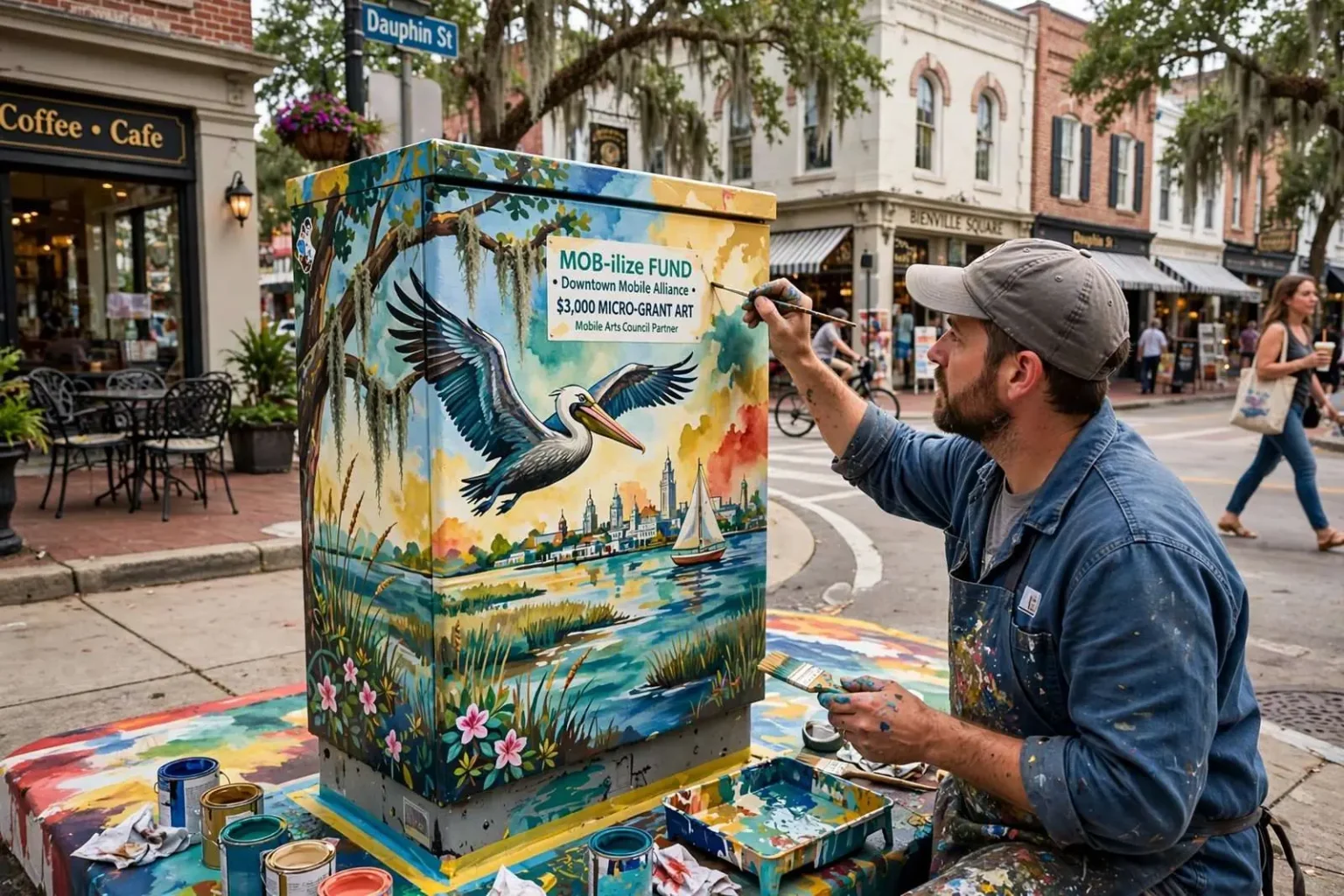
Local artists with an eye for brightening city streets have a new opportunity in downtown Mobile. The Downtown Mobile Alliance is offering micro-grants to pay artists who transform plain utility boxes into works of public art, giving painters a paid canvas on some of the most heavily traveled blocks of the central business district.
The program, known as the MOB-ilize Fund, is a placemaking grant that compensates local artists for painting the metal utility boxes scattered around downtown. Rather than leaving the gray steel cabinets to sit as blank infrastructure, the alliance’s program turns them into colorful street-level art that pedestrians encounter between storefronts, restaurants, coffee shops and offices. Each grant totals $3,000, and the alliance has opened applications to artists interested in helping enliven downtown Mobile.
Placemaking projects of this kind have become a staple of downtown revitalization strategy across the country. The idea is straightforward: small, visible investments in the public realm — murals, benches, lighting, and in this case painted utility boxes — signal that a district is cared for, encourage people to linger, and give visitors something to notice and photograph between destinations. For a downtown like Mobile’s, where historic storefronts and modern offices share the same walkable grid, even modest touches of color can change how an entire block feels.
The first completed box came from artist Harlan Schwall, who partnered with the Mobile Arts Council on the project and gave the initiative its first showcase piece. Schwall’s finished box demonstrated exactly what the alliance hopes other artists will replicate: taking a fixture that most people walk past without a second glance and turning it into something that rewards attention. The Mobile Arts Council’s involvement also underscores how the program is intended to work — as a partnership between the downtown advocacy organization and the local arts community rather than a top-down commissioning effort.
The Downtown Mobile Alliance has long served as the steward of downtown Mobile’s commercial and cultural health. Formed from the city’s downtown business association and its Main Street-style revitalization organization, the alliance manages the downtown business improvement district, coordinates events and streetscape improvements, and advocates for investment in the historic core. Its territory covers the dense grid of blocks between the waterfront and the medical district, an area bounded by landmarks residents know well: Bienville Square, Cathedral Square, Dauphin Street’s restaurant row and the galleries of the Lower Dauphin entertainment district.
That geography matters for a program like the MOB-ilize Fund. Downtown Mobile’s economy depends heavily on foot traffic generated by restaurants, nightlife, festivals and the convention trade, and the area’s walkability is one of its chief selling points. Utility boxes sit at nearly every corner in such a district — enclosures for traffic signal controls, electrical service and telecommunications equipment. In most cities they are painted a single municipal gray and ignored. Painted, they become waypoints, and a corridor of them can quietly knit several blocks into a coherent arts walk.
How the grants work and who should apply
The MOB-ilize Fund’s structure is intentionally simple. An artist applies to the alliance, and once selected, receives a $3,000 micro-grant to design and execute a painted treatment on an assigned utility box. The scale of the canvas is modest — these cabinets are roughly the size of a refrigerator — but the compensation is meaningful for working artists, covering materials, labor and design time at a level that respects the craft involved. Unlike many public art commissions that go through lengthy selection juries or require large portfolios, a micro-grant program lowers the barrier to entry for emerging painters who have never held a public commission.
For artists, the program offers more than the fee. A painted box downtown is public work with a permanent address, visible every day to thousands of commuters, students and visitors. That kind of exposure has historically functioned as a calling card in Mobile’s arts scene, where juried shows at the Mobile Arts Council’s gallery and the LoDa Artwalk tradition already give local painters regular chances to sell and exhibit. A utility box commission adds something different: work that lives outdoors, year-round, integrated into the streetscape rather than hung on a gallery wall.
Applicants should also understand the practical demands of the medium. Utility boxes are metal, and exposure means sun, salt air and rain, so a treatment intended to last needs proper surface preparation and exterior-grade paints and sealers. The Gulf Coast climate is unforgiving on outdoor finishes, with hurricane-season downpours and intense summer UV, so durability is part of the design brief, not an afterthought. Artists also work on active sidewalks, which means coordinating around pedestrian traffic on busy blocks near Bienville Square and along Dauphin and Government streets.
A Gulf Coast trend in miniature
The effort follows a broader push among Gulf Coast cities to use small-scale public art projects to add character to walkable commercial districts. Across the region, communities have discovered that modest investments in visual character — murals, sculptures, painted pianos and decorated utility cabinets — deliver outsized returns in public attention. Neighboring cities along the coast have run similar traffic-signal-box and mural programs, and the approach has been embraced by Main Street organizations throughout Alabama and the panhandle as a low-cost complement to bigger infrastructure spending.
The logic is economic as much as aesthetic. In mid-sized downtowns like Mobile’s, retail and restaurant tenants live and die by the experience of walking through the district. City leaders and downtown advocates have spent two decades arguing that the historic core competes with suburban shopping precisely on the qualities a car cannot provide: shade, texture, surprise and human scale. Painted utility boxes fit squarely in that playbook. They cost a fraction of what streetscape reconstruction costs, they are finished in days rather than months, and they photograph well — which matters in an era when a downtown’s reputation travels through visitors’ social media feeds.
There is also a maintenance argument. A painted box is easier to monitor for graffiti and grime than a drab one, because residents and business owners notice it and claim a sense of ownership over it. Cities that have run utility box art programs report that tagged panels get cleaned and repainted quickly precisely because the neighborhood is watching. In a downtown where the alliance already funds cleaning and safety ambassadors through the business improvement district, adding art to the same fixtures folds naturally into existing stewardship routines.
What it means for Mobile’s artists and residents
For Mobile’s working artists, the MOB-ilize Fund lands in a community with deep creative infrastructure. The Mobile Arts Council has operated for decades as the umbrella organization for the city’s visual and performing artists, hosting exhibitions, administering grants and connecting artists with commissions. The city’s public art profile has grown alongside it, from the sculptures installed around Bienville Square to the murals that have spread through the downtown and midtown corridors. A $3,000 micro-grant will not transform any artist’s finances, but a portfolio of downtown boxes can sustain a career’s momentum, providing visibility that outlasts any single exhibition.
For residents and visitors, the payoff is cumulative. No single painted cabinet will change anyone’s impression of downtown, but a dozen of them — each in a different artist’s hand, spread across the blocks people actually walk — adds a layer of discovery to routine trips. A lunchtime walker on Dauphin Street encounters something new on the way to the sandwich shop. A family heading to the History Museum of Mobile or the cruise terminal passes pieces that spark questions from kids about who made them and how. That everyday encounter with art, unmediated by a ticket or a gallery door, is precisely what placemaking advocates promise when they talk about activating the public realm.
The alliance’s challenge now is volume. One showcase box makes a statement; a network of them makes a program. Whether applications flood in will depend on how quickly word travels through Mobile’s close-knit arts community — and on artists seeing that Schwall’s completed box was not a one-off experiment but the first installment of an ongoing commitment to the district’s street-level character.
The program also fits the rhythm of downtown Mobile’s event calendar. The district already draws crowds for Mardi Gras parades rolling through the historic streets, First Friday ArtWalk evenings, outdoor concerts and the seasonal festivals that fill Bienville Square. Every one of those events puts thousands of people on sidewalks within steps of a utility box, and the alliance’s placemaking philosophy holds that a visitor’s experience is built from exactly those small, repeated moments of contact with the street. Art on the fixtures people lean against while they wait for a parade makes the whole investment in events feel more finished.
Artists interested in applying can find program information through the Downtown Mobile Alliance and the Mobile Arts Council, which have jointly promoted the fund’s opening. For a city that has spent years polishing its image as the Gulf Coast’s historic center of culture, the MOB-ilize Fund is a small line item with a visible payoff — $3,000 at a time, one gray steel box at a time, on the corners where downtown Mobile does its daily business.


