
Downtown Mobile Bar Owner Urges City to Shorten Open Container Hours After New Year’s Eve Shooting
A downtown Mobile bar owner wants open container hours cut to 9 p.m. after a deadly New Year's Eve shooting on Dauphin Street.
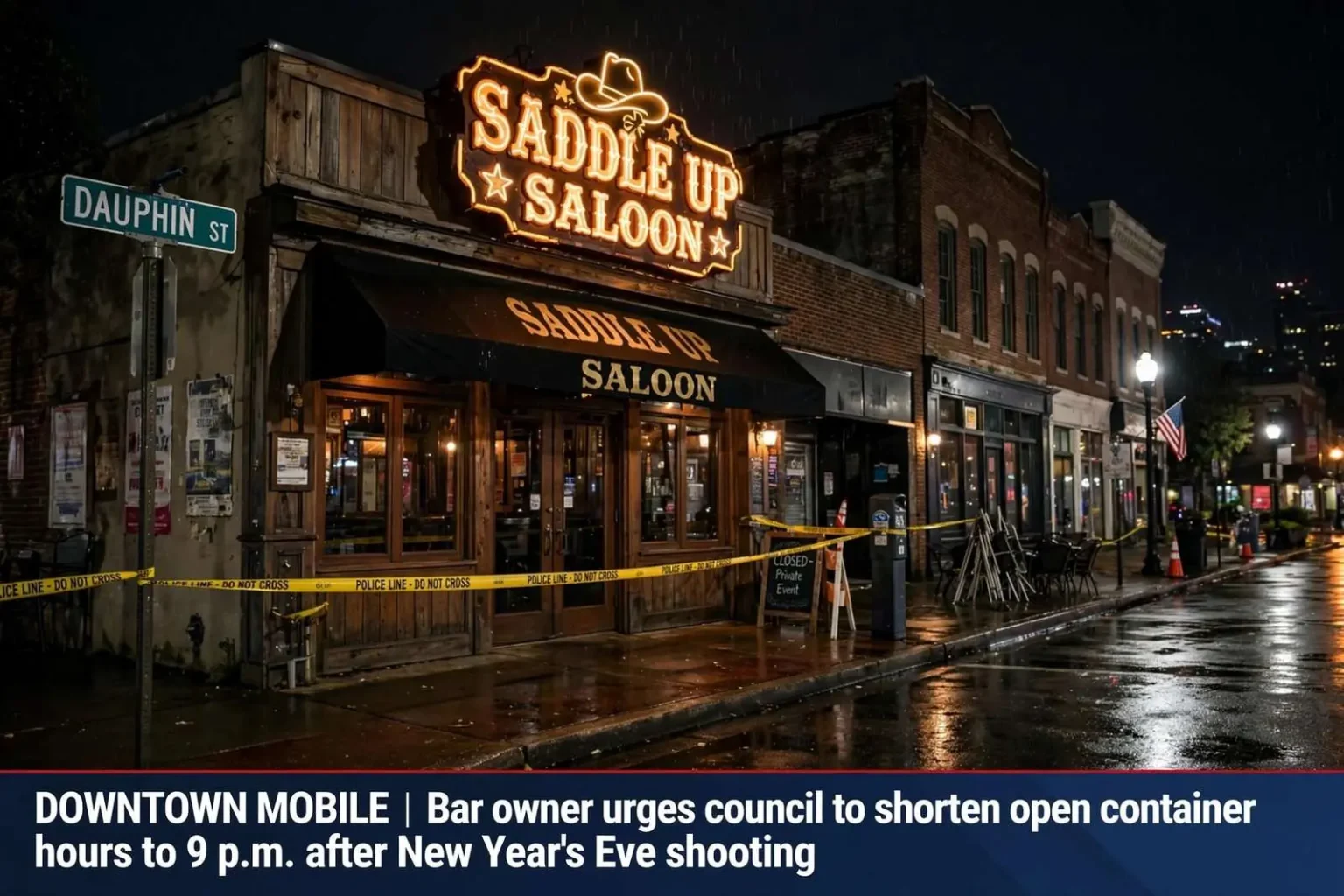
A downtown Mobile bar owner is pressing city leaders to reconsider how late people can drink on public streets, arguing the current open container rules are fueling safety problems after a deadly New Year’s Eve shooting. Greg Loughlin, who owns Saddle Up Saloon near the block where the shooting occurred, asked the Mobile City Council to consider trimming the hours of the open container ordinance from midnight back to 9 p.m.
The request puts a fresh spotlight on one of downtown Mobile’s most closely watched policy debates: how to balance the lively, walkable nightlife that has grown up around Dauphin Street with mounting concerns about crowds, congestion and violence in the entertainment district. Loughlin’s appeal came in the days after a holiday shooting that shocked residents across the city and prompted officials at every level of Mobile government to promise a response.
Owner Describes a Changed Dauphin Street
Loughlin told council members he has watched downtown change over the past nine months, describing crowds that bring their own alcohol, play their own music and form large congested groups. He argued the problem is not primarily a policing issue but one of numbers — people taking advantage of the ability to drink outdoors on the street.
In his view, the open container ordinance has effectively turned certain blocks into an outdoor party zone that businesses like his did not sign up for. Patrons who buy drinks inside a licensed bar are subject to the rules and oversight that come with a license, he suggested, while the crowds spilling along the sidewalk operate with no such structure. The result, in his telling, is a strip that grows more crowded and more chaotic as the night wears on, with the heaviest congestion arriving in the hours just before midnight.
Loughlin’s proposal to roll the cutoff back to 9 p.m. would mark a significant change. Under the current ordinance, people in the downtown entertainment district may carry open containers of alcohol on public streets until midnight, a policy that city leaders have credited with helping downtown compete with nightlife destinations across the Gulf Coast. Rolling the hour back by three hours would shrink that window considerably and, in theory, push the heaviest street drinking back inside bars earlier in the evening.
His concerns intensified after police said a man fired into a crowd on New Year’s Eve using a Glock equipped with a switch, a small device that converts a semi-automatic firearm into a fully automatic one. Police said the shooting was deadly. The use of a switch — an illegal modification under federal law — added a particularly alarming dimension to an already troubling incident, and it reinforced worries among downtown operators that the combination of large late-night crowds and armed individuals has grown too dangerous to ignore.
Loughlin is not the only business owner along the Dauphin Street corridor who has voiced frustration in recent months, but his decision to take the issue directly to the council chamber made him one of the most public faces of the debate. Saddle Up Saloon sits close to the block where the New Year’s Eve shooting occurred, placing him and his staff near the aftermath of the violence and giving his testimony a firsthand weight that council members acknowledged.
City Officials Split on the Idea
Mayor Sandy Stimpson said every proposal deserves a hearing as the city works through its response. “We’re going to consider everything,” Stimpson said, adding that people view the problem through different lenses and that each suggestion will be vetted before the city settles on an outcome.
The mayor’s posture reflected the political complexity of the question. Mobile’s downtown entertainment district has been a centerpiece of the city’s revitalization efforts for more than a decade, and any change to the rules that govern it touches bar owners, restaurateurs, residents of the growing downtown apartment stock, and the police department all at once. Stimpson’s administration has generally favored data-driven review before policy shifts, and his comments signaled that no option — including Loughlin’s — would be dismissed out of hand.
Councilmember William Carroll pushed back against rolling anything back in the entertainment district, whether hours or closing times. “It’s unfortunate that the incident happened, but we can’t allow our businesses to suffer because of the act of an individual,” Carroll said, calling the district’s flexibility a benefit that drives entertainment and supports downtown businesses.
Carroll’s position represents a view held by a meaningful segment of the council and the business community: that the open container rules are an economic development tool, not a nuisance. Supporters of the current framework argue that the ability to stroll Dauphin Street with a drink in hand is part of what distinguishes Mobile’s downtown from districts where nightlife is confined behind bar doors. Rolling back the hours, they fear, would thin out the crowds that keep restaurants and venues viable, precisely at a moment when the city wants continued investment in the city center.
The split between Loughlin’s camp and defenders of the current rules mirrors debates playing out in entertainment districts across the Southeast, from New Orleans to Nashville, where the rapid growth of late-night crowds has forced cities to reexamine everything from parking to alcohol policies. In Mobile’s case, the conversation now carries the added urgency of a fatal shooting that occurred in the middle of the very hours the ordinance covers.
Public Safety Director Lawrence Battiste said officials would go back to the drawing board and assemble what he called an aggressive plan, noting complaints that conditions downtown have worsened and that traffic flow needs attention. Battiste, a former Mobile police chief who now oversees the city’s public safety strategy, has been a familiar presence in the downtown debate, and his pledge to assemble a comprehensive response suggested the administration’s answer would extend beyond any single change to the alcohol ordinance.
Whether that plan includes adjusted hours, stepped-up enforcement, traffic modifications or new technology remains to be seen. What Battiste’s comments made clear is that the Police Department and the mayor’s office view the situation downtown as serious enough to warrant a coordinated strategy rather than a piecemeal reaction to a single incident.
Next Steps for the District
A separate conversation was already on the calendar: several bar owners and managers planned to meet with the Downtown Mobile Alliance and Police Chief Paul Prine to talk through safety issues. That meeting offered a second track for the debate — one bringing the businesses most affected by the rules directly together with the department responsible for policing the streets they occupy.
The Downtown Mobile Alliance, the nonprofit organization that manages the city’s downtown business improvement district, has long played a convening role in discussions about the corridor’s health, from cleanliness and marketing to public safety. Its involvement in the upcoming talks underscores that the city views the response as a partnership effort rather than a mandate handed down from Government Plaza.
The debate also touches on the broader question of how Mobile polices its largest special events and heaviest nightlife weekends. The city draws enormous crowds downtown during Mardi Gras season, when parades roll through streets only blocks from the entertainment district, and officials have spent years refining how they manage those masses of people. Lessons from that experience — barricading, staffing levels, coordination with other agencies — are likely to inform whatever aggressive plan Battiste’s office assembles, along with any recommendations that come out of the bar owners’ meeting with Chief Prine and the Alliance.
Under state law, devices like the one used in the New Year’s Eve shooting are already prohibited, but their increasing availability has troubled law enforcement across the region. Officers in Mobile and surrounding jurisdictions have repeatedly warned about the difficulty of detecting the small modifications during routine encounters, and their spread has become a recurring theme in discussions about gun violence along the Gulf Coast.
For Loughlin, the meetings represent a chance to press his case with the people who will ultimately shape whatever changes come. He has framed his request not as an attack on downtown nightlife itself but as an attempt to rescue it from the behavior of a minority of street drinkers who, in his view, are driving away the customers that legitimate businesses depend on. Whether a majority of the council ultimately agrees that trimming the open container hours is the right lever remains the central question of a debate that now seems likely to extend well into the new year.
In the meantime, downtown Mobile continues to operate under the rules that were in place on New Year’s Eve, with police maintaining their usual presence along Dauphin Street on weekend nights and business owners watching for signals from Government Plaza. The council has not announced a timeline for a decision on the ordinance, and any formal change would require action in a public meeting, giving residents and business owners further opportunities to weigh in before the city settles on its approach.


