
Downtown Mobile Church Hosts Fundraiser for Family Fighting for Adoption Rights
Open Table UCC hosts a Jan. 3 fundraiser for Cari Searcy and Kimberly McKeand, the Mobile couple fighting for adoption and marriage rights.
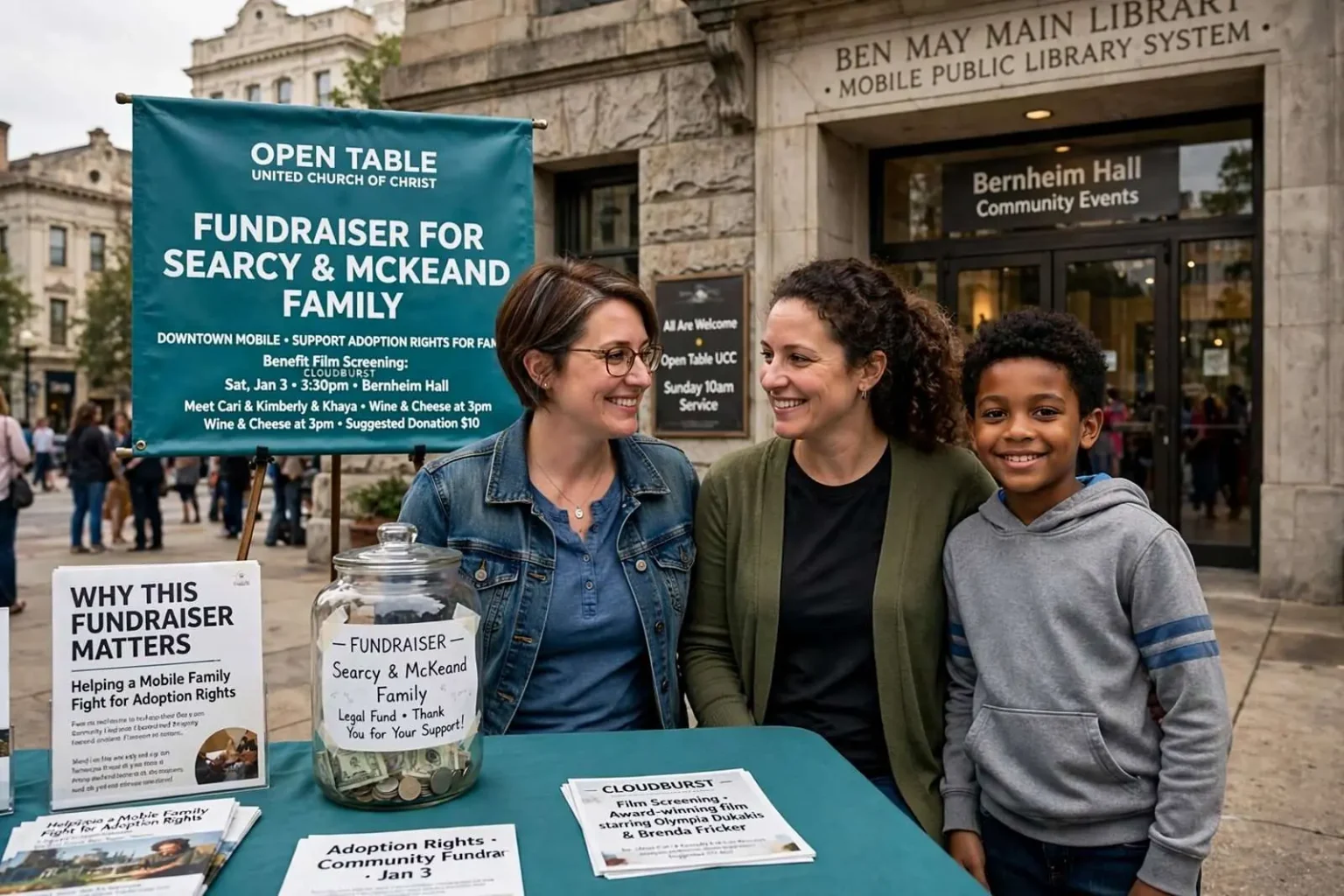
A downtown Mobile church is raising money for a local couple whose fight for parental rights has become a test case in Alabama’s ongoing same-sex marriage battles. Cari Searcy and Kimberly McKeand, who married in California in 2008, are challenging Alabama’s marriage laws in federal court. Searcy is seeking the right to adopt McKeand’s biological son, Khaya. Alabama does not recognize the couple’s marriage or Searcy’s claim as a legal parent.
At the center of the case is a family situation familiar to parents everywhere: a couple raising a child together, and a legal system that recognizes only one of them. The couple married in California during the brief 2008 window when same-sex marriage was legal there, returned to Mobile, and built their family life in the city. But when Searcy sought to adopt Khaya and be recognized as the boy’s second legal parent, Alabama law stood in the way, because the state neither recognizes their California marriage nor extends adoption rights on the basis of it.
The practical stakes are concrete. Legal adoption determines who can make medical decisions for a child, who can enroll a child in school, who retains custody if something happens to the biological parent, and who is entitled to inherit. For families like Searcy’s and McKeand’s, the gap between their daily reality and their legal status leaves one parent without any formal relationship to the child they are raising.
A Case Headed Through the Federal Courts
A decision from the federal Circuit Court is expected soon. Whatever the outcome, the losing side is expected to appeal to the 11th Circuit Court of Appeals in Atlanta and ultimately to the U.S. Supreme Court.
The case arrives at a moment when the national legal landscape around same-sex marriage is shifting rapidly. Since the U.S. Supreme Court struck down the federal Defense of Marriage Act in 2013, federal courts across the country have repeatedly ruled against state bans on same-sex marriage recognition, producing a patchwork of rulings that legal observers widely expect the Supreme Court to eventually resolve. Alabama’s own constitutional amendment defining marriage as between a man and a woman, adopted by voters in 2006, now stands directly in the path of that judicial trend, and Mobile’s federal court has become one of the arenas where the question will be tested.
The couple’s legal fight has drawn attention well beyond Mobile precisely because it frames the issue through parenthood rather than marriage alone. Even among Americans still divided on the question of marriage, second-parent adoption — the mechanism that lets a non-biological parent establish legal ties to a child — is viewed by family law practitioners as a distinct matter, one that courts in many states have handled apart from the marriage debate. Alabama’s refusal to recognize the couple’s marriage forecloses the usual route to that recognition, which is what sends the adoption question into federal court alongside the marriage question itself.
A Church Steps Up
Open Table United Church of Christ is hosting a fundraiser for the family on Saturday, Jan. 3, at Bernheim Hall in the Ben May branch of the Mobile Public Library downtown. The event will screen “Cloudburst,” an award-winning film from writer and director Thom Fitzgerald starring Olympia Dukakis and Brenda Fricker. The movie starts at 3:30 p.m., but attendees are invited to arrive at 3 p.m. for wine, cheese and a chance to meet Searcy and McKeand. A suggested donation of $10 per person is requested. Those unable to attend can contribute through the couple’s website.
The choice of host congregation is fitting. The United Church of Christ has been among the most openly supportive mainline denominations on questions of marriage equality, and congregations in the denomination have performed same-sex weddings and welcomed same-sex couples into full membership for years. Open Table, as its name suggests, has built its identity around radical welcome, and members of the congregation have been involved in supporting the couple as their case moved through the courts.
Bernheim Hall adds a sense of occasion to the event. The hall sits within the Ben May Main Library, the flagship branch of the Mobile Public Library system in the heart of downtown, and its historic meeting space has long hosted civic gatherings, lectures, and community cultural events. For an afternoon built around a film and a conversation with the family at the center of a landmark case, the venue offers both the seating capacity and the gravitas the occasion calls for.
The Film on the Screen
“Cloudburst” makes an apt centerpiece for the afternoon. The film, written and directed by Canadian filmmaker Thom Fitzgerald, stars Olympia Dukakis and Brenda Fricker as a longtime couple whose relationship is tested when one of them is injured and the two are separated by family interference — a story about aging, love, and the legal and social forces that can pull committed partners apart. Dukakis, the veteran stage and screen actress best known to wide audiences for her Academy Award-winning role in “Moonstruck,” earned acclaim for her performance in the film’s lead role, and the movie has collected audience awards on the festival circuit for its mix of road-movie energy and plainspoken emotional honesty.
Organizers have framed the film as more than entertainment: it is a story that mirrors, in fictional form, the same underlying questions the couple’s case presents — what happens to a family when the law declines to see it. Attending the screening gives Mobile audiences a way to engage with those questions through narrative before meeting the family living them out in the local courts.
Why the Fundraiser Matters
Federal litigation is expensive, and cases that travel through the district courts toward a circuit court and potentially the Supreme Court accumulate costs over months and years. Fundraisers like Saturday’s event are how families without national organizational backing sustain a legal fight — through community donations, film screenings, benefit dinners, and the slow accumulation of small contributions. The $10 suggested donation reflects the grassroots nature of the effort: the goal is broad participation, not a small circle of large donors.
For those who cannot attend in person, contributing through the couple’s website offers the same support from a distance. Organizers note that even small donations help cover the ongoing costs of the case, and that awareness matters as much as money, since public attention shapes the environment in which courts, legislators, and voters weigh the underlying questions.
A Community Watching the Courts
The timing of the fundraiser is deliberate. With a decision expected soon from the federal court, the Mobile community is watching to see whether Searcy will be able to adopt Khaya and whether the state’s marriage laws will withstand the constitutional challenge. Should the case move upward on appeal, the couple’s names would join the list of plaintiffs whose family circumstances have become the vehicle for landmark rulings — a role no family seeks, but one that carries real consequence for thousands of households across Alabama and the broader Southeast.
Mobile’s role in that history is already established. The city’s federal courthouse has been the site of some of the nation’s most consequential civil rights litigation across the past half-century, and the marriage cases now moving through the same building connect the present debate to that long local tradition of courtroom tests over equality. Whatever the outcome of the current case, the proceedings themselves become part of the historical record.
Saturday’s event offers residents a direct, personal way to be part of that moment — to meet the family behind the case captions, see a film that speaks to their situation, and support a legal fight that will likely be decided in courtrooms far from the Bernheim Hall where the community is gathering to stand behind them.
The Human Side of the Case Files
What distinguishes the Searcy-McKeand case from the abstract legal debate is its specificity. There is a child involved, a household in Mobile, and a parent who cannot sign the school form or authorize the surgery. Family law attorneys point out that these gaps affect thousands of Alabama households in similar configurations, and that most families never make it to federal court because the process is too costly or too daunting. A ruling in this case would not merely resolve one family’s status; it would clarify the ground on which every comparable Alabama family stands.
That broader significance is part of why the community response has grown as the case has progressed. Church groups, advocacy organizations, and individual supporters across the region have followed the filings, attended hearings, and contributed to the fundraising effort. Supporters describe the case as a chance for Alabama courts to see the family, not just the legal abstractions — a goal the fundraiser’s meet-and-greet format serves directly, putting faces and conversation ahead of case captions.
Mobile’s Broader Moment
The case also lands in a city navigating its own evolving relationship with these questions. Mobile’s Mardi Gras traditions, its churches, and its civic institutions are old and deeply rooted, and the past several years have seen conversations about inclusion move through those institutions at varying speeds. Congregations like Open Table represent one strand of that evolution, and their willingness to host events like Saturday’s screening signals how local institutions are engaging with issues once considered settled by silence.
The afternoon’s structure — wine and cheese at 3 p.m., the film at 3:30, the couple on hand throughout — is designed to be welcoming rather than political, an afternoon at the library rather than a rally. Organizers hope attendees will come away with two things: a better understanding of the family’s situation, and a concrete way to help as the case approaches its next legal milestone.
With a ruling expected soon and appeals likely to follow regardless of the outcome, the coming months will determine how long the family’s legal limbo lasts. In the meantime, the community gathering at Bernheim Hall on Jan. 3 represents the part of the story that happens outside the courtroom — neighbors showing up, a congregation opening its doors, and a city watching a case that could reshape how Alabama recognizes the families living within it.


