
Downtown Mobile Fundraiser Backs Nonprofit Helping Homeless Residents
Old Majestic in downtown Mobile held a silent auction benefiting Haywood's Hope, a nonprofit providing resources to homeless residents.
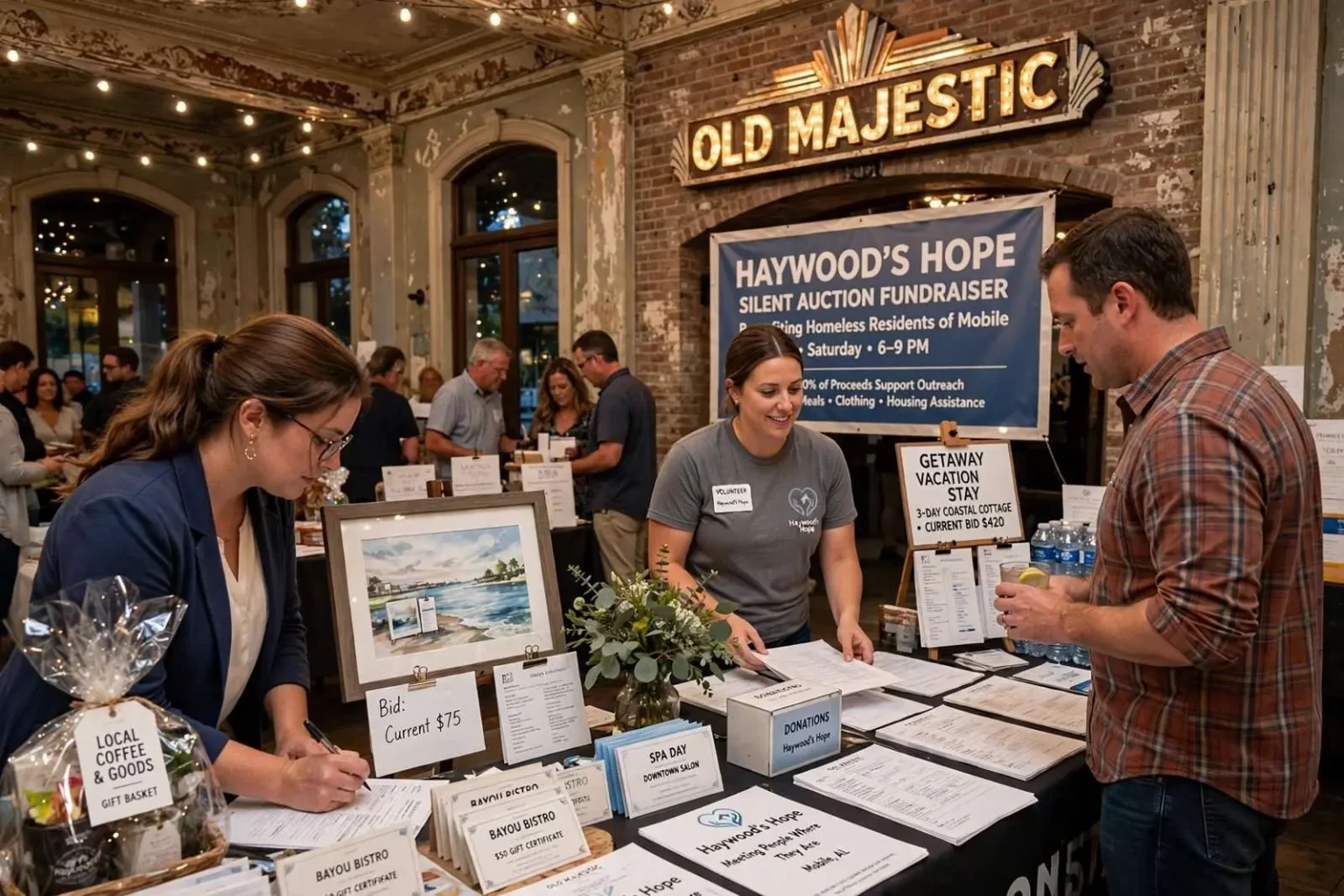
MOBILE, Ala. — A downtown Mobile venue turned a Saturday evening into support for the city’s most vulnerable residents. Old Majestic hosted a silent auction fundraiser benefiting Haywood’s Hope, a nonprofit created by a local couple to connect people in dire need with resources — an effort that has taken on added urgency during the COVID-19 pandemic. The gathering drew supporters from across the city for a night of bidding that doubled as an introduction to a growing charitable effort on Mobile’s streets.
The event ran from 6 to 9 p.m., with attendees bidding on a range of donated items, tickets, and even a vacation stay. Guests circulated among tables of auction items while volunteers managed bid sheets and answered questions about the organization’s work. Proceeds from the auction go toward the organization’s work providing assistance to homeless individuals across the Mobile area. For a nonprofit that operates largely on donations and volunteer labor, a single successful evening can fund months of outreach — meals, clothing, hygiene items and the transportation and paperwork that help people move from the street toward shelter and services.
A nonprofit born from a couple’s calling
Haywood’s Hope was created by a local couple who saw people in crisis and decided to act. Rather than building a large institution, the organization was designed to work person by person — meeting individuals where they are, learning what they need most urgently, and connecting them with the resources that can change their circumstances. That model of direct, relationship-based outreach has become increasingly common among small Gulf Coast nonprofits, which often fill gaps that larger agencies cannot reach: a bus ticket to a family member’s home, a replacement identification card, a bed at the right moment, a follow-up visit after an emergency room stay.
Organizers behind Haywood’s Hope have emphasized meeting basic needs for people living on the streets, particularly as the pandemic strained shelters and services across the Gulf Coast. COVID-19 upended the traditional safety net in ways that outreach workers felt immediately. Shelters reduced capacity to allow for social distancing, leaving fewer beds at the very moment that job losses and economic disruption pushed more people toward homelessness.soup kitchens and meal programs adapted to grab-and-go formats, and outreach teams found that the usual path from street to shelter to permanent housing slowed to a crawl. For organizations like Haywood’s Hope, the pandemic did not create the problem — it magnified it.
Mobile’s homeless population is spread across the city in ways that are easy for the housed to miss: camps tucked along drainage easements and wooded lots, people sleeping in cars, families doubling up in motels. Reaching them requires persistence and trust, which is why the couple at the center of Haywood’s Hope built the organization around showing up consistently rather than waiting at an office for people to come in. Each connection made — a warm meal, a tent, a conversation about available services — represents the first step in what outreach workers describe as a long climb back to stability.
The venue and the evening
Old Majestic, the downtown venue that hosted the fundraiser, occupies a building whose name recalls Mobile’s theatrical past, and its event space has become a favorite for benefit gatherings in the heart of the city. Hosting a fundraiser in a venue like this does more than provide tables and chairs — it signals that the cause belongs in the civic mainstream of downtown Mobile, where professionals, artists and neighborhood leaders mingle at charity events throughout the year. The three-hour format is a familiar one: guests arrive, bid, socialize, and hear brief remarks that connect the evening’s fun to the organization’s mission.
Silent auctions work because they enlist the community’s own resources for the cause. The items on offer — donated by local businesses, artists and supporters — ranged from gift certificates and event tickets to the headline vacation stay, giving bidders options at every price point. Every dollar raised above the value of the item goes straight to the mission, and donors get the satisfaction of supporting both a local charity and the businesses that contributed the goods. For small nonprofits, such events also serve as marketing: many of the guests bidding Saturday night were likely learning about Haywood’s Hope for the first time, and a portion of them will become recurring donors or volunteers.
The fundraiser gave the nonprofit both financial backing and visibility among downtown patrons. That visibility matters beyond the money. When people experiencing homelessness know that a named, trusted organization is looking for them, the connection comes faster; when donors understand exactly how their contributions are used, they give again. Organizers have said that word of mouth generated at events like this often leads to tips about people in need, offers of goods and services, and volunteers willing to ride along on outreach.
Homelessness on the Gulf Coast and how neighbors can help
The problems Haywood’s Hope addresses are not unique to Mobile. Across the Gulf Coast, communities have wrestled with rising housing costs, limited shelter capacity and the lingering economic effects of the pandemic. Advocates in the region emphasize that homelessness is rarely a single-cause problem — it typically arrives through some combination of job loss, medical bills, family breakdown, mental illness, addiction or a lease that simply cannot be renewed. Effective outreach therefore looks less like a handout and more like case management: identifying the immediate barrier, solving it, and then working on the deeper issues one at a time.
Local experts generally advise residents who want to help to support organizations doing the work rather than improvising individual aid. Cash given at an intersection may meet a moment’s need, but structured donations to groups like Haywood’s Hope fund the steady, patient work of connection — the shelter beds, identification documents, treatment referrals and transportation that actually change trajectories. Volunteering is equally valuable, whether preparing meals, sorting clothing donations, or helping with the administrative work that keeps a small nonprofit running.
As the evening at Old Majestic wound down and the winning bids were tallied, the organization came away with more than a check. It left with a room full of new advocates, a stronger reputation in the downtown community it serves, and momentum for the work ahead. For the people Haywood’s Hope reaches on Mobile’s streets, that momentum is the difference between another night alone and the first real step toward a roof, a bed and a plan.
Pandemic pressures on shelters and services
The timing of the fundraiser — during the COVID-19 pandemic — shaped both the event and the need behind it. Across Mobile and Baldwin counties, service providers spent the pandemic navigating a moving set of restrictions: occupancy limits that cut shelter beds, quarantine requirements that complicated intake, and heightened risks for a population whose health is often already fragile. Organizations that once relied on congregant meal services had to pivot to packaged food, and drop-in centers that offered showers, laundry and case management had to limit access or close entirely for periods of time. Each adaptation cost money, and each gap left people with fewer places to turn.
At the same time, the economic shock of the pandemic pushed new faces into the outreach system. Workers in hospitality, food service and retail — sectors that anchor the Gulf Coast economy — faced layoffs and reduced hours, and for households living paycheck to paycheck, a single missed rent cycle could start a cascade toward eviction. Emergency rental assistance programs eventually offered relief, but the paperwork and processing times left many families in limbo, staying in cars or with relatives while applications moved. Outreach groups report that people who had never before needed help found themselves calling for the first time, unsure of how the system worked.
Fundraising events also had to adapt during this period. Organizations that depended on galas and benefit dinners saw them canceled or scaled down, and many nonprofits shifted to auctions, outdoor gatherings and online bidding to keep revenue flowing. The Saturday event at Old Majestic reflected that adjustment — an in-person gathering, staged carefully, that preserved the social energy of a benefit while respecting the caution the era demanded. Attendees, many of whom had spent more than a year away from crowded rooms, responded with the kind of generosity that a cause like this tends to draw out.
What comes next for the organization
For Haywood’s Hope, the work after the auction is much the same as the work before it, only better resourced. The organization’s routine consists of the unglamorous essentials: loading supplies, driving routes through the city, checking on people known by name, and following up on promises made during previous visits. Outreach workers describe building trust as the central task — people living on the street have often been disappointed by institutions and are slow to accept help from strangers. Consistency is what changes that, and consistency is what donations fund.
The broader community has a stake in that success as well. Cities that make progress on homelessness do so through a network of shelters, nonprofits, churches, health providers and government programs working in coordination, and every organization in that network plays a role. Small, nimble groups like Haywood’s Hope often serve as the connective tissue — finding the people that larger systems miss and walking them to the door of the service that fits. The Saturday night at Old Majestic added resources and visibility to that effort, and demonstrated once again how Mobile’s downtown community rallies when a neighbor asks for help on behalf of those with no address at all.


