Downtown Mobile Restaurants Feed Officers Working Long Mardi Gras Hours
Operation Feed the Cops brings downtown Mobile restaurants together to feed officers working 20-hour shifts during Mardi Gras.
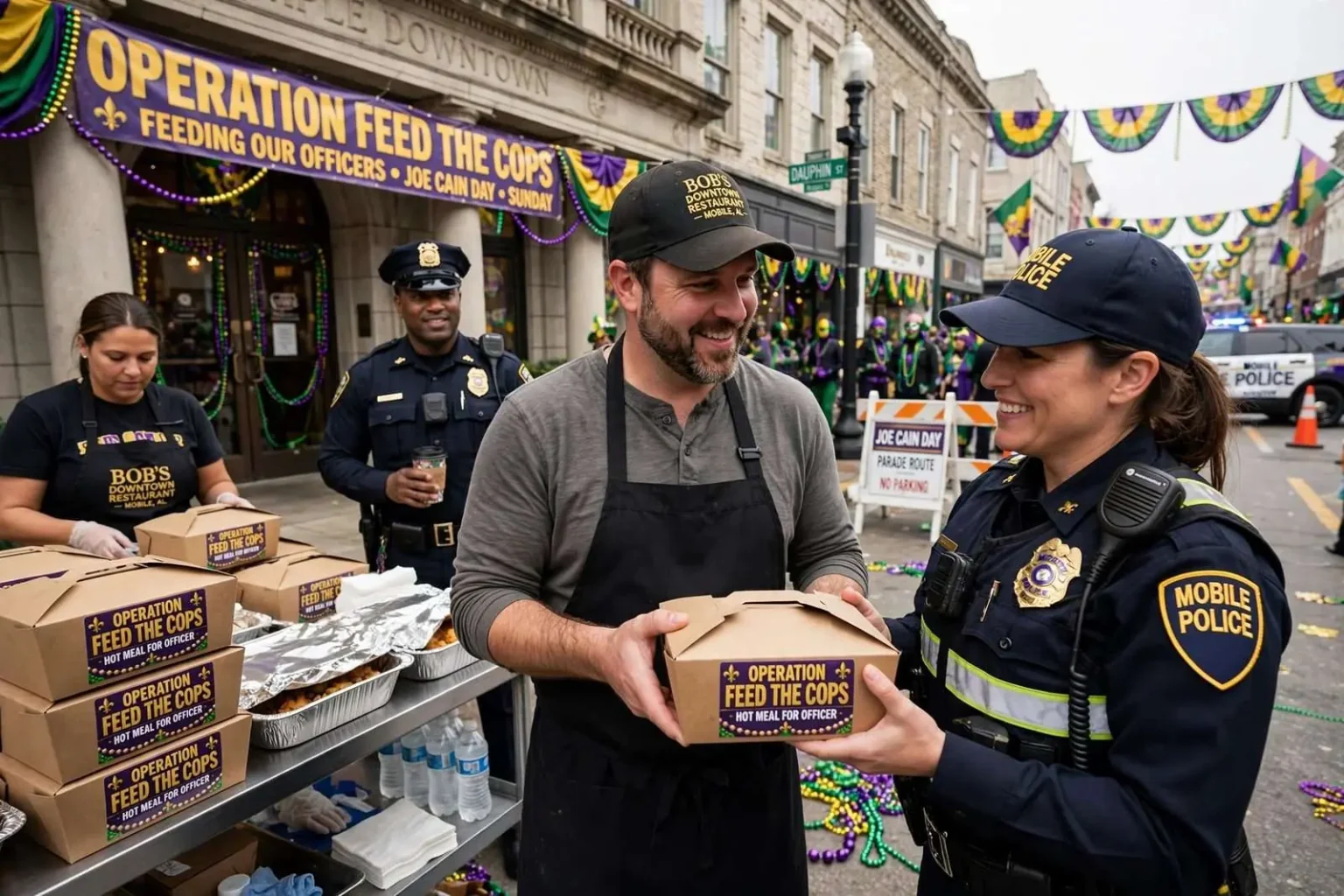
While Carnival crowds fill downtown Mobile’s streets, a group of restaurant owners is making sure the police officers keeping those streets safe don’t go hungry. The effort, known as “Operation Feed the Cops,” delivers meals to Mobile police officers throughout Joe Cain Day — one of the busiest stretches of the Mardi Gras season. On Fat Tuesday, officers will get to meet the organizers and pick up their meals inside the temple downtown.
Joe Cain Day falls on the Sunday before Ash Wednesday, and it has become one of the most unpredictable and crowded days of Mobile’s Carnival calendar. The day honors Joseph Stillwell Cain, the Mobile man widely credited with reviving Mardi Gras celebrations after the Civil War, and it draws its signature procession through downtown streets that are already packed with visitors and families. For the officers assigned to the corridor of parades, barricades, and blocked intersections, the day means hours on foot directing traffic, separating crowds from floats, and responding to calls in a downtown transformed by tens of thousands of celebrants.
Feeding that many officers is no small logistical task, and it is exactly the gap the restaurant owners behind Operation Feed the Cops set out to fill. Instead of leaving officers to grab whatever food they can find between assignments, participating kitchens prepare and deliver meals directly to the men and women working the route. The result is a steady pipeline of hot food moving from downtown dining rooms to the officers standing at intersections and along parade lines.
A Program Born From a Simple Observation
The program started just last year, and it has grown from a simple observation: during Mardi Gras, Mobile officers spend long days on their feet with little chance for a real break. Carnival season in Mobile stretches for weeks, with parade schedules that intensify as Fat Tuesday approaches, and the final days demand near-continuous coverage from the police department. Officers who might normally rotate through conventional shifts find themselves working extended hours in cold, rain, or wind, often without a proper meal until their day ends.
That reality is familiar to anyone who has watched the parade routes from a restaurant window. Downtown establishments sit in the middle of the action, close enough to see the pace at which officers move from one responsibility to the next. The owners who launched the effort saw that pace up close, and they decided their kitchens could do something about it.
Tony Sawyer, owner of Bob’s Downtown Restaurant and one of the participating business owners, said feeding officers through the grind of Carnival season is about more than a meal.
“It’s important to us that we give back to our community, that we give back to the men and women of Mobile during Mardi Gras when they’re working 18, 20 hours a day with very little rest, seven days a week,” Sawyer said. “We just got to make sure that they get fed.”
Sawyer said supporting the people who keep the city’s streets safe, day in and day out, is part of what keeps the community strong. His restaurant sits in the heart of the downtown dining district, blocks from the parade routes, and it is the kind of business whose busiest weeks of the year are the very weeks when the police presence is heaviest. Owners like Sawyer see both sides of the Carnival economy: the crowds that fill their dining rooms and the officers who make it possible for those crowds to celebrate safely.
Why the Effort Matters During Carnival Season
Mobile’s Mardi Gras is the oldest organized Carnival celebration in the United States, with roots reaching back to the city’s colonial era, and it has grown into a season that dominates life in the city from late winter through early spring. Mystic societies stage parades and balls across multiple weeks, and the density of events ramps up sharply in the final stretch. Joe Cain Day and Fat Tuesday anchor that final stretch, drawing the largest crowds of the season into the narrow downtown grid of streets that predates the automobile.
Policing that environment requires a different posture than a normal week. The Mobile Police Department assigns officers to parade intersections, staging areas, and crowd lines, and it supplements its regular patrol coverage with the specialized traffic and crowd management the season demands. An officer’s “shift” during the final days of Carnival can blur into a single long stretch of duty, with rest breaks measured in minutes. Restaurant meals delivered to the route mean an officer can eat without leaving an post unattended for long or spending a rare pause searching for an open kitchen.
The schedule matters for families, too. Officers working 18 or 20 hours a day, seven days a week, through the season’s climax have little time to prepare meals at home, and the meals that reach them on the route are often the most reliable food they get during the longest days. That practical support is what the organizers say drove them to act in the first place.
How the Meal Deliveries Work
Throughout Joe Cain Day, participating restaurants coordinate deliveries so that food reaches officers at intervals across the day rather than in a single handoff. The approach spreads the effort across multiple kitchens, allowing each participating business to contribute what it does best, from sandwiches that hold up outdoors to full plates prepared in volume. Officers on the route receive the meals where they stand, which keeps the disruption to their assignments to a minimum.
The Fat Tuesday arrangement gives the effort a closing chapter. Rather than simply delivering food one last time, the organizers invite officers to come inside the temple downtown to meet the people behind the program and collect their meals in person. It is a small change in logistics with a noticeable effect: the exchange becomes a moment of face-to-face thanks between the business community and the department, rather than a handoff through intermediaries.
Meeting the organizers also lets officers connect names and faces to the food they have been receiving, something organizers say helps reinforce that the gesture comes from neighbors and business owners rather than from an anonymous charity drive.
The Restaurants Behind the Program
Downtown Mobile’s restaurant scene has grown steadily over the past two decades, with establishments clustered within walking distance of Bienville Square, Dauphin Street, and the parade routes. Bob’s Downtown Restaurant, where Sawyer works as owner, is among the longtime fixtures that serve the downtown lunch crowd during the week and the surge of Carnival visitors on weekends. Businesses like these absorb the pressure of the season — longer hours, larger crowds, heavier demand — and their owners have a direct stake in how smoothly the streets run.
That shared stake is part of what makes the collaboration work. Each owner who joins the effort contributes food and labor during what is already the busiest stretch of their own calendar, which organizers describe as a deliberate choice rather than a convenience. The message that sends to the department is that the support comes from people who are working just as hard during Mardi Gras as the officers they are feeding.
For the second-year program, maintaining momentum mattered as much as launching it. First-year efforts often run on enthusiasm alone; surviving into a second year requires the organizers to plan around their own peak season, coordinate schedules, and commit kitchens and staff before the parades begin. The growth from a simple observation into a repeatable annual effort suggests the organizers found a formula that works on both sides of the exchange.
What It Means for the Community
Support gestures like this one play a role beyond the immediate benefit of a hot meal. Large public events depend on a functioning relationship between the people attending and the people policing, and small acts of recognition are one of the ways that relationship is maintained. When officers working a 20-hour day see that local business owners noticed their effort and responded, the interaction shifts from an enforcement presence to a shared civic project.
The program also highlights how downtown Mobile’s identity as an entertainment district depends on cooperation among its restaurants, its police department, and the city events that draw crowds. Carnival season brings revenue that many downtown businesses count on, and the same crowds bring demands on public safety that the city must staff and fund. Operation Feed the Cops sits at the intersection of those two realities, converting a portion of the season’s prosperity back into support for the people managing it.
For Mobile residents who line the routes each year, the effort offers a picture of how the city works during Carnival: business owners cooking, officers directing, and meals moving between them. As the second year of the program closes out on Fat Tuesday, the organizers’ focus turns toward the same goal as the first — making sure that when the final parades roll and the crowds head home, the officers who held the streets are not the ones who went hungry.