
Downtown Mobile Shop Hosts Lunchtime Lone Bellow Set to Benefit Gulf Coast Foster Families
Downtown Mobile's Do Goods Mercantile hosted The Lone Bellow for a lunchtime benefit supporting Fostering Together Gulf Coast foster families.
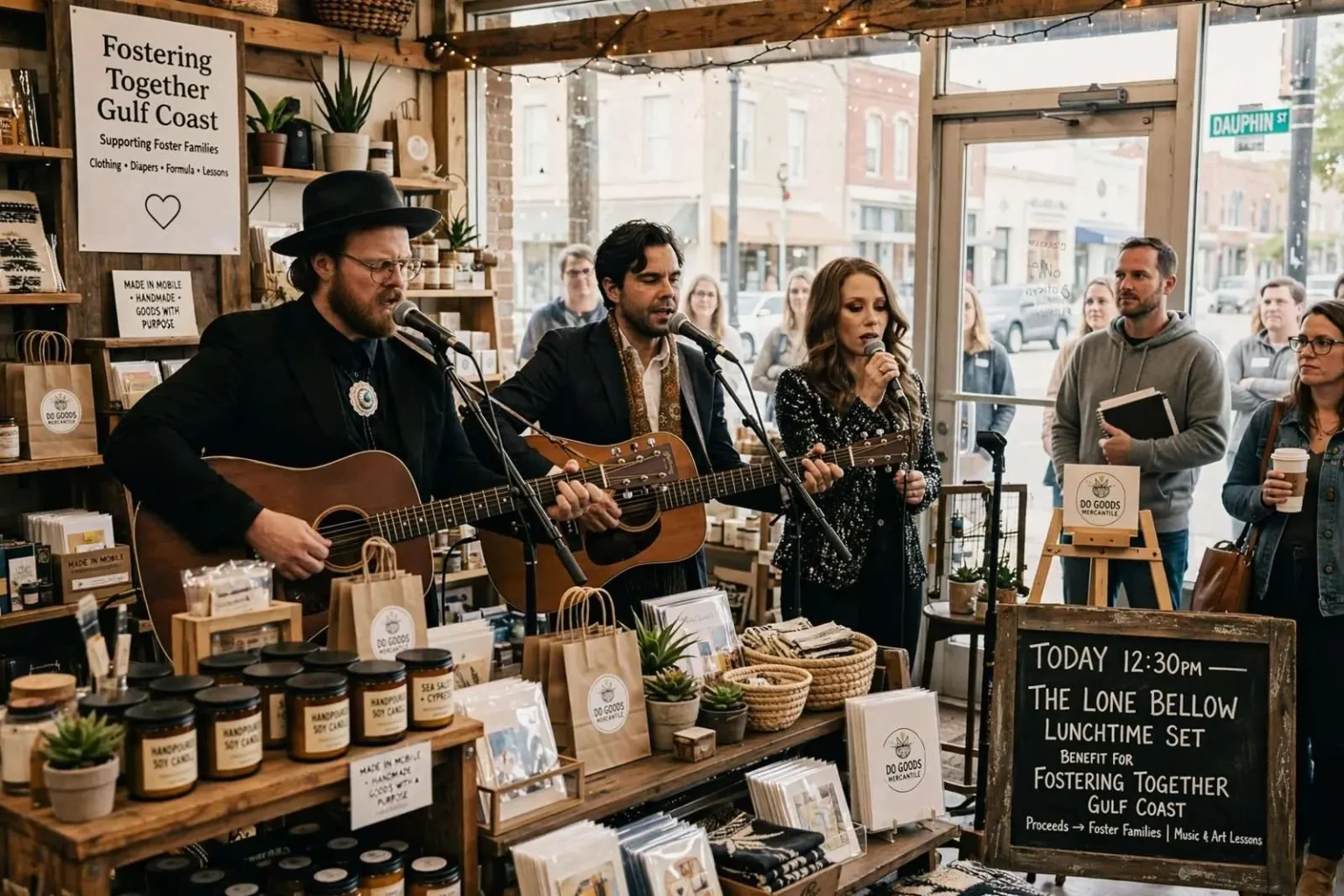
MOBILE, Ala. — A downtown Mobile merchant turned a lunch break into a fundraiser Tuesday, pairing an intimate acoustic performance by touring band The Lone Bellow with a drive to support local foster families.
Do Goods Mercantile Company hosted the midday set at 12:30 p.m., giving shoppers a chance to catch the three-piece band up close ahead of its evening show at the Saenger Theatre on the group’s new album tour. The format — a full touring act squeezed between racks of merchandise in a storefront the size of a living room — is the kind of show big venues can’t offer, and the kind downtown Mobile has become known for as its retail corridor has filled with independent shops.
For The Lone Bellow, the stripped-down lunchtime set was a warm-up for the evening’s full-band performance at the historic Saenger Theatre, the restored 1920s movie palace on Joachim Street that anchors downtown Mobile’s live-music calendar. Touring acts passing through the city have increasingly added daytime in-store appearances to their schedules, drawing audiences that might not buy a concert ticket but will linger in a shop to hear three voices and a guitar up close.
Raising money for Fostering Together Gulf Coast
Proceeds from the event go to Fostering Together Gulf Coast, a local charity that supports foster families across the region — providing essentials like clothing in the right sizes, diapers and formula at a moment’s notice, and walking alongside families after a placement.
The charity’s model responds to the immediate realities of foster care. Children often enter care with little more than the clothes they are wearing, and the families who take them in may get only hours of notice before an arrival. A crib has to be set up, formula purchased, clothes found in the right size — all before the child is through the door. Organizations like Fostering Together Gulf Coast exist to make that scramble survivable, supplying what the placement demands when the placement happens.
Annie Persinger, who owns Do Goods Mercantile, said the charity fills an urgent gap for children entering foster care, often with nothing of their own.
“We stand in the gap for children who have entered into foster care because that’s such a scary time for them,” Persinger said. “They’ve been taken away from what they know and they really don’t know what’s ahead. And so to have families that are available to bring them into their home and provide a safe place for them, I think that’s tremendously important.”
Her shop’s involvement reflects the role small merchants increasingly play in downtown Mobile’s civic life. Do Goods Mercantile has built its business on goods with a purpose — handmade and locally sourced items from makers with stories worth telling — and benefit events like Tuesday’s show extend that identity into the community’s needs.
Funds head to music and art lessons
Beyond emergency supplies, money raised through the event will pay for music lessons through Mob Town Music and art lessons through Coastal Makers Art Studio, offered to interested foster families through Fostering Together.
That allocation says something about the charity’s philosophy. Emergency supplies answer the first week of a placement; music and art lessons address everything after it. For children whose lives have been upended, creative activities offer stability, expression and the ordinary experience of being a kid with a recurring activity — a piano lesson, a painting class — that has nothing to do with the circumstances that brought them into care.
Partnering with local studios also keeps the raised dollars circulating in Mobile’s creative economy. Mob Town Music and Coastal Makers Art Studio both serve the city’s growing arts scene, and connecting them with foster families builds relationships that outlast any single fundraising event.
The lunchtime show doubled as a chance to shine a light on the needs of foster families around the Gulf Coast while bringing live music to downtown Mobile — a pairing that has become a template for the neighborhood’s small businesses, which have increasingly used their storefronts as venues for causes as well as commerce.
Foster care on the Gulf Coast
The needs Persinger described are not abstract in Mobile and Baldwin counties. The foster care system across Alabama relies on a network of foster families who open their homes to children removed from their birth families, and the demand for placements consistently outpaces the supply of available homes. When a child enters care, the child welfare system must find a bed, a caregiver and a household willing to absorb the disruption — sometimes the same day.
That is where the gap organizations like Fostering Together Gulf Coast fill becomes visible. Government agencies handle casework and oversight, but the practical logistics of a placement — a backpack, a school uniform, a birthday gift, a bed — often fall to families and the community around them. Charities that stand in that gap determine whether a placement starts with a stockpile of supplies or with an empty pantry and a stressed caregiver.
Support after the placement matters just as much. Foster families face emotional strain, court dates, visitation schedules and the uncertainty of how long a child will stay. Community support — meals, supplies, respite and simple encouragement — is a measurable factor in whether foster families continue after their first placement, which makes events like Tuesday’s fundraiser an investment in the system’s capacity, not just its compassion.
The band and the venue
The Lone Bellow’s stop in Mobile fit the band’s reputation for closeness with its audience. The Brooklyn-formed trio built its following on harmony-heavy live performances that spill off the stage, and an in-store set strips the experience to its essence: three voices, acoustic instruments and a room small enough that every listener is front row. The evening show at the Saenger offered the full production, but the lunchtime audience got the version of the band that made its name.
The Saenger Theatre itself is part of the story of downtown Mobile’s revival. Restored to its 1920s grandeur, the theater hosts touring acts, comedy and local productions, and its marquee on Joachim Street signals a downtown that hums after dark — a transformation driven in part by the independent merchants who stayed and invested when the district’s future was uncertain.
Businesses like Do Goods Mercantile occupy the intersection of that revival and the city’s civic conscience. Benefit events tie foot traffic to community needs, giving shoppers a reason to visit and a reason to care — and giving charities an audience that shows up for music and stays for the cause.
How locals can help
The needs of foster families around the Gulf Coast extend well beyond one fundraiser. Families entering the system need clothing in the right sizes, diapers, formula, car seats and beds; children already in placements need tutors, mentors and the ordinary enrichment — lessons, camps, birthday celebrations — that stable families take for granted. Local organizations that serve the foster community accept donations of goods and money year-round and can connect willing volunteers with the placements that need them most.
For those drawn deeper, foster parent training programs run continuously in the region, and the shortage of available homes means the need for new families is constant. Between becoming a foster parent and writing a check lies a wide range of ways to help — and Tuesday’s lunchtime crowd got a reminder that closing the gap can start with something as simple as buying lunch, hearing a band and letting the music point toward the need.
The money raised Tuesday will move quickly — supplies within days, lessons within weeks — but the relationships formed between downtown Mobile’s merchants, its musicians and its foster families may prove the more lasting product of the show.
Why in-store shows work
The lunchtime fundraiser also demonstrated why in-store performances have become a staple of the independent retail economy. For the band, a daytime set builds the evening’s audience and sells merchandise to fans who want a moment with the artists. For the shop, it converts a slow weekday lunch hour into a crowd, and a crowd into customers who might not otherwise have walked through the door. For the charity, it attaches a cause to an experience people were already going to enjoy — the least intrusive ask in fundraising.
The model has flourished in record stores and boutiques across the country precisely because everyone leaves with something: the artist with new listeners, the merchant with sales, the charity with donations, and the audience with a story that a stadium show rarely provides. Downtown Mobile’s walkable retail district, with its cluster of owner-operated shops around Dauphin and Joachim streets, gives the format a natural home.
The timing mattered, too. A 12:30 p.m. set reaches downtown workers on their lunch break — the office crowd, shop staff and nearby residents — rather than the evening concert audience. That brings people into the cause who would never buy a ticket on their own, which is how local charities build awareness beyond the circles that already support them.
What comes next for the partnership
Events like Tuesday’s rarely stay one-time affairs when they succeed. Merchants who find a charity that fits their identity tend to make the benefit an annual tradition, and bands that discover a welcoming shop on their tour routes come back on the next pass through town. The combination of The Lone Bellow’s tour stop, Do Goods Mercantile’s storefront and Fostering Together Gulf Coast’s mission has the makings of exactly that kind of repeatable partnership.
The specific allocation of the proceeds — music lessons at Mob Town Music and art lessons at Coastal Makers Art Studio for interested foster families — also creates ongoing visibility. Every lesson paid for by the fundraiser is a child carrying the event’s story forward, and every family enrolled becomes a connection between the charity and the studios that can outlast the donation itself.
For downtown Mobile, the afternoon was a small demonstration of the district’s character: a lunch hour that turned into a concert, a concert that turned into a fundraiser, and a fundraiser that will turn into supplies, lessons and support for families navigating one of the hardest transitions a household can face. The children standing in that gap will likely never know which band, which shop and which lunch crowd made it happen — which is, in the end, how the best community charity works.


