Dozens of Mobile Seniors Receive First COVID Vaccine Doses at MLK Day Clinic
A Mobile County Health Department clinic on MLK Day delivered first COVID vaccine doses to dozens of seniors 75 and older.
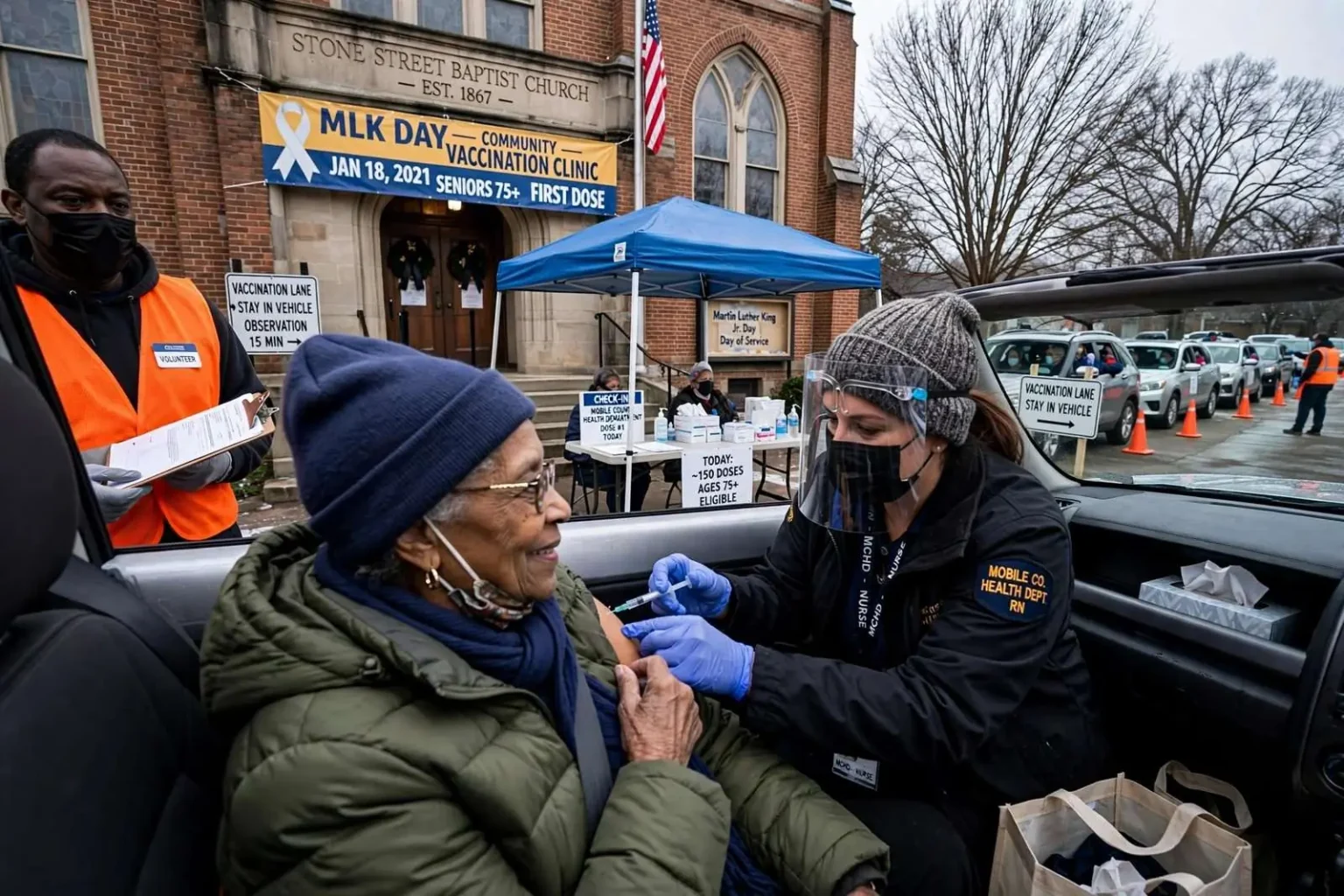
Dozens more senior citizens in Mobile rolled up their sleeves for a first dose of the COVID-19 vaccine Monday, as the county health department held a special vaccination clinic on the Martin Luther King Jr. Day holiday — turning a day off into a day of protection for some of the residents most vulnerable to the virus.
Cars began lining up at dawn for the event, which was hosted at a historic Black church in Mobile. By the time the first doses went in arms, the line of vehicles stretched through the church grounds, with seniors and their family members waiting out the process in the January cold as volunteers directed traffic and checked people in.
Joan Yates, among the first in line, was eager for her turn. “I’m excited about it, very excited. I’m happy they’re doing this so I can get one,” Yates said, giving voice to a mood shared by most of the seniors filing through the clinic — relief that the shot had finally reached them.
A church turned vaccination site
Senior Pastor Milton Saffold of Stone Street Baptist Church said the clinic’s location mattered, noting that the pandemic has hit minority communities especially hard even as its effects reach across racial lines. Hosting the clinic at the church met people where they already were — in a familiar building, in a neighborhood they know, staffed by people they trust — rather than asking hesitant or homebound seniors to navigate an unfamiliar medical facility across town.
That choice reflected what the pandemic had already demonstrated by that point in the rollout. Nationwide, Black and Hispanic residents were dying of COVID-19 at rates well above their share of the population, a gap driven by work in essential jobs, multigenerational households, underlying health conditions and unequal access to care. Mobile was no exception, and public health officials in the county had been explicit that reaching minority communities would require clinics held inside them.
Stone Street Baptist Church itself carries the kind of history that makes such a setting meaningful. The congregation counts among the oldest Black churches in Mobile, a institution that has anchored its neighborhood through more than a century and a half of the city’s life. Using its halls as a vaccination site put one of the community’s most trusted institutions at the center of the most important public health campaign in a century.
Churches across Alabama played exactly this role throughout the rollout. In city after city, congregations offered parking lots for drive-through lines, fellowship halls for observation areas and, just as important, their pulpits for the message that the vaccine was safe. Pastors addressed rumors from the pulpit, hosted question-and-answer sessions with medical professionals, and in many cases rolled up their own sleeves in front of their congregations to demonstrate confidence in the shot. Public health researchers later credited those partnerships — the so-called faith-based outreach that met hesitancy with trust rather than lectures — with much of the progress made in closing the vaccination gap in Black communities during 2021.
The trust runs both ways and has deep roots. Black churches in the South have long doubled as civic infrastructure, hosting voter registration drives, blood drives, food distribution and health screenings when other institutions failed to reach their communities. A vaccination clinic at Stone Street Baptist on a January Monday was the pandemic-era expression of that same division of labor: the health department brought the doses, and the church brought the legitimacy.
Who was eligible
Primarily seniors aged 75 and older were vaccinated at Monday’s event. Alabama’s initial rollout limited eligibility to that age group along with first responders and health care workers, a prioritization that followed federal guidance and reflected the reality of the state’s limited early supply. Seniors 75 and older faced the highest risk of hospitalization and death from the virus, which put them at the front of the line while younger residents waited for eligibility to expand in the weeks and months ahead.
The health department had 100 doses reserved for the holiday clinic, plus an additional 50 left over from Saturday’s large-scale vaccination event at the Mobile cruise terminal. Every dose counted in those weeks: Alabama, like most states, was receiving vaccine allocations far below what demand required, and counties were scheduling clinics down to the last vial rather than risk waste.
The arithmetic meant that Monday’s clinic could protect roughly 150 more residents — a small number against a pandemic, but a meaningful one for the families who had spent months trying to get an appointment for a parent or grandparent. For many waiting in line, the shot marked the end of a year spent isolated.
The logistics behind even a modest clinic were considerable. A vaccination event required cold-chain storage for the doses, a check-in desk matching each appointment to a resident, nurses to draw and administer the shots, and a waiting area where recipients could be observed for the rare immediate reactions. Volunteers handled much of the flow — escorting seniors from their cars, printing cards that recorded the dose and the due date for the second one, and scheduling return appointments before anyone left the building. By mid-January, the county’s teams had run enough events to move a line of several hundred people through in a morning, but each clinic still represented weeks of coordination between the health department, the host institution and the volunteer groups who supplied the manpower.
“Staying inside mostly and trying to be protective of myself and others,” said senior Mary Darrington, describing her pandemic routine — the months of skipped gatherings, grocery deliveries and phone calls that had replaced the normal life of a Mobile retiree. Her account matched what seniors across the country described during the first winter of the vaccine rollout: long stretches of isolation that were themselves a health risk, endured because the alternative felt more dangerous.
Those routines were exactly what the vaccine promised to end, though not overnight. First doses in January meant second doses in February, and full protection arrived weeks after that. Public health officials cautioned throughout the rollout that vaccinated seniors still needed to mask and distance until the numbers in their communities fell, but the first shot changed the calculus of daily life for the people who received it. The grandchild visit, the church service, the restaurant meal — all of it moved from impossible to merely delayed.
The holiday’s meaning
The setting of the clinic on Martin Luther King Jr. Day added a resonance that organizers did not have to explain. King’s legacy includes some of the nation’s most consequential fights over health care and health equity, from the Memphis sanitation workers’ strike he joined to his warnings about the “appalling conditions” of the poor. Holding a vaccination clinic for seniors at a historic Black church on that holiday connected the pandemic’s hardest-hit communities to a civil rights tradition that had always treated health as part of justice.
Local officials and clergy made the point in practical terms rather than speeches: the virus was taking a disproportionate toll on the very communities the holiday honors, and the fastest way to honor the day was to put doses in the arms of the people it most endangered. The church setting did the ceremonial work on its own — a day of service, in a place of service, doing work that kept the neighborhood’s elders alive.
What came next in the rollout
Officials said additional public vaccination events were in the works, with details yet to be announced. The holiday clinic was part of a broader strategy the county health department and its partners pursued through the winter and spring: large-scale sites at familiar venues, smaller clinics in churches and community centers, and mobile efforts aimed at seniors who could not travel.
The weekend rhythm — a big event Saturday at the cruise terminal, a targeted clinic Monday at a church — showed how the early rollout actually worked on the ground. Vaccine arrived in unpredictable weekly allocations, counties built clinics to match whatever supply they received, and partners such as churches, fire departments and civic groups supplied the venues and volunteers that government health departments could not marshal alone. Every clinic depended on that improvisation, and each one turned a shipment of doses into protected residents within days of the vials arriving.
For the seniors who drove up in the dawn line Monday, the arithmetic was simpler than any policy discussion. They had waited out a year of isolation, they were old enough to be first, and a church down the street finally had the shot. The volunteers who escorted them from their cars, the nurses who drew the doses and the pastor who opened the doors all described the same goal: getting Mobile’s most vulnerable residents through the pandemic’s endgame, one holiday clinic at a time.