
Driver Found Asleep on I-10 Bayway in Mobile, Family Says He Is Okay
A driver was found asleep on the I-10 Bayway in Mobile with what appeared to be a gun in his lap. Family says he fell asleep in traffic and is okay.
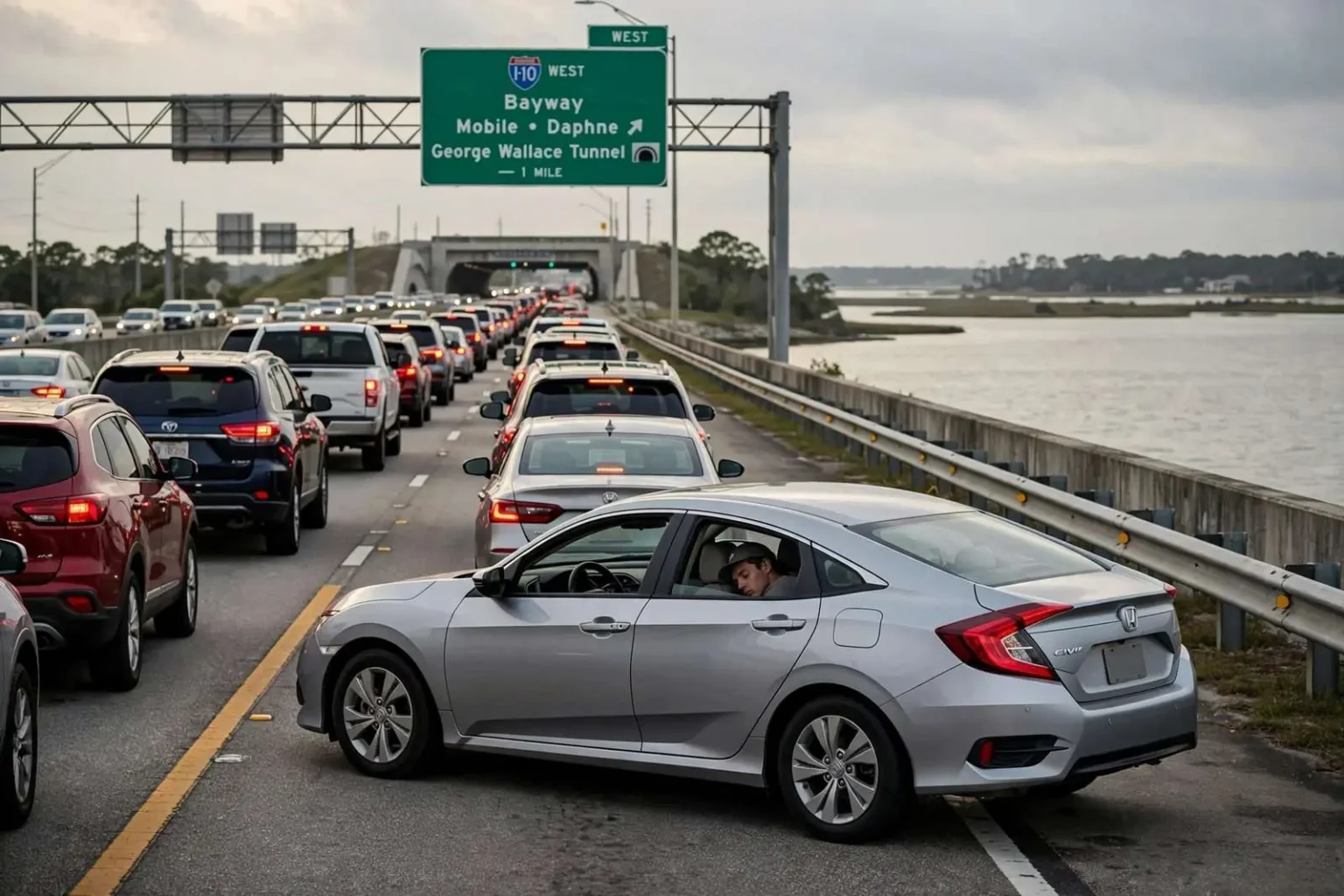
A driver was captured on video appearing to be asleep on the I-10 Bayway in Mobile Tuesday afternoon, prompting concern from other motorists. A viewer who recorded the video on her cellphone says she came across the driver parked in the right westbound lane of the Bayway, stopped in traffic with the vehicle sitting motionless while cars moved slowly around it.
She got out of her vehicle to check if anything was wrong and found the driver asleep, with what appeared to be a gun sitting in his lap. The sight turned a strange traffic moment into a genuinely alarming one, and the video she recorded made its way quickly through local social media as viewers tried to work out what had happened. A family member of the young man later reached out and said he fell asleep while stuck in traffic and woke up after traffic began moving again, and the family member confirmed the young man is doing okay.
A strange sight in a familiar bottleneck
The I-10 Bayway is a busy stretch of highway connecting Mobile to the Eastern Shore across Mobile Bay, and it is frequently subject to traffic congestion. The route carries commuters between Mobile and Baldwin County, beach traffic heading to and from the coast, and freight moving along the Gulf Coast corridor, and it funnels all of that through a crossing that includes the George Wallace Tunnel under the Mobile River. During afternoon rush hours, westbound traffic backing up from the tunnel can bring vehicles to a standstill for miles, which is the kind of stop-and-go congestion that a driver describes dozing off in.
Anyone who drives the Bayway regularly has seen the odd things that standing traffic produces. Motorists get out of their cars to stretch, drivers drift across lanes as attention fades, and the sheer length of the delays means that a stationary vehicle surrounded by other stationary vehicles does not immediately stand out. That is apparently how this episode unfolded: a car parked in the right lane looked, at first, like every other car in the backup, until the viewer walked up to the window and saw the driver slumped asleep with a gun in his lap.
What the video showed and what viewers did
The decision by the motorist who recorded the video to get out and check on the driver reflects a reflex common among Gulf Coast drivers, where checking on a stranded vehicle is ordinary behavior. What she found instead was a situation with real ambiguity: a sleeping driver, a visible firearm, and traffic inching forward around a vehicle that could move at any moment. Situations like that one are exactly the kind that law enforcement asks the public to report rather than manage on their own, because there is no way to know from the window of a car whether the person behind the wheel is ill, impaired, exhausted or something else entirely.
Videos like this one spread quickly because they capture something viewers can immediately imagine. Every driver on the Bayway has been stuck in the same traffic, and every one of them can picture creeping past a motionless car and wondering whether the driver inside is unconscious. The clip prompted conversation about drowsy driving, about firearms left visible in vehicles, and about what the right response is when a motorist sees something that looks wrong on the highway.
The family’s explanation
The family member who reached out after the video spread offered a plain explanation: the young man fell asleep while stuck in traffic and woke up when traffic began moving again, and he is doing okay. The account matches the scene in the video: a driver in a dead-stopped lane who dozed off and rejoined the flow of traffic without incident. Extreme fatigue behind the wheel is a recognized hazard, and sleep researchers have long warned that microsleeps and full lapses can occur even at low speeds in heavy traffic when a driver has been awake too long.
The family’s account also put to rest the more alarming interpretations that viewers had been raising as the video circulated. A sleeping driver with a visible gun invites speculation about everything from medical emergencies to something far worse, and the confirmation that this was an exhausted young man who had nodded off in a traffic jam reframed the episode from a mystery into a cautionary tale. It also spared the driver a lasting reputation as the man on the video, a fate that viral traffic footage often delivers before anyone knows the full story.
Drowsy driving is a highway hazard of its own
Even when it ends as harmlessly as this one did, falling asleep behind the wheel is among the most dangerous things a driver can do. Safety agencies have documented for years that fatigue slows reaction time, narrows attention and produces lapses that the driver does not remember, and the crashes that result tend to be severe because a sleeping driver never brakes. The hazard is usually discussed in terms of long overnight drives, but this episode is a reminder that exhaustion can catch up with a driver anywhere, including in a line of stopped traffic in the middle of the afternoon.
The circumstances that produce a moment like this are common in the region’s commuting life. Drivers who started work before dawn, worked overnight shifts or stacked long days on top of long drives are all at higher risk, and stop-and-go congestion can lull an exhausted brain into sleep faster than open highway does. Safety campaigns urge drivers to watch for the warning signs, including repeated yawning, drifting thoughts and missed exits, and to get off the road before a microsleep becomes a decision the driver never consciously made.
The Bayway’s long congestion problem
The Bayway where this happened is one of the Gulf Coast’s most persistent bottlenecks, and the congestion that produces backups stretching for miles is a daily fact of life for the region. The route connects downtown Mobile to the Eastern Shore communities of Spanish Fort and Daphne across Mobile Bay, and it channels that traffic through the George Wallace Tunnel, a structure built decades ago that handles fewer lanes than the highways feeding it. The mismatch turns every rush hour into a slow crawl and every minor incident into a major delay, and planners have studied fixes for years, including a long-discussed new bridge and tunnel crossing of the Mobile River.
Until any of those projects are built, the backups will continue, and so will the small human dramas that happen inside them. The Bayway’s congestion matters beyond inconvenience: emergency vehicles get stuck in the same traffic, freight deliveries run late, and the region’s two sides remain functionally separated for hours at a stretch. The episode this week, a driver so exhausted he slept through a traffic jam, is a small illustration of how much time and energy the region spends in that bottleneck every day.
What to do when you see something wrong on the highway
The episode ends safely, but it raises a question many viewers asked: what should a motorist do if they see a driver who appears to be asleep, ill or otherwise incapacitated? Law enforcement guidance is consistent. Call 911 with the location, the direction of travel and a vehicle description, and let dispatchers route the nearest officer to check on the driver. Reporting is especially important when the situation involves anything unexpected, such as a visible weapon, because officers can approach a vehicle far more safely than a passing motorist can.
A motorist who stops to help should weigh the conditions carefully. Standing outside a vehicle in live traffic carries its own risk, and the presence of a firearm changes the calculus entirely. In this case the good intentions of a fellow driver produced answers quickly, and the family’s follow-up message resolved the incident publicly. The reminder that remains is simple: exhaustion, distraction and strange behavior on the highway are worth a phone call, and the 911 system exists precisely so that a driver who seems asleep on the Bayway gets a wake-up visit from an officer instead of becoming a headline.
Viral videos and the stories behind them
Episodes like this one follow a now-familiar arc on the Gulf Coast. A driver records something strange, the clip spreads through local social media within hours, and speculation fills the space where facts have not yet arrived. By the time the family member reached out with the explanation, thousands of people had already watched the video and formed their own conclusions. The resolution in this case was harmless, which is not always true of viral traffic footage, and the episode is a useful example of how quickly an out-of-context image can be read in ways the person in it never intended.
The young man at the center of the video, by his family’s account, committed no offense more serious than driving while exhausted. He woke up when traffic moved and drove on, unaware for a time that he had become the subject of a video watched across the area. His family’s willingness to speak up and confirm he was okay closed the loop that the video opened, and it did the community a service by replacing speculation with an account everyone can recognize: a long day, a long traffic jam and a driver whose body finally demanded sleep before the Bayway’s congestion finally released him.


