
DUI Crash on Old Shell Road Seriously Injures Passenger; Mobile Police Arrest Driver
Mobile police say a DUI driver hit a tree on Old Shell Road, seriously injuring his passenger; 24-year-old Devin Foster faces assault and DUI charges.
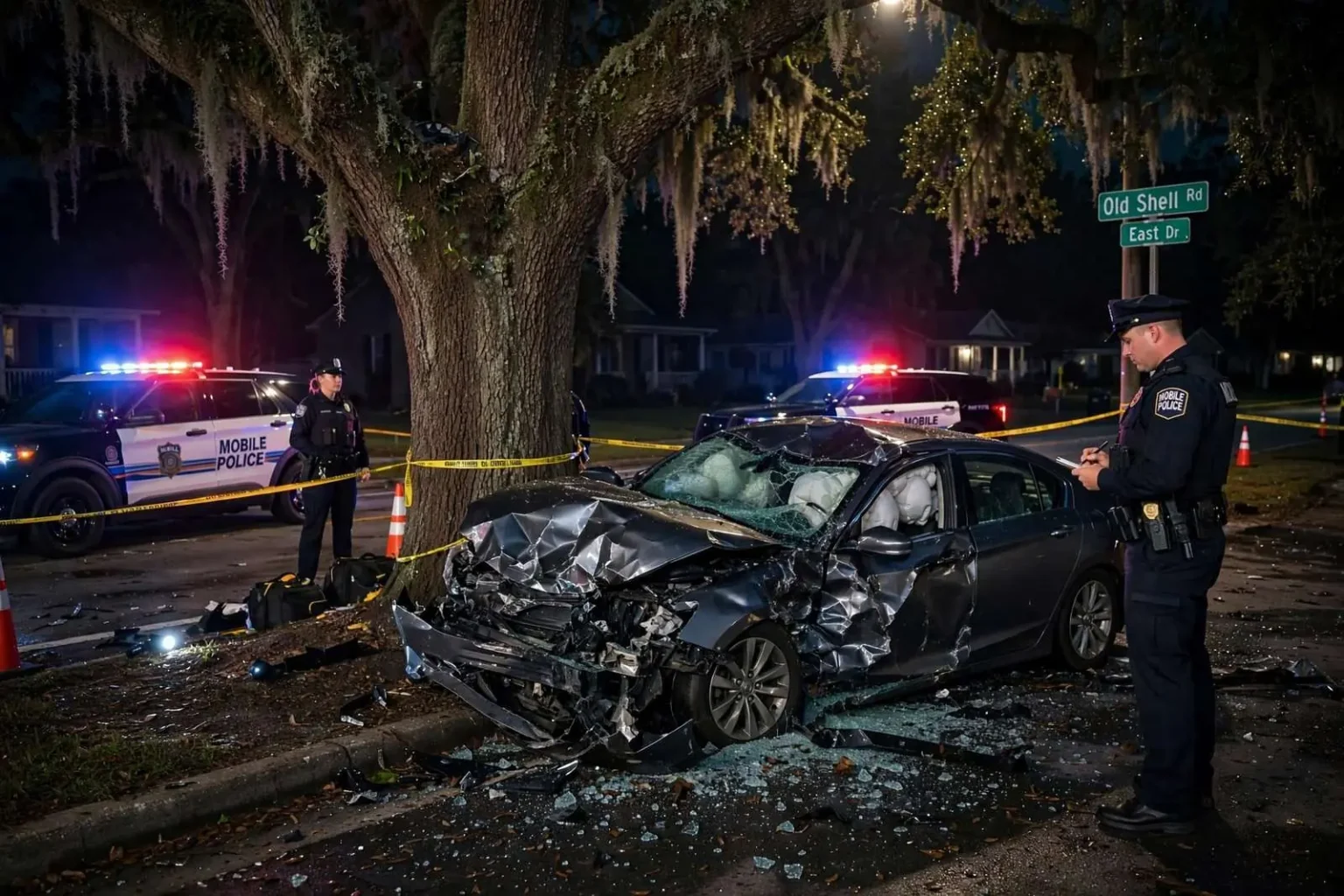
A woman was seriously injured and the driver of her vehicle was arrested on DUI charges after an early-morning wreck in Mobile, according to the Mobile Police Department. Officers were called around 3:15 a.m. to the intersection of Old Shell Road and East Drive in the Spring Hill area, where they found a vehicle that had left the road and struck a tree.
Police said the passenger, a woman, suffered serious injuries in the crash and was taken to a hospital for treatment. Investigators determined the driver, 24-year-old Devin Foster, was under the influence at the time of the wreck. Foster was arrested and charged with assault and driving under the influence.
The 3:15 a.m. hour places the crash in the pattern that officers in Mobile and every other American city know well: the window when alcohol-related collisions peak, when traffic is sparse but speeds are often at their highest, and when a single vehicle leaving the roadway can go undetected until someone happens along. At that hour, the intersection of Old Shell Road and East Drive would have been nearly empty — which meant no drivers ahead to slow the vehicle’s path and no one behind to witness the moments before impact.
The Scene on Old Shell Road
The intersection sits in Spring Hill, one of Mobile’s most established residential neighborhoods, where Old Shell Road serves as the primary east-west artery between the University of South Alabama area and Midtown. East Drive is a quieter residential street that meets Old Shell amid a mix of homes, schools, and neighborhood institutions, and large mature trees line many of the area’s roads — the same trees that, when a vehicle leaves the pavement, become unyielding obstacles.
Striking a tree at speed is among the most dangerous single-vehicle crash configurations, offering none of the energy absorption of a guardrail or the give of a ditch. Serious injuries are common, and the fact that the vehicle came to rest against a tree meant responders faced a scene where extraction and rapid transport to trauma care were the immediate priorities. Mobile Fire-Rescue units typically accompany police on serious-injury wrecks to cut patients out and stabilize them for the run to the hospital.
The DUI Charge and the Assault Charge
Police said the assault charge reflects the serious harm to Foster’s passenger — Alabama prosecutors frequently pair it with DUI counts when impairment results in significant injury. Under Alabama law, driving under the influence is typically charged as a misdemeanor for first offenses, but when a drunk driver injures someone, prosecutors have the option of reaching for felony assault statutes that treat the impaired decision to drive as reckless disregard for human life.
The two charges operate in tandem. The DUI count establishes that Foster was under the influence while operating the vehicle; the assault count addresses the consequence — a passenger whose life was upended by serious injuries. Together they can expose a defendant to years in prison, substantial fines, and the long tail of collateral consequences: license revocation, an ignition interlock requirement, and a record that follows employment and housing for decades.
The charges are allegations, and Foster is presumed innocent unless convicted in court. Prosecutors will need to prove both impairment — through field sobriety testing, blood-alcohol evidence, or observations of the driver — and the causal link between the impairment and the passenger’s injuries, a standard that defense attorneys routinely challenge in cases where no breath or blood result has been publicized.
Impaired Driving in Mobile County
The crash adds to a persistent toll in Mobile County, where state and local data have long shown DUI crashes producing injuries and deaths on roadways from downtown to the suburbs. Alabama’s law enforcement community treats impaired driving as a priority offense, with saturation patrols and DUI checkpoints deployed on weekends and holidays, when the risk peaks.
Passengers are a recurring and often overlooked part of the DUI problem. Many people injured or killed in alcohol-related crashes are riding with an impaired driver rather than driving themselves, and safety advocates continue to press the message that a passenger’s options — calling a ride, refusing to get in the car, asking the driver to stop — are limited but real. Once a car is moving at speed with an impaired person behind the wheel, the passenger’s fate is largely out of their own hands.
How a DUI Crash Investigation Unfolds
In the hours after a crash like this one, Mobile police investigators follow a sequence designed to preserve evidence that fades fast. Observations of the driver — odor of alcohol, speech, balance, demeanor — are documented immediately, as are any admissions. If the driver is hospitalized alongside the victim, officers typically remain at the bedside to obtain consent or a warrant for a blood draw, because chemical tests taken hours later still carry weight in court.
Physical evidence does the rest. Investigators measure the vehicle’s path off the roadway, the impact point on the tree, and the final resting position to estimate speed. Witness canvassing comes in the morning, when residents along East Drive and Old Shell Road are interviewed for anything they heard or saw. The completed file goes to the District Attorney’s Office, which decides how the felony assault and DUI charges will proceed through Mobile County’s court system.
For the injured woman, the legal process is paired with a long recovery. Serious injuries from tree-impact crashes — fractures, internal injuries, head trauma — can require surgery, months of rehabilitation, and lasting disability. Victims in these cases also have the option of pursuing civil claims against an impaired driver, a separate track that can address medical bills and lost income beyond what the criminal case resolves.
Spring Hill and the Roads It Drives
Spring Hill is one of Mobile’s most recognizable neighborhoods, home to the University of Mobile’s original roots in the area, established schools, churches, and tree-shaded streets that predate the city’s postwar sprawl. Old Shell Road itself is a historic corridor — its name a relic of the shell-covered roadbed that once connected Mobile to the west — and today it carries a steady mix of commuters, students, and neighborhood traffic past shops and homes.
Residents of the neighborhood experience crashes like this one twice: once in the sirens that wake the street, and again in the weeks of questions afterward about lighting, speed, and safety at intersections that most people cross without a second thought. Neighborhood associations in Spring Hill have historically engaged with the city on traffic calming and enforcement along Old Shell Road, and every serious wreck renews that conversation.
The Morning After
By the time most of Mobile woke up, the scene at Old Shell Road and East Drive had been cleared, the wrecked vehicle towed, and the sidewalk that briefly hosted flashing blue lights had returned to its quiet early-morning self. But the consequences were just beginning: a woman facing the start of a hospital stay, a 24-year-old driver facing two charges and the court calendar that follows, and two families beginning the long process of absorbing a night that changed everything.
Mobile police use cases like this one in their ongoing public messaging, and the pattern of the message never changes: impairment and driving are a combination that turns vehicles into projectiles and passengers into victims. The department’s traffic investigators respond to hundreds of injury crashes a year, and a substantial share involve drivers who made the decision to drive after drinking — a decision made minutes before the crash that shaped the rest of everyone’s night.
What Happens Next
Foster’s case will move through the Mobile County court system, beginning with an initial appearance where bond conditions are set. Felony assault charges tied to DUI crashes can be resolved by plea or by trial, and outcomes depend heavily on the evidence collected in the first hours — the driver’s condition, the chemical test results, and the crash reconstruction. If convicted, Foster would face penalties under Alabama’s DUI and assault statutes, including mandatory substance abuse treatment components that accompany most DUI sentences.
The woman injured in the crash, meanwhile, will measure the outcome in different terms: surgeries and therapies, the pace of her own recovery, and the support of the people around her. Her name and condition have not been released, and police have not provided further detail about her injuries beyond describing them as serious.
Until the courts finish their work, the case stands as the latest entry in Mobile’s long ledger of DUI crashes — a record kept in hospital rooms and courtrooms rather than in any single statistic, and written one night, one decision, and one intersection at a time. The presumption of innocence belongs to the driver. The road belongs to everyone, and the cost of forgetting that fell, this time, on a quiet Spring Hill corner just after 3 in the morning.


