Early Morning Fire Guts Education Building at First Baptist Church of Leroy
An early morning fire destroyed the education building at First Baptist Church of Leroy in Washington County, but firefighters saved the sanctuary next.
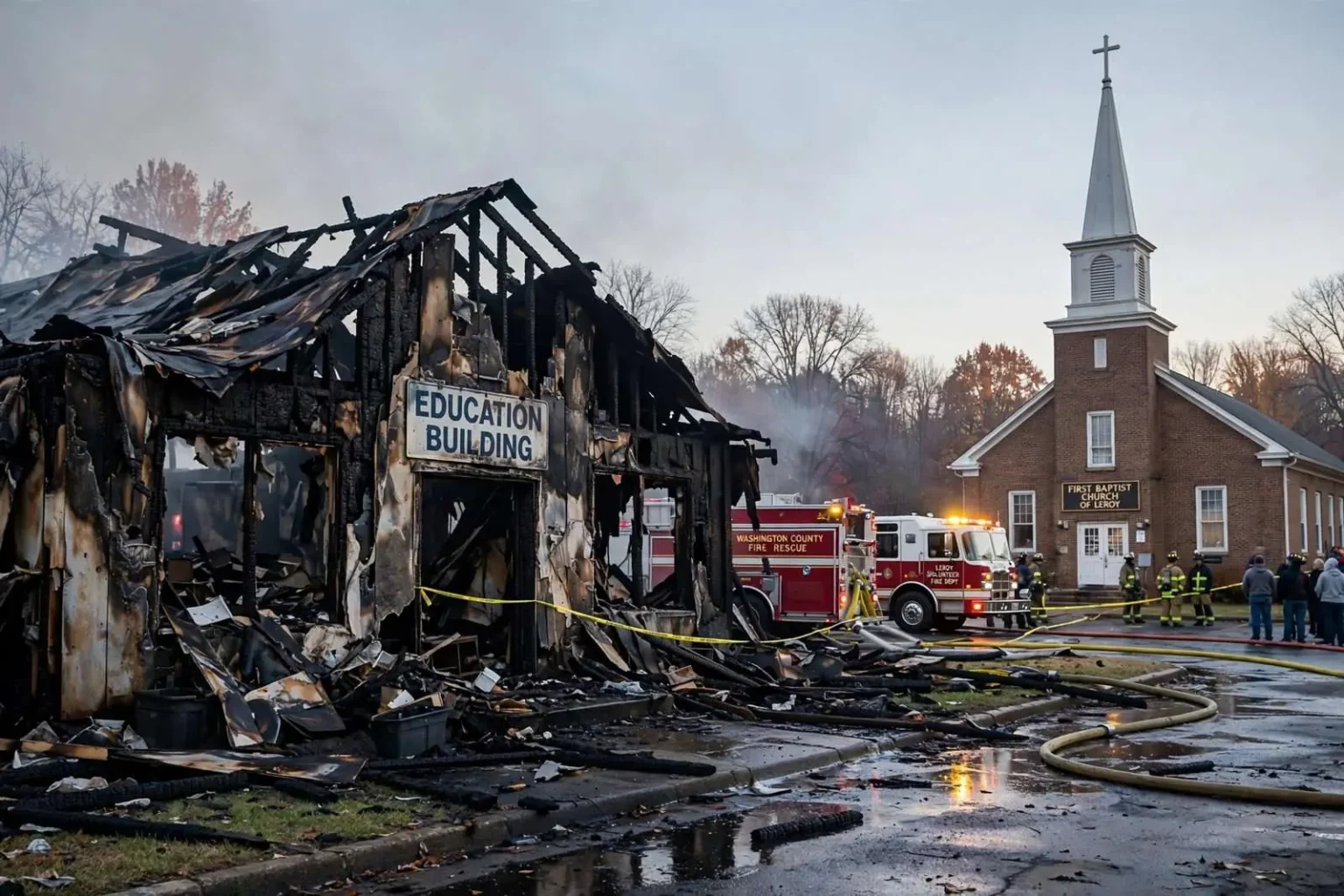
An early morning fire tore through the education building at First Baptist Church of Leroy on Monday, destroying offices and classrooms just hours after the congregation had gathered inside for its annual Christmas concert. Flames were reported at the Washington County church around 4 a.m., converting a building full of Sunday school rooms and memories into a loss before most of the community had woken. The timing struck members as especially cruel, coming on the heels of a night the church had spent celebrating together.
Pastor Ben Posey said he rushed to the property as soon as he learned what was happening, arriving to find the building where much of the church’s day-to-day work is done fully involved. “Just a blurry rush to get over here in time and get over here as quick as I could to see what was going on,” Posey said of the drive to the church. For a pastor, the education building is the working heart of a congregation’s life, and watching it burn from the parking lot is a sight that reshapes a church’s year.
Firefighters from several area departments worked to keep the flames from spreading, holding the fire to the education building and sparing the sanctuary next door. The contents of the education building were a total loss, while the sanctuary sustained only minor water damage. The difference between a total loss and a saved sanctuary often comes down to that multi-department response, with volunteer companies from neighboring communities arriving in relays to protect exposures while one building burns.
Sanctuary saved by multi-department response
In rural counties like Washington, church fires draw responses from several volunteer departments at once, because no single station fields the manpower and water supply to fight a fully involved structure alone. Tanker shuttles haul water from distant hydrant-less points, and commanders assign arriving engines to defensive positions aimed at keeping fire from jumping to adjacent buildings. That the sanctuary next door survived with only water damage is the measure of how the morning’s fight was waged.
The education building itself could not be saved. Offices where the church’s administrative life happened, classrooms furnished over years of budget meetings and volunteer workdays, and the accumulated equipment of a Sunday school program were all consumed. Fires in wood-framed buildings of that age move quickly through wall cavities and attic spaces, and by the time flames show on the exterior, the interior is usually already lost.
Posey described the lost building as far more than storage and meeting space, calling it the place where the congregation handled much of its planning, teaching and one-on-one mentoring over the years. “A lot of behind the scenes detail goes on in that building so it’s just a space that’s been a comfort for years and for this church,” he said. “A lot of big decisions have been made in that building, a lot of great discipleship and mentoring of people.”
Congregants measured the loss in the same personal terms. A church education building accumulates decades of small artifacts: handprint crafts, bulletin boards, the office where a pastor counseled a grieving family, the corner where a committee argued through a budget. Those layers of ordinary use are what members grieve when the fire is out and the structure has been condemned.
Worship moves to Leroy High School
Church leaders expect regular services to resume within about a week. In the meantime, the congregation planned to meet in the auditorium at Leroy High School, the town’s school becoming its temporary sanctuary. Rural congregations lean on exactly that kind of neighborliness in a crisis, and school facilities, idle on Sundays, are the most common fallback for churches that lose their buildings.
Volunteers began clearing debris the same day, and Posey said offers of help arrived from across the Leroy community as word of the fire spread. “We get emotional over it. I had a moment where I finally got in my office and I saw a special bible that was ruined, but it’s stuff. We can replace stuff,” he said. The distinction he drew, between the objects lost and the congregation that survived, became the church’s public message within hours of the fire.
The cause of the fire remained under investigation. Investigators will examine the scene for accidental causes such as electrical faults and heating equipment, and church fires draw careful scrutiny because of the small number that prove to be intentionally set. In the early days after a fire, officials typically release few findings, leaving the congregation and the community to begin their recovery while the technical work proceeds.
A community closes ranks
Leroy is a small community in southern Washington County, an agricultural and timber region where churches function as the primary civic institutions. The town sits near the Tombigbee River, and its church rolls, school events and civic life overlap to a degree city congregations would find unfamiliar. News of a church fire in a community of that size reaches everyone by word of mouth within hours, and the response that follows is personal rather than institutional.
The annual Christmas concert that filled the building hours before the fire is the kind of tradition that anchors a rural church’s calendar, drawing families who attend sporadically the rest of the year. That the fire followed the concert by only a few hours gave the loss an added weight, as members passed from one of the building’s happiest nights to watching it burn before dawn. Several members reportedly had helped decorate the rooms that were gone by morning.
Recovery for a rural congregation is a months-long project that runs through insurance claims, salvage, architectural decisions and the physical work of rebuilding. Churches that navigate it successfully tend to be the ones that keep their rhythms intact during the wait, meeting on schedule wherever space can be found, which is precisely what First Baptist’s move to the school auditorium is designed to accomplish. Denominational networks and sister churches typically supplement local help with funds and furnishings.
The days after the fire brought the usual cadence of rural mutual aid: equipment offered, meals arranged, a fund opened, and neighboring pastors standing ready to fill the pulpit if needed. For the congregation of First Baptist of Leroy, the education building is gone and its replacement is years away, but the community’s judgment, expressed in the volunteers who showed up with tools the same morning, is that the church itself was never in the building.
Washington County, sprawling and lightly populated along the Mississippi state line, depends almost entirely on volunteer fire service outside its few municipal departments. Volunteers carry pagers around the clock, leave jobs and family dinners for structure fires, and train on nights and weekends to standards that keep small departments insurable and effective. A church fire is the kind of call that mobilizes the whole network, and the departments that responded to Leroy would have included neighboring companies responding under automatic aid arrangements.
Water supply shapes every rural firefight. Without hydrants, departments stage tankers in a shuttle between the fire scene and the nearest fill point, and the flow they sustain limits how aggressively crews can attack the fire itself. Commanders facing a fully involved building with limited water typically shift early to protecting exposures, the calculation that saved the Leroy sanctuary while its neighbor burned.
Fires in church education buildings also raise distinctive hazards for investigators. The buildings sit vacant for long stretches of the week, contain classrooms with donated furnishings and aging wiring, and often have additions built in different eras with different electrical systems. Investigators reconstruct the fire’s origin from burn patterns and witness accounts, and their findings determine everything from insurance coverage to whether criminal charges follow.
The sight of a pastor picking through a burned office resonated with congregations across the region that have lived through the same experience. Church fires are common enough that denominational bodies maintain disaster response programs for them, offering recovery checklists, rebuilding consultants and emergency funds. The first days’ decisions, from securing the site to choosing where to meet, are the ones these programs emphasize most, because they set the tone for the recovery to come.
Meeting in a school auditorium also carries a practical echo for a congregation like Leroy’s, since many of its members attended school in the same building. The overlap of church and school in small-town life means the temporary sanctuary is not an alien space but a shared one, and leaders planned services that felt as continuous with the church’s normal rhythm as the setting allowed. Sunday school classes were expected to spread into classrooms and available corners as the arrangement settled in.
Insurance adjusters and investigators will spend weeks cataloging the loss, from the furniture and teaching materials to the records and keepsakes that no policy can replace. Church leaders face the paperwork of recovery while also tending a congregation in grief, a dual burden pastors of small churches carry without much support staff. Posey’s public composure, framing the loss as stuff that can be replaced, served both audiences at once.
Communities that rally around burned churches usually keep that support going through the phases of recovery that follow the initial surge, from insurance settlements to groundbreakings. The measure of the Leroy community’s response will come not in the first week but in the months when rebuilding becomes routine work. Members, for their part, have the example of the sanctuary’s survival to build around, a building that stands as the visible piece of the church the fire did not take.