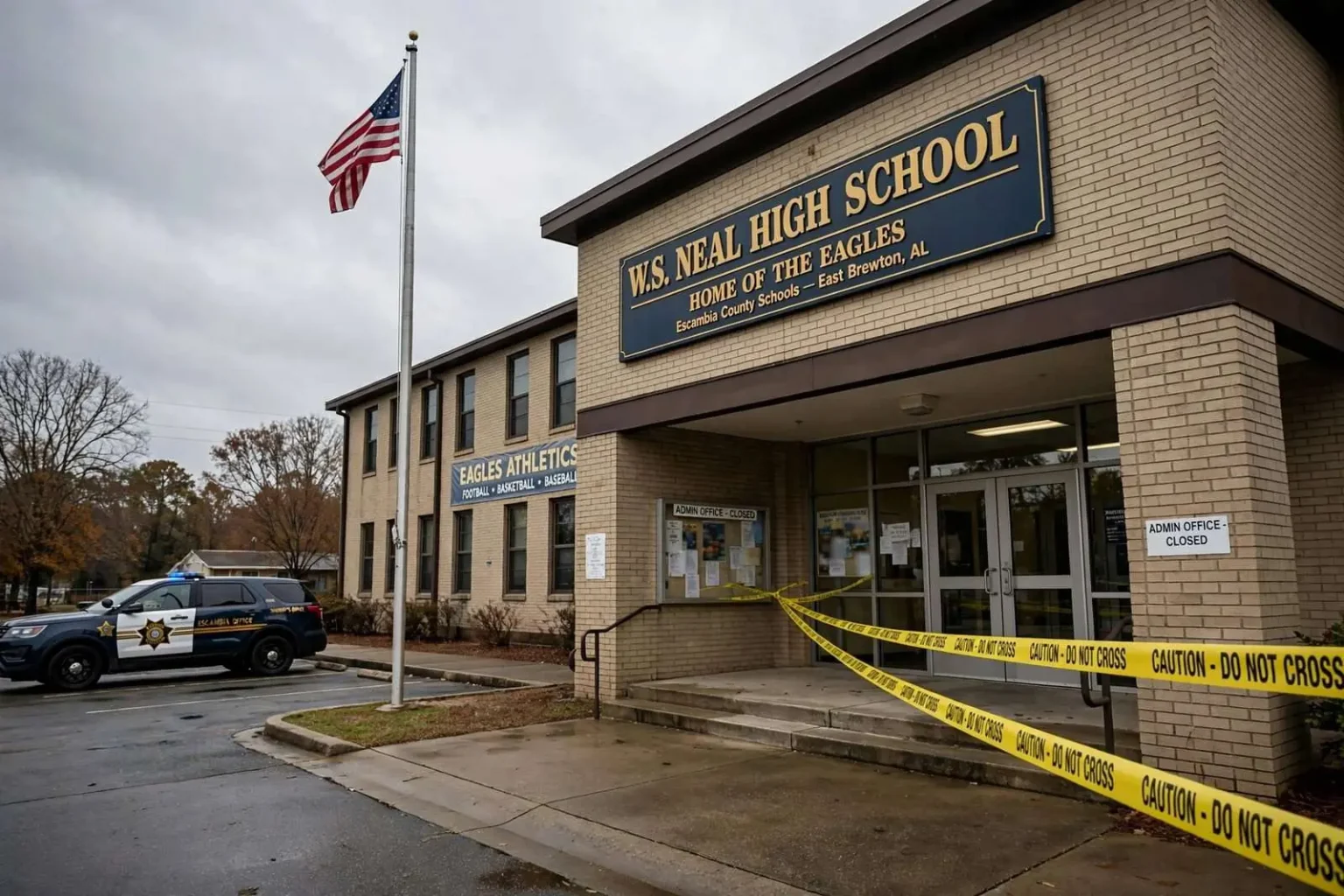
A teacher in East Brewton has become the second person arrested and charged with felony computer tampering in an ongoing grade-changing scandal at W.S. Neal High School in Escambia County, deepening a case that has disrupted the school’s spring graduation planning and cast scrutiny on how student records are protected.
Lisa Odom was taken into custody and subsequently released on a $5,000 bond, according to court records. Authorities allege that between October 2017 and March 2018, Odom used stolen login credentials belonging to assistant principal Coy Campbell to alter multiple students’ grades and transcripts — a period of months during which, investigators say, the school’s grading records were accessed and changed through an account that belonged to a campus administrator.
The allegations place a teacher among the suspects in a scheme that began surfacing with a student’s arrest. Earlier in the investigation, 18-year-old student Matthew Hutchins was also arrested for his role in the scandal. Court documents allege that on March 14, Hutchins used Campbell’s credentials to change his own grade from a 92 to a 96, and may have altered grades for other students as well.
The scheme has created significant complications for the school as it works to select a valedictorian for the upcoming graduation ceremony, officials said. When grades become unreliable, the calculations that determine class rank — often decided by hundredths of a point among top students — cannot be trusted until every altered record is identified and corrected. The investigation remains ongoing, and authorities have not ruled out additional arrests.
How the Scheme Unfolded
The mechanics described in court records follow a pattern familiar in school data breaches: credentials belonging to a user with broad privileges were obtained by someone else, and the account was used from inside the school’s own systems. Campbell’s login, as an assistant principal, would have carried administrative access to the student information system — the software that holds grades, transcripts, attendance, and the demographic records that follow every student through graduation. Whoever holds such credentials can change not just a current grade but the historical record a transcript represents.
That is what distinguishes this case from ordinary grade disputes. Altering a transcript means altering the official document that colleges, scholarship committees, and the state rely on — and the allegations span months, from October 2017 through March 2018, suggesting repeated access rather than a single impulsive change. Hutchins’s alleged edit on March 14, shifting his own grade from a 92 to a 96, may have been among the last of the changes before the scheme came to light, and investigators believe other students’ records may have been altered too.
The $5,000 bond set for Odom, and the felony charge itself, reflect how Alabama law treats unauthorized computer access. The state’s computer crime statute makes it a felony to access a computer or network without authorization with intent to defraud — and altering official school records through a stolen login sits squarely within that definition. Each conviction can carry a prison sentence of up to ten years, and prosecutors may treat multiple altered records as multiple offenses depending on how the indictment is drawn.
For the school community in East Brewton, the arrests have produced a season of questions: how long the changes went undetected, how many records are affected, and who knew what. The investigation remains ongoing, which means answers will come through the court system and through whatever additional charges the district attorney brings — potentially against students whose grades were changed with their knowledge, or against anyone else who used the stolen credentials.
The Valedictorian Problem
Among the case’s most concrete consequences is the problem it created for graduation. Selecting a valedictorian requires a verified class ranking, and class rankings are only as trustworthy as the grades beneath them. With evidence that multiple students’ grades and transcripts were altered over five months, school officials could not certify the standings until auditors compared current records against backups, teacher gradebooks, and the paper trail of report cards issued during the affected period.
The complications ripple outward from the podium. Class rank determines not only who speaks at graduation but who qualifies for certain scholarships, college admissions guarantees, and honors designations. A student whose grade was altered — up or down — may have received honors they did not earn, or lost opportunities they deserved. Correcting the record means reconstructing what the true grades were, which in turn means relying on teachers’ original gradebooks and the school system’s data backups, assuming both survived the period intact.
East Brewton and W.S. Neal High School sit in the heart of Escambia County’s school community, where W.S. Neal has served generations of students from East Brewton and the surrounding communities. A scandal of this kind — teacher and student arrested, administrator’s credentials compromised, graduation planning disrupted — is the kind of event a small city talks about for years, and the reputational stakes for the school are as real as the legal ones for the defendants.
Why Grade-Changing Cases Are Taken Seriously
Prosecutors treat grade tampering as more than youthful mischief because the transcript is a financial instrument. Scholarships worth tens of thousands of dollars, college admissions decisions, and eligibility for athletics and honors programs all rest on grades. A single altered number can redirect scholarship money from one student to another — which is why the law classifies the conduct as computer tampering with intent to defraud rather than a school discipline matter.
The case also illustrates a vulnerability school systems across the country have confronted: the administrator account. Faculty and staff logins carry wide access to student records, and when such credentials are shared, stolen, or guessed, the school’s own audit trail points at the wrong person. Systems have responded with measures like multi-factor authentication, mandatory password changes, access logs reviewed by technology staff, and discipline for credential sharing — measures that, after this case, Escambia County’s schools will likely be expected to demonstrate.
For Campbell, the assistant principal whose credentials were used, the ordeal is a professional violation: months of unauthorized activity conducted under his name, discovered only through investigation. His cooperation with authorities and his own records will factor into how investigators reconstruct the timeline, and nothing in the allegations suggests he was a knowing participant.
The investigation remains ongoing, and with two arrests already made — an 18-year-old student and a teacher — officials have signaled that the inquiry is broader than a single changed grade. Until it concludes, W.S. Neal High School’s graduating class will wait for verified standings, the court system will work through the felony charges, and East Brewton will absorb a story that has turned the school’s own records system into the scene of the crime.
The Legal Road Ahead
The charges against both defendants will move through Escambia County’s court system, where felony cases proceed from initial arrest and bond through preliminary hearings, grand jury review, and — if indictments follow — trial or plea. Odom’s release on $5,000 bond is standard for a nonviolent first-tier felony charge, but the charge’s severity should not be mistaken for its consequences: a felony conviction carries the loss of a teaching certificate, the end of an education career, and potential prison time.
For Hutchins, the 18-year-old student, the stakes run in a different direction. As an adult facing felony charges over an act alleged to have occurred months earlier, his case will test how prosecutors weigh a young defendant’s age against the breach of trust the scheme represents. Cases like this one often resolve through plea agreements that include restitution, probation, and community service rather than incarceration, but the felony record — and its effect on college applications and financial aid — follows a young defendant regardless of sentence.
Investigators still have work ahead. Reconstructing five months of unauthorized access means pulling system logs, matching access times to school days, and interviewing students whose grades changed without any documented basis. Whether additional arrests follow depends on what those records show and on how many people beyond the two charged defendants used or benefited from Campbell’s stolen credentials. Officials have emphasized only that the investigation is ongoing — the phrase that, in cases like this, usually means more news is coming.
The school year’s end will arrive with or without the answers. What W.S. Neal High School will have learned — about passwords, audits, and the trust it extends to the adults and students in its building — has already been paid for at a price the whole community is counting: a teacher arrested, a student charged, a graduation in limbo, and a school’s grading system exposed as vulnerable to anyone holding the right login. The lessons, like the scars, will outlast the case.