ECAT Launches Free Bus Route Linking Pensacola and Gulf Breeze After Bridge Closure
After Hurricane Sally damaged the Pensacola Bay Bridge, ECAT launched free Route 20 bus service between Pensacola and Gulf Breeze to ease Garcon Point.
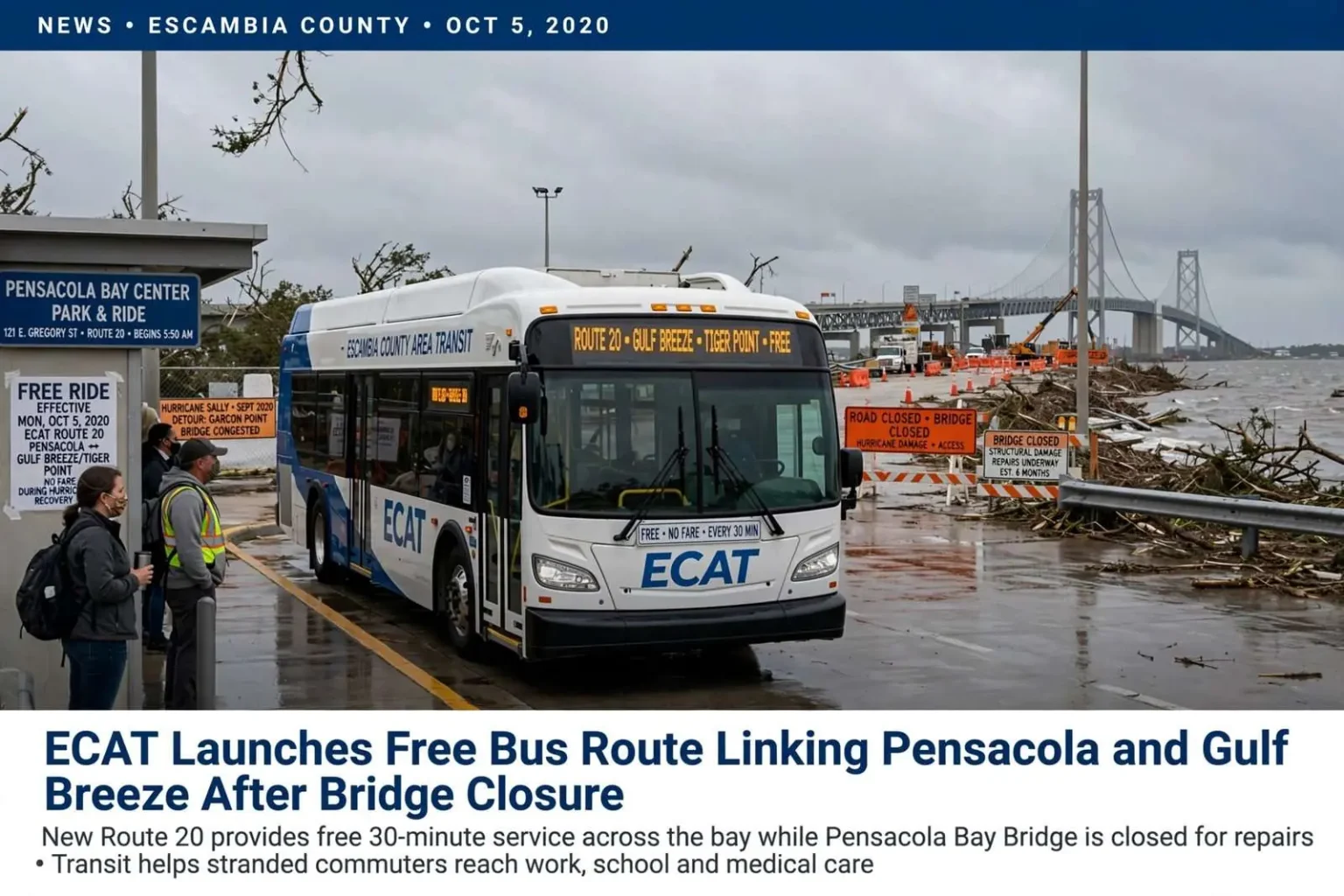
Escambia County Area Transit rolled out a temporary lifeline for commuters stranded by Hurricane Sally damage, launching a free bus route connecting Pensacola with Gulf Breeze while the storm-battered Pensacola Bay Bridge sat closed for repairs.
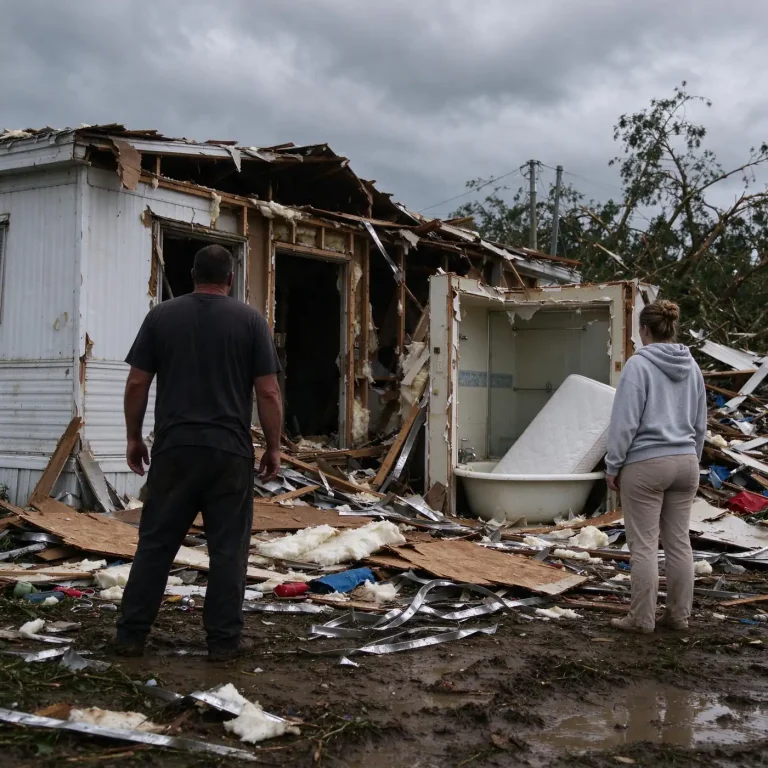
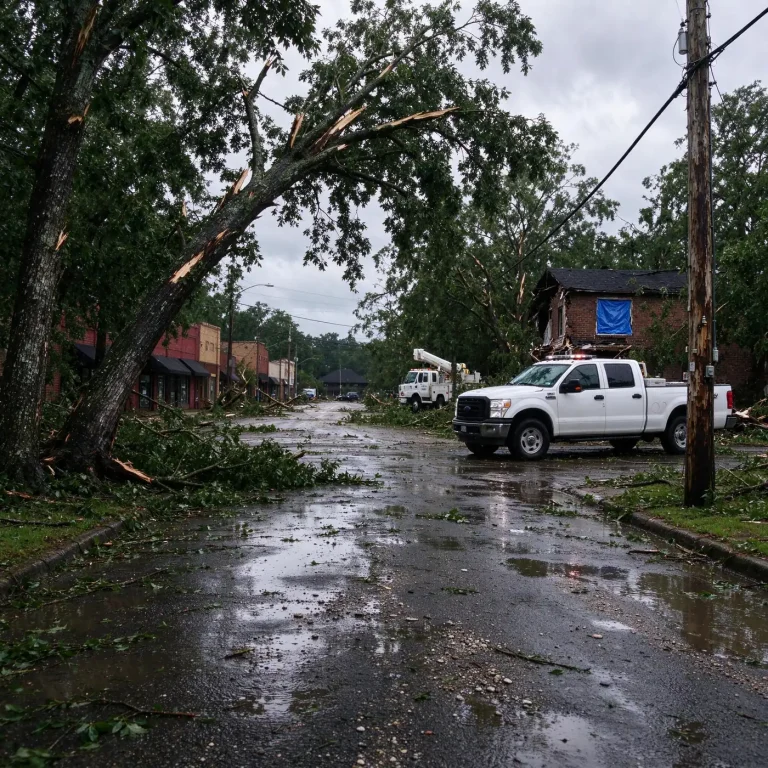
The new service arrived at a moment of acute strain. Hurricane Sally, which came ashore in September 2020 as a slow-moving Category 2 storm, knocked out the region’s principal bay crossing and left thousands of workers, students and families on the Santa Rosa side of the bay scrambling for a way to reach jobs, schools and medical appointments in Pensacola.
Route 20 details
The Florida Department of Transportation announced in early October that the bridge carrying U.S. 98 across Pensacola Bay would remain shut for roughly six months, weather permitting. The timeline meant residents could not count on a quick fix, and planners moved to give the region a dependable alternative while repairs proceeded.
In response, ECAT began operating its new Route 20 on Monday, Oct. 5, carrying passengers between Escambia County and the city of Gulf Breeze at no fare — ECAT had already suspended all bus fares following the hurricane, a gesture that continued as the region dug out from the storm.
Buses depart the Pensacola Bay Center Park and Ride lot at 121 E. Gregory St. beginning at 5:50 a.m., with the final run of the day leaving Tiger Point Community Center at 1370 Tiger Park Lane at 8:50 p.m. The reverse trip starts from Tiger Point at 6:05 a.m. and wraps up at the Bay Center by 8:20 p.m.
Buses arrive at the starting location every half hour, and the full route covers approximately 34 miles, with rides lasting 45 minutes to an hour depending on traffic. The schedule was built to cover a full working day, letting commuters on both sides of the bay reach early shifts and get home after late ones without depending on the choked road network.
Riders board at the downtown Pensacola park and ride, cross the bay by the available detour route, and ride down into Gulf Breeze and out toward Tiger Point, connecting neighborhoods that lost their direct highway link overnight.
Easing pressure on Garcon Point
With the bay crossing out of service, traffic on the Garcon Point Bridge surged nearly five-fold in the days after the storm, according to state transportation officials. Roughly 6,500 vehicles crossed that bridge daily before the closure; counts climbed to around 31,350 per day afterward.
The Garcon Point Bridge, a toll bridge spanning East Bay between the Milton area and Gulf Breeze, suddenly found itself carrying the load of a major interstate-class crossing. Commuters sat in long queues at both approaches, and the trip between Pensacola and communities along U.S. 98 that once took minutes stretched to an hour or more.
Transit leaders said the new route was designed to take some of that load off. “The intent is to alleviate traffic on the Garcon Point Bridge and to provide an easier commute between Pensacola and the City of Gulf Breeze,” said Escambia County Mass Transit Director Tonya Ellis, who credited the Florida Department of Transportation, Pensacola, Gulf Breeze and Santa Rosa County with getting the route running quickly after the storm.
The cooperation among four separate governments was notable in a region where service boundaries ordinarily divide transit planning. FDOT’s involvement reflected the scale of the disruption: with a state highway closed, the state had a direct interest in keeping people moving, and bus service was the fastest tool available.
Adjustments to Pensacola Beach service
ECAT also adjusted service to Pensacola Beach. Before Sally, Route 61 ran three trips a day linking the mainland to the barrier island, serving both beach workers and residents. With the storm’s damage to the causeway approaches and the island’s recovery needs, the agency reworked that service pattern to match where vehicles could actually go and where riders actually needed to be.
Pensacola Beach, cut off at times after the hurricane, depends entirely on a small number of crossings, and any disruption there strands a community of residents and the workforce that staffs its hotels and restaurants. The transit adjustments sought to keep that workforce connected while the road network was repaired.
What the closure meant for the region
The Pensacola Bay Bridge carries U.S. 98 between downtown Pensacola and Gulf Breeze, and for most drivers it is the only practical crossing of Pensacola Bay. When Sally’s winds and storm surge damaged it, the region’s road map was redrawn overnight: trips that crossed the bridge in minutes became long detours through Milton and over the Garcon Point span.
The economic stakes were considerable. Workers in Pensacola’s hospitals, shipyard, restaurants and offices live throughout Santa Rosa County, and Gulf Breeze residents depend on Pensacola for employment, medical care and commerce. Schools, delivery routes and emergency services all had to be rerouted around the gap in the network.
FDOT’s six-month estimate reflected the extent of the damage inspectors documented after the storm, and the agency warned from the start that weather could extend the schedule. For a crossing of that size, repairs involve not just the roadway surface but the structural elements beneath it, and crews must verify the safety of every span before traffic is allowed back.
How riders used the route
For commuters, the free Route 20 service offered a way to avoid the worst of the congestion entirely. A rider could park at the Bay Center lot, ride across the bay, and read or rest instead of white-knuckling the Garcon Point detour twice a day. Employers along the corridor encouraged workers to consider the bus, and the half-hour frequency made same-day schedule changes manageable.
The route also served residents without cars — a population that grows sharply after a hurricane, when vehicles are damaged or destroyed and household budgets are strained. Free fares across the whole ECAT system during the recovery period removed one more barrier for families putting their lives back together.
Transit planners noted that emergency routes like this one often reveal latent demand: people who would ride transit regularly if the schedule and destinations fit their lives. Whether any of the hurricane ridership carried over after the bridge reopened remained to be seen, but the episode demonstrated that the region could stand up a cross-bay bus service in a matter of days when governments coordinated.
Looking ahead
The temporary route was framed from the start as a bridge-era service, tied to the closure of the Pensacola Bay Bridge rather than a permanent addition to the ECAT network. As repairs progressed, officials said the route would be evaluated continuously and adjusted based on ridership and the state’s repair schedule.
For the six months the crossing remained shut, though, the message from ECAT and its partner governments was practical: the bridge is gone, the Garcon Point span is overloaded, and a free bus running every half hour is the fastest way to keep the two sides of the bay connected while the region’s most important crossing is rebuilt.
The story of the numbers
The traffic figures behind the closure tell the story plainly. A crossing built to absorb tens of thousands of vehicles a day was gone, and its substitute — the Garcon Point Bridge, a modest toll span that normally handles a fraction of that volume — was suddenly asked to carry nearly five times its usual traffic. Around 31,350 vehicles a day poured over a bridge designed and priced for about 6,500.
The effects rippled through daily life on both sides of the bay. Commute times doubled and tripled. Fuel costs climbed for families making the long detour. Local roads in Milton and along the detour corridors, never built for through-traffic at that scale, absorbed wear and congestion they had never seen. Businesses in Gulf Breeze worried about customers who could no longer reach them easily, and Pensacola employers worried about workers who could no longer reach them at all.
Against that backdrop, a free bus running every half hour over the same constrained road network still offered something valuable: predictability. A bus on a fixed schedule with a dedicated operator can be planned around in a way that an unpredictable traffic jam cannot. Riders arriving at the Pensacola Bay Center lot in the pre-dawn dark or catching the last evening run from Tiger Point knew exactly when they would travel.
The episode also highlighted the region’s dependence on a small number of water crossings. The Pensacola Bay area is defined by its water — the bay, the sound, the barrier islands — but every mile of open water is also a choke point when a storm damages one of the few bridges that span it. Sally demonstrated in a single day how quickly the region’s connectivity could collapse, and the rapid launch of Route 20 showed the corresponding value of having a transit agency positioned to respond.
Officials promised to keep the public updated as repairs advanced, and riders were encouraged to check ECAT’s published schedule for any adjustments to departure times as conditions changed along the detour corridors.