Egyptian Mummies and Eternal Life Makes American Debut at History Museum of Mobile
The Egyptian Mummies and Eternal Life exhibition makes its American debut at the History Museum of Mobile with more than 100 ancient artifacts.
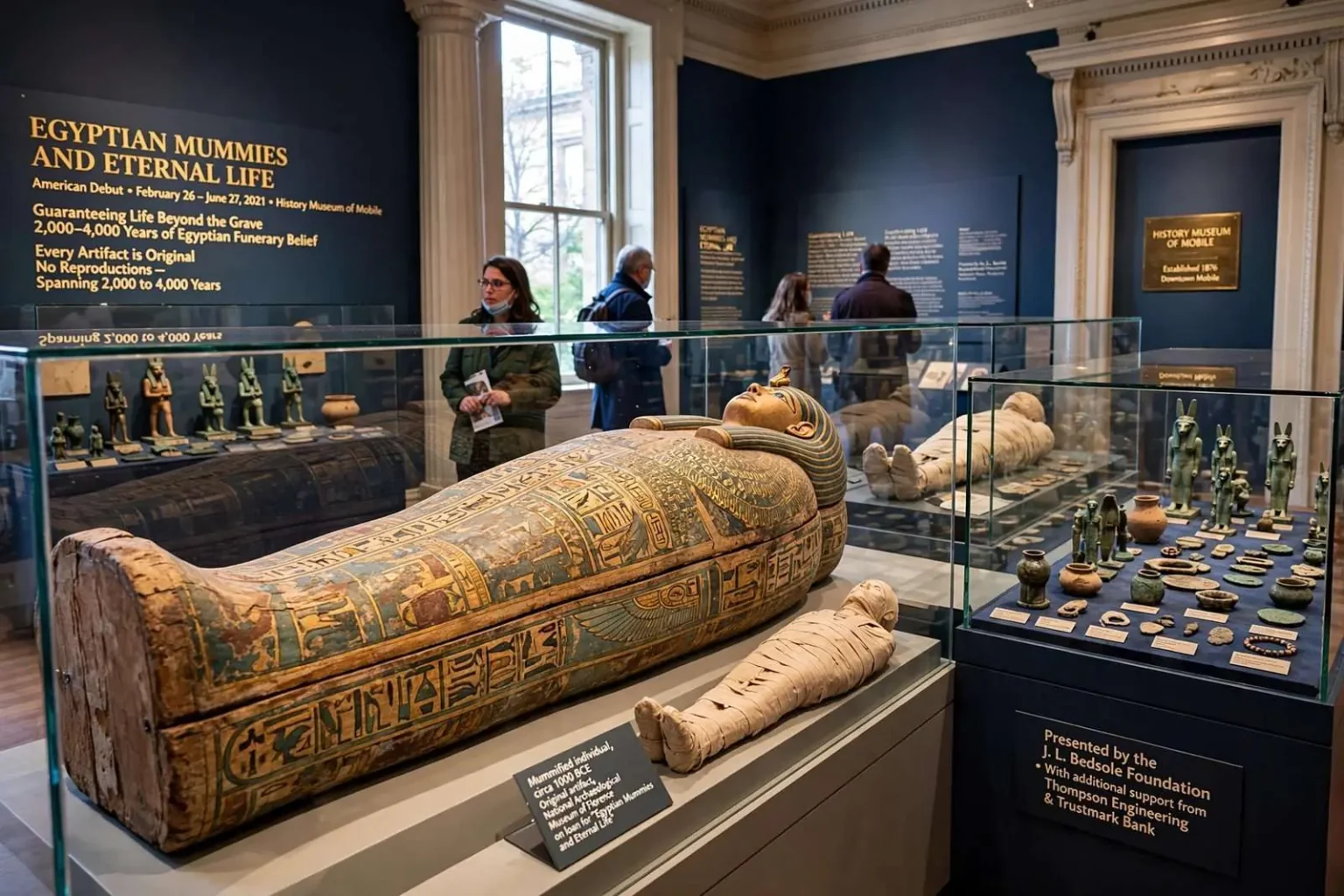
MOBILE, Ala. — More than 100 ancient Egyptian artifacts, including mummies, painted sarcophagi, funeral trousseau, and votive objects, went on display at the History Museum of Mobile as the touring exhibition “Egyptian Mummies and Eternal Life” made its American debut. The arrival of an international exhibition of this scale in downtown Mobile was an event few Gulf Coast residents could have imagined seeing without a trip to a major metropolitan museum, and it gave the city’s museum season a centerpiece unlike anything else on the regional calendar.
The exhibition, on view from February 26 through June 27, arrived in Mobile after earlier stops in Europe, Asia, and Canada. It was organized by Contemporanea Progetti of Florence, Italy, in collaboration with the National Archeological Museum of Florence, and presented locally by the J. L. Bedsole Foundation with additional support from Thompson Engineering and Trustmark Bank. The path the show traveled before reaching Alabama speaks to both its prestige and its ambition, a touring production built to bring one of the world’s great archaeological collections to cities far from the traditional museum capitals.
Every artifact an original
Every artifact in the show is an original, with no reproductions, ranging from roughly 2,000 to 4,000 years old. That fact alone set the exhibition apart. Visitors were not looking at casts or models but at the actual objects, from the small votive pieces left as acts of devotion to the great painted coffins built to carry the dead into eternity. Museums that host shows of authentic material of this age spend years arranging loans, insurance and transport, and the collaboration with Florence’s National Archeological Museum placed Mobile among the stops entrusted with that responsibility.
The range of the collection gave visitors a full sweep of ancient Egyptian funerary practice. Mummies sat alongside the painted sarcophagi built to protect them, while funeral trousseau, the assembled goods buried with the dead, and votive objects showed the material culture that surrounded Egyptian beliefs about death. Spanning two millennia, the objects demonstrated how the civilization’s burial customs evolved while its central convictions about the afterlife remained remarkably stable.
Organizers arranged the pieces thematically around a single idea: that Egyptian funeral rituals, even those that can seem macabre to modern eyes, were designed not merely to preserve the body but to guarantee the continuation of life beyond the grave. That framing guided visitors through the logic of Egyptian religion rather than presenting the artifacts as curiosities. The displays walked visitors through how mummification and entombment prepared the deceased for the afterlife in the tombs and pyramids of ancient Egypt, explaining each step of a process the Egyptians regarded not as morbid but as essential, the necessary work of securing immortality.
The significance of mummies in Egyptian belief is worth unpacking for visitors who arrive knowing only the pop-culture version. To the Egyptians, the body was not discarded packaging but a necessary vessel for the afterlife, which is why mummification developed into a sophisticated practice and why its failure threatened the deceased’s eternity. The painted sarcophagi in the show were engineered with the same seriousness, layered with prayers, protective figures and maps of the journey ahead, so that the occupant had everything required for the passage. Seen through that lens, the macabre impression fades and the objects reveal themselves as acts of devotion, made by families and craftsmen who believed they were preparing a relative not for an ending but for a continuation.
Votive objects carried a different kind of meaning. These were items presented in devotion, connecting the living to gods and to the dead, and their presence in a funerary exhibition helps visitors understand that Egyptian religion was not confined to the tombs of pharaohs. Ordinary people participated in the same system of belief, commissioning smaller objects and making offerings that carried their hopes into the temples and graves. A collection spanning 2,000 to 4,000 years captures all levels of that society, from the grandest royal-adjacent work to the humble pieces made for families of modest means.
Visiting during a pandemic
Because the exhibition opened during the COVID-19 pandemic, the museum operated under capacity restrictions. The timing was a challenge for a show built around close viewing and steady attendance, but it also meant that visitors who did come experienced the galleries at a level of calm that blockbusters rarely allow, with room to linger in front of objects that normally draw crowds several rows deep. Museum staff adapted quickly, building the reservation systems and timed entry practices that became standard for cultural venues during the pandemic.
The museum was open seven days a week, 9 a.m. to 5 p.m. Monday through Saturday and 1 to 5 p.m. on Sundays, with free admission on the first Sunday of each month. That free-Sunday tradition kept the exhibition accessible to families who might not manage the regular admission price, an emphasis consistent with the museum’s civic role in downtown Mobile. For a show of this caliber, the free Sundays were a genuine opportunity, offering the kind of access to world-class artifacts that is usually limited to those who can afford major-city museum visits.
Museum officials asked visitors to reserve a timeslot in advance for free Sundays, since demand was high; the March free Sunday had already filled shortly after tickets were released. Reservations were handled through the museum’s Facebook page, a practical choice that met visitors on the platform where the museum’s audience already followed its announcements. The speed with which the first free day filled confirmed what organizers suspected: demand along the Gulf Coast for authentic ancient artifacts was far stronger than the pandemic might have suggested.
The exhibition also arrived at a moment when cultural institutions everywhere were rethinking how to serve their audiences safely. Timed reservations, limited capacity and online booking were unfamiliar to many visitors at the start of the run, and museums that navigated them smoothly, as Mobile’s did, set the standard for the years that followed. The Facebook-based reservation system, unusual compared with formal ticketing platforms, lowered the barrier for older visitors and first-time users who already followed the museum socially, and it kept the process personal rather than technological.
The Economic and civic ripple effects of a run like this extend well past the museum’s doors. Visitors who came downtown for the exhibition filled nearby restaurants and shops before and after their tours, and the show’s months-long stay gave tourism promoters a cultural anchor to pair with the city’s other attractions. Museums across the country measure their impact in exactly these terms, and a debut exhibition of international origin gave Mobile a season-long draw that no single evening event could match, and one that reinforced downtown as the cultural center of the Gulf Coast region.
A milestone for the downtown museum
For Mobile, hosting the American debut underscored the downtown museum’s growing reputation for landing internationally organized exhibitions, a rare chance for Gulf Coast residents to see authentic ancient artifacts without leaving Alabama. The History Museum of Mobile, housed in the old City Hall complex in the heart of downtown, has long served as the region’s primary institution for history, and its ability to secure a show that had toured Europe, Asia and Canada reflected years of relationship-building with international organizers and local underwriters alike.
The local support structure made the engagement possible. The J. L. Bedsole Foundation, a Mobile philanthropic organization with a long record of backing educational and cultural projects across the region, took the presenting role, while Thompson Engineering and Trustmark Bank added support as sponsors. That pattern of local businesses and foundations underwriting cultural exhibitions has become an important part of how Mobile sustains its arts scene, connecting corporate resources with public access.
For schools across the region, the exhibition offered a field-trip destination with few local rivals, bringing lessons on ancient civilizations to life through objects students would otherwise know only from textbooks. Teachers along the Gulf Coast could build units around a visit, and the thematic organization of the show, focused on beliefs about death and eternity, gave older students material for serious study of religion, archaeology and cultural history rather than a simple spectacle.
From the first mummy case to the last votive offering, the exhibition gave Mobile a season it had never quite had before, an American debut claimed by a downtown Alabama museum. The run from late February through late June gave residents months to plan a visit, and the full free Sundays made sure the opportunity reached as broadly as possible. For everyone who walked the galleries, the show delivered what the best exhibitions always do, a direct, unmediated encounter with the distant past, in this case one lasting thousands of years, standing quietly in the heart of Mobile.