El Cantador Closes Southeastern Tour at Callaghan’s With Great Peacock
Mobile's El Cantador closed a Southeastern tour on Saturday, December 8, 2012, at Callaghan's Irish Social Club, sharing the bill with Nashville's Great Pe.
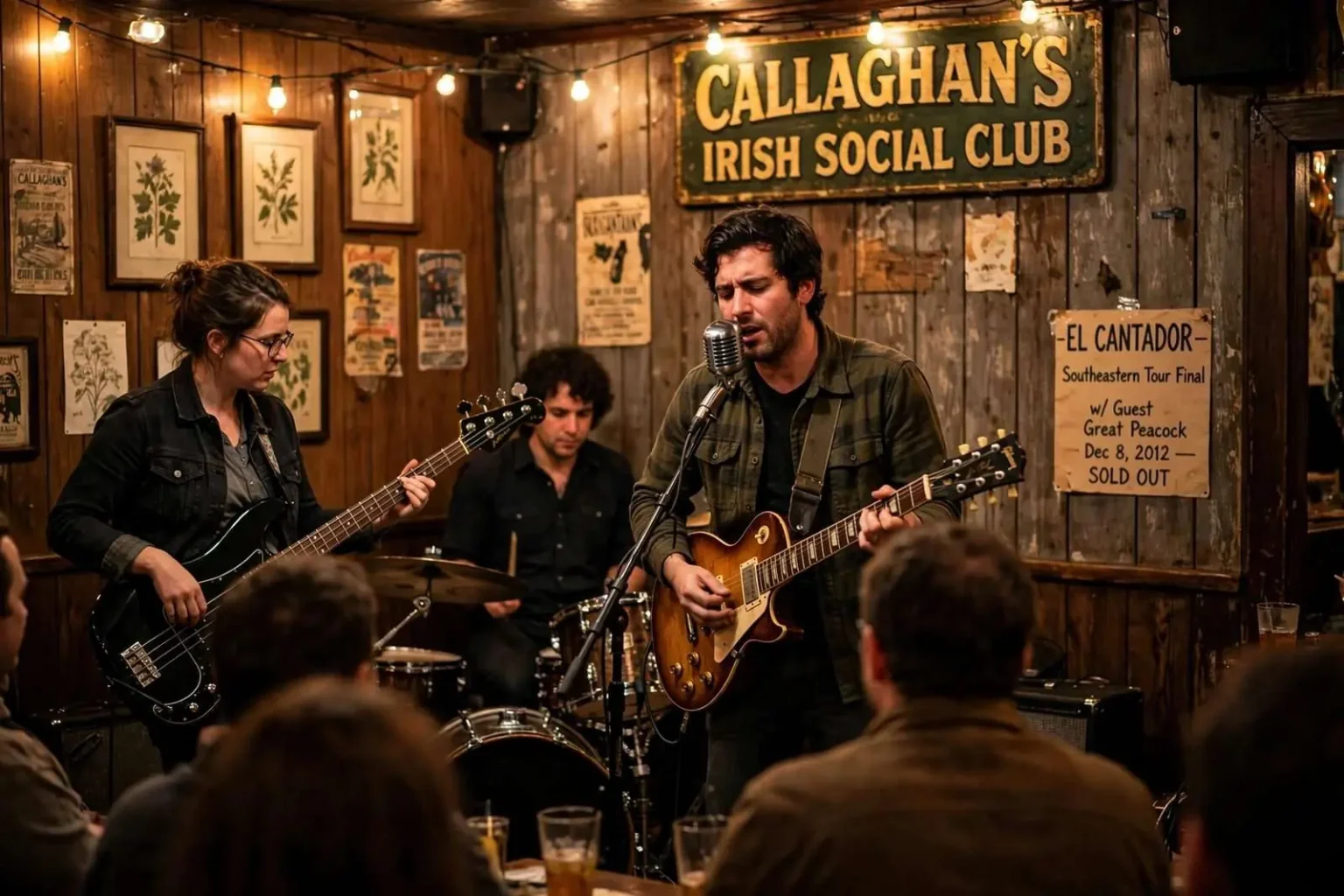
Mobile’s El Cantador closed a Southeastern tour on Saturday, December 8, 2012, at Callaghan’s Irish Social Club, sharing the bill with Nashville’s Great Peacock. For a band that had spent the year building its reputation on the road, ending the run at home — in the neighborhood room that has hosted more than one career on its way up — was a fitting final stop.
The homecoming carried real stakes for the band. Callaghan’s is not a room you ease into; its audiences sit close, listen hard and expect bands to deliver without the cushion of a big-stage sound system. El Cantador, one of Mobile’s most consistently ambitious indie rock acts, closed its Southeastern dates there with new material in hand and a hometown crowd on hand to hear it first.
A New EP and a Label Partnership
The band performed songs from its upcoming EP, Translation Wave, scheduled for release January 29. The record is co-released on This Is American Music, which also planned to reissue the group’s 2011 album Fools For Light. For a regional band, the pairing of a new EP and a reissued album amounts to a reset button: new songs to build a set list around, and a back catalog given fresh distribution at exactly the moment new listeners are paying attention.
The label relationship marked a milestone in the band’s trajectory. This Is American Music had made its name working with Southern independent acts, and its decision to both release Translation Wave and reissue Fools For Light signaled that El Cantador’s catalog was viewed as durable rather than disposable — music worth keeping in print while the band’s profile grew. “We are damn honored to be involved with all of these fine Mobile folks,” the label said, a statement that doubled as a nod to the city’s scene as a whole.
Translation Wave’s January 29 release date gave the December homecoming show the feel of a preview. Audiences at Callaghan’s heard the new songs before they existed as recordings anyone could stream, in a room small enough that the band could read faces while it played them. That sequencing — road-tested live first, released second — is how independent bands have always preferred to build records, and El Cantador’s tour closing at home made the city the first audience for the batch.
The Songs and the Sound
El Cantador’s music had, by 2012, settled into a sound that set it apart in the Mobile scene: rhythm-heavy, texture-rich indie rock with an experimental edge that still landed as songs rather than sketches. Fools For Light had established the band as one of the region’s most-recorded acts, and the prospect of a reissue gave newer fans a chance to trace how the group’s writing had evolved between the album and Translation Wave.
Live, the band built its reputation on precision and dynamics — the kind of performance where quiet passages actually get quiet, and the loud passages earn their volume. In a listening room the size of Callaghan’s, that dynamic range is an advantage: nothing is wasted on filling a big hall, and every shift in arrangement registers with an audience sitting a few feet from the amps.
The December 8 date also capped a stretch in which the band had scaled back its Mobile appearances as road demand grew — the classic trade-off of a working regional act. Staying home too often blunts the appetite for a hometown show; staying away too long cedes the home base. Closing the tour in Mobile, with new songs and a label partnership to show for the road work, was the balance struck.
Great Peacock Brings the Folk Side
Great Peacock, the Nashville duo of Andrew Nelson and Blount Floyd, brought folk melodies rooted in traditional folklore to the bill. The pairing gave the night a two-act arc — Nashville harmony and acoustic grounding from the visitors, Mobile’s electric experimentalism from the headliner — and positioned Callaghan’s, as it often does, as the kind of room where two different Southern traditions can share a stage comfortably.
Nelson and Floyd’s project drew on the storytelling side of Southern music rather than the volume side, and their songs leaned on melodies that predate any of them — the folklore tradition refracted through modern Nashville songwriting. For El Cantador’s audience, the opener offered a different vocabulary: Where the headliner worked in layers and electronics, Great Peacock worked in voices and strings, and the contrast made the bill feel curated rather than assembled.
Floyd’s brother, Wess, had previously appeared in town with the SouthSounds Music Festival, a connection that gave the visiting duo a thread into Mobile’s scene before they ever played a note here. That kind of link — one brother on a festival stage, another on a club bill months later — illustrates how the Gulf Coast circuit actually works: musicians circulate, vouch for each other, and the audiences follow.
SouthSounds and the City’s Scene
The SouthSounds Music Festival, which Wess Floyd had played, has become one of Mobile’s signature contributions to the regional music economy — a multi-day showcase built specifically on emerging acts, staged across downtown venues. For local bands, SouthSounds functions as both a coming-out party and a network node, connecting Mobile acts with regional ones in front of industry scouts and hometown crowds alike. El Cantador and Great Peacock both belonged to the world SouthSounds was built to spotlight: Southern independent artists on the way up, booked city to city by word of mouth.
That ecosystem is why a December Saturday at Callaghan’s mattered beyond the door count. Mobile’s scene runs on exactly this exchange — local headliners with national ambitions, regional openers with their own followings, and a handful of venues trusted to present both. The bill that closed El Cantador’s tour was a working example of the circuit in miniature.
Callaghan’s as a Listening Room
Callaghan’s, long praised as one of Alabama’s best listening rooms, has hosted everyone from local acts to touring names; a caller recently learned Alabama Shakes had played there less than a year before their Grammy nod. That last fact has become part of the room’s lore — told and retold by regulars who want newcomers to understand what the unassuming neighborhood bar represents: a stage where a band can be unknown in one season and world-famous the next.
The listening-room reputation is earned through the room’s physical character. Callaghan’s is small, close and acoustically honest; conversation dies when the music starts, not because of house rules but because the sound leaves nowhere to hide. For touring artists used to bars where the stage is wallpaper, the room’s attention is a revelation, and for Mobile audiences it has created a culture: you come to Callaghan’s to hear the band, not to talk over it.
The Bar Behind the Stage
Part of Callaghan’s endurance comes from the fact that it is, first and last, a neighborhood bar. The Oakleigh Garden District watering hole built its base on food, regulars and a porch culture long before it became a magnet for serious music, and that foundation is what allows it to take chances on bills like El Cantador and Great Peacock. The room does not need any single show to survive, which frees it to book for love of the music — and audiences can tell the difference.
The Alabama Shakes footnote gives the room’s booker a standing argument. When a band can play your stage and, within a year, be collecting Grammy nominations, every subsequent booking carries a plausible “remember where you heard them first.” That reputation compounds: serious local musicians want to play there, regional acts ask for the date, and national ones add the room when routing between New Orleans and the Panhandle.
For El Cantador, the December 8 date stacked those advantages. A hometown headlining set, in the city’s best listening room, with new songs premiering and a reissue on the way — few bands get to close a tour from a stronger position, and the crowd on hand understood it was seeing a scene moment, not just a gig.
What the Tour Closed Out
The Southeastern run that ended that Saturday represented the band’s investment in the road — the slow, unglamorous accumulation of markets, audiences and mileage that turns a local act into a regional one. Closing it at Callaghan’s meant the tour’s final impressions were formed at home: a sold-quality room, familiar faces, and a bill that introduced Nashville collaborators to the band’s base.
The timing also positioned the band for the January 29 release. Translation Wave would arrive with the momentum of a finished tour, a label doubling down on the catalog, and a hometown audience already carrying the new songs in its head. Independent releases live or die on exactly that foundation — and Mobile’s date on the calendar was where the foundation got poured.
The reissue of Fools For Light completed the picture. Between the EP and the album, This Is American Music effectively gave the band a two-record presence heading into the new year — rare support for a regional act, and a measure of the label’s stated esteem for “all of these fine Mobile folks.”
The Room, the Band, and the Moment
Stripped to its essentials, the night was Mobile’s scene doing what it does best: a hometown band sharing its new work with its own city, a Nashville duo finding a new audience one room at a time, and a listening room doing what it has done for years — putting the music in front of people who came to hear it.
El Cantador’s December 8, 2012 closing date at Callaghan’s Irish Social Club, with Great Peacock on the shared bill, stands as the kind of night the city’s music calendar is built around: Translation Wave still ahead of its January 29 release, Fools For Light headed back into print, a label honored to be involved, and a Mobile crowd that knew its band had come home from the road with something to show for it.
Why Homecomings Matter on the Gulf Coast Circuit
The December date fits a pattern that Gulf Coast music watchers know well. Regional bands that tour hard eventually reach a decision point: the road pays in exposure but not much else, and the hometown show is where the two currencies — exposure and community — get exchanged. Callaghan’s has long been the venue where that exchange happens in Mobile, because its listening-room culture treats a local band’s return the way bigger cities treat a theater date.
The bill’s construction reinforced it. Great Peacock’s folk-rooted set gave El Cantador’s electric close a narrative frame — the region’s acoustic tradition handing off to its experimental present — and gave the touring duo a Mobile debut backed by a hometown headliner’s crowd. On the Southeastern club circuit, that kind of mutually beneficial pairing is how scenes stay connected between festivals, and December 8 offered a compact demonstration.
For the band, the arithmetic at the end of the night was straightforward: a tour closed, new songs heard by the people most invested in hearing them, a label partnership publicized, and a homecoming completed in the room best suited to hold it. Not a bad way to end a road year — and with Translation Wave still a month from shelves, the best part of the story was left for January.