Elberta Man, 20, Critically Injured After Truck Crashes Into Power Pole in Escambia County, Florida
A 20-year-old Elberta, Alabama, man was critically injured Wednesday evening when his pickup truck ran off Bauer Road in Escambia County, Florida, and struck a power pole, Florida Highway Patrol says.
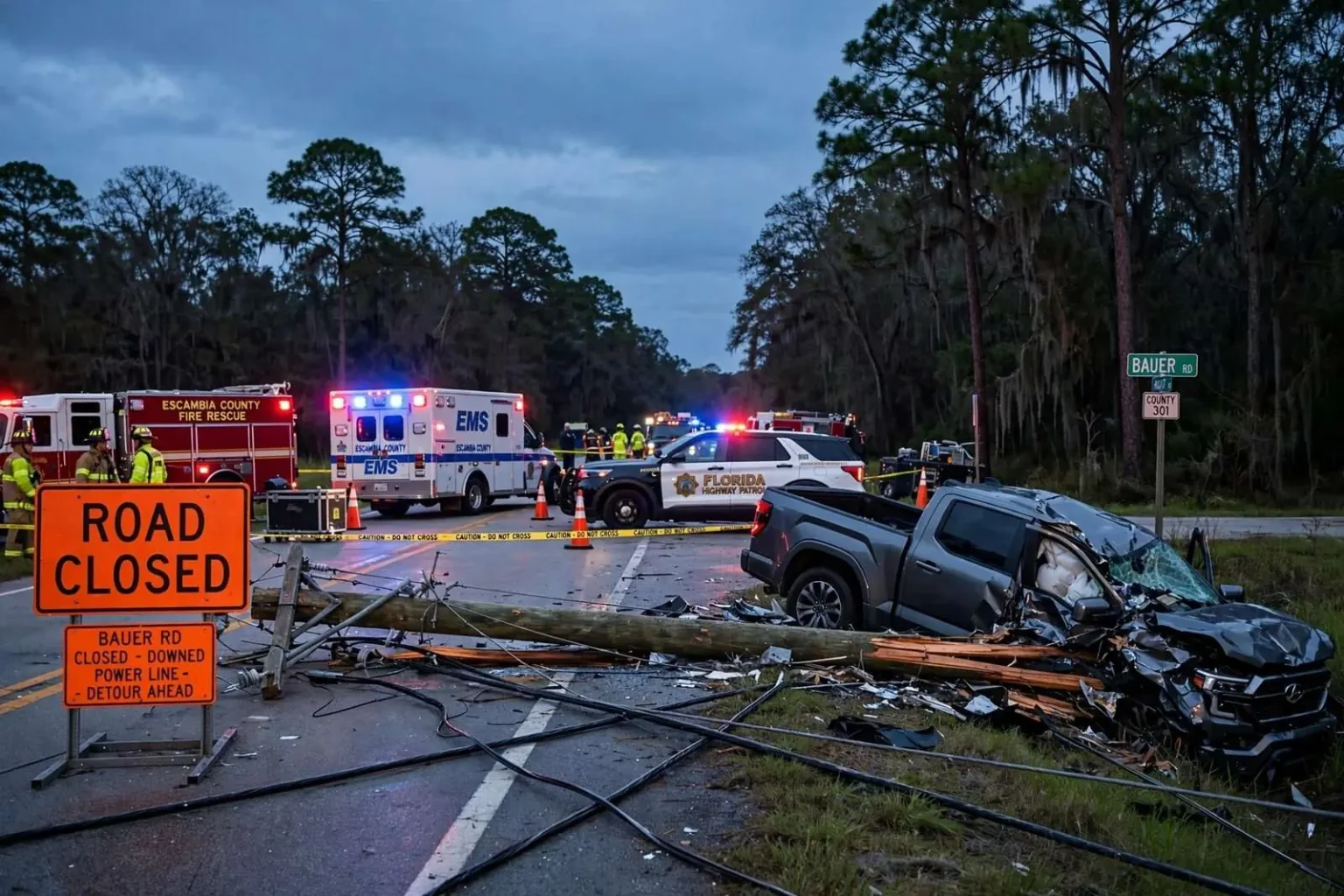
A 20-year-old Elberta, Alabama, man was critically injured Wednesday evening after his pickup truck ran off a rural road in Escambia County, Florida, and crashed into a power pole, according to the Florida Highway Patrol. The crash happened around 7:05 p.m. on Bauer Road, south of U.S. Highway 98, troopers said. Escambia County Fire Rescue and EMS crews responded to the scene.
Florida Highway Patrol says the driver ran off the roadway while traveling on Bauer Road and struck the pole, causing him to be ejected from the truck. He was transported to a hospital with critical injuries. Ejection from a vehicle is among the most dangerous outcomes possible in a single-vehicle crash, dramatically increasing the risk of fatal and life-changing injury, and the young driver’s critical condition reflected that reality. Troopers did not release details about whether a seat belt was in use at the time of the crash.
The crash site lies in the fast-growing corridor south of U.S. Highway 98 in Escambia County, an area of rural roads, residential subdivisions and wooded parcels between Pensacola and the Perdido Bay communities. Bauer Road itself carries a steady mix of local commuter traffic, and like many routes in the region it runs straight through stretches where speeds can climb well above what rural shoulders and fixed objects like utility poles can forgive when a vehicle leaves the pavement.
Road Closed for Downed Line, Fire Hazard
The impact knocked down the power pole, leaving a live wire in the roadway and creating a fire hazard, FHP said. Bauer Road was blocked off in the area for repair work, and troopers said the closure was expected to remain in place for the foreseeable future while crews addressed the downed line.
Downed power lines transform a crash scene from a traffic incident into a public safety emergency that extends well beyond the involved vehicles. Energized lines on or near the roadway can electrocute anyone who comes into contact with them or with the ground around them, and responders must establish a safety perimeter until the utility can cut power to the affected span. The fire hazard cited by troopers adds a second danger: a damaged vehicle leaking fuel near arcing electrical equipment is a scenario fire crews treat with the highest urgency.
Utility crews responding to such crashes face the same work whether the pole was struck at midnight or at rush hour: setting a replacement pole, re-hanging lines and restoring service to the homes and businesses fed by the circuit. The closure of Bauer Road in the area of the crash meant detours for local drivers, and officials cautioned that the closure would remain in place for the foreseeable future — language that signals an extended repair rather than a same-evening reopening.
The Florida Highway Patrol continues to investigate the exact circumstances that led the truck to leave the roadway. In single-vehicle run-off-road crashes, investigators typically examine speed, roadway conditions, visibility, driver distraction, impairment and any mechanical factors before determining a cause. The results of that investigation determine whether any charges follow and appear in the crash report that insurers and families rely on afterward.
A Crash With Roots on Both Sides of the State Line
The driver’s home in Elberta, Alabama, underscores how tightly woven the communities of southern Baldwin County and southern Escambia County have become. Elberta sits just north of the Alabama-Florida line, close enough that daily life — school, work, shopping, and evening drives — routinely crosses the state boundary. Elberta residents travel Pensacola-area roads so regularly that a crash on Bauer Road, though it happened in Florida, sent ripples back through a small Alabama town of roughly a thousand people where news of a young resident’s critical injury travels quickly.
The corridor south of U.S. 98 has seen substantial growth in recent years, as Pensacola’s expansion pushes residential development west and south along the coast. That growth puts more traffic on rural two-lane roads that were never designed for it, and fixed-object crashes — into trees, ditches and utility poles — remain among the most lethal crash types on such roads. Utility poles along the roadway are particularly unforgiving: they are rigid, they are close to the travel lane in many places, and a striking vehicle often wraps around them or snaps them at the base, as happened on Bauer Road.
Emergency response to the scene highlighted the multi-agency nature of rural crash work. Escambia County Fire Rescue handles fire suppression, hazardous-electrical scenes and vehicle extrication, while EMS provides advanced life support transport to the region’s trauma-capable hospitals. Florida Highway Patrol takes over the traffic-crash investigation and roadway closure management. Each agency’s piece of the response must fit with the others’, particularly on a scene complicated by a live wire, where no one approaches the vehicle until the electrical hazard is controlled.
No further details on the driver’s condition or the crash investigation have been released. What remains known is the sequence: a Wednesday evening drive, a departure from the roadway, a violent encounter with a power pole, an ejection, a critical hospitalization, and a stretch of Bauer Road closed while the electrical infrastructure was rebuilt.
Single-vehicle crashes involving utility poles often cause secondary hazards beyond the initial collision, including power outages and fire risk from exposed lines, which is why emergency crews frequently close affected roadways until utility repair teams can safely clear the scene. The Bauer Road closure followed that standard practice exactly. Residents of the area were left to plan around the closed road, and utility customers served by the damaged circuit faced the possibility of interruptions while repairs proceeded.
What Drivers Can Take From the Crash
For drivers who use rural roads like Bauer Road every day, the crash is a reminder of the physics and choices that govern single-vehicle outcomes. Speed on a rural two-lane road shortens the time available to correct a drift off the pavement. Seat belts prevent the ejections that turn survivable crashes into critical ones. And the fixed objects that line rural routes — poles, trees, mailboxes and ditch culverts — mean that even a brief departure from the lane can produce a devastating impact.
The investigation by the Florida Highway Patrol will ultimately fill in the missing details: how fast the truck was traveling, why it left the road, and whether any contributing factors beyond the driver’s actions played a role. Until that report is complete, the crash stands as one more entry in the region’s all-too-familiar pattern — a young driver, a rural road south of U.S. 98, a pole that did not move, and a community on both sides of the state line hoping for recovery.
Meanwhile, the repair work on Bauer Road proceeds on the timeline utility crews dictate rather than the one drivers prefer. Replacing a snapped pole and re-energizing lines safely is careful work, and the “foreseeable future” closure troopers described reflects the reality that electrical repairs cannot be rushed. Drivers who normally cut through the area were advised to plan alternate routes until the road reopens, and the crash scene itself remains a marker of how quickly an ordinary evening drive can end in a hospital, a closed road and a damaged power grid.
Escambia County’s rural south has a long history of crashes like this one, which is why area responders drill repeatedly on the coordination a downed-line scene demands. The first minutes belong to sizing up hazards: Is the line energized? Is there fuel on the ground? Are there patients who cannot be reached until the electrical threat is cleared? Only after those questions are answered can rescuers approach the vehicle, and the difference between a controlled scene and a second casualty often comes down to that discipline. On Bauer Road, crews handled those steps while managing a closed road and a damaged circuit simultaneously.
The timing of the crash, around 7:05 p.m. on a Wednesday evening, placed it in the window when commuter and after-work traffic is heaviest on roads like Bauer Road. Darkness complicates such scenes for responders and passing drivers alike, and the closure of the roadway in both directions within the crash area served the added purpose of keeping curious drivers away from the live-wire zone. Troopers and fire crews on scene diverted traffic while repair work continued under the area’s streetlight-less rural darkness.
For the utility serving the area, the repair sequence after a pole strike is methodical: de-energize and ground the affected lines, clear the wreckage, set a new pole, transfer conductors and equipment, restore the circuit, and only then release the roadway back to traffic. Each step protects both the crews and the public. Until that sequence ran its course on Bauer Road, the “foreseeable future” closure troopers announced was the safest language available, and residents who use the road daily were left to build their routes around a gap in the map.