Elizabeth Warren endorses Kiani Gardner in Lower Alabama congressional runoff
U.S. Sen. Elizabeth Warren has endorsed Kiani Gardner in the Democratic runoff for Alabama's 1st Congressional District, the Lower Alabama seat.
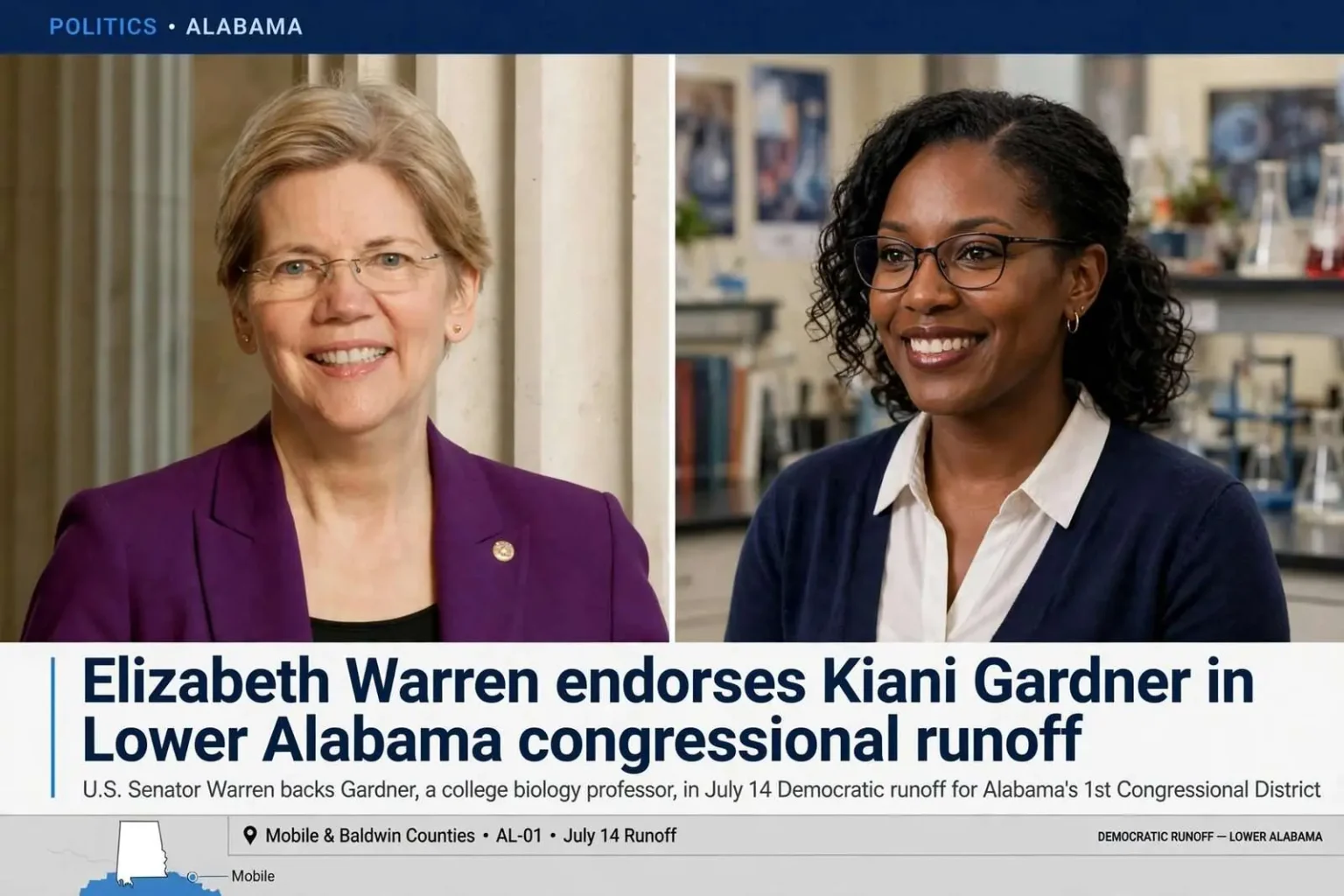
U.S. Sen. Elizabeth Warren has endorsed Kiani Gardner in the Democratic runoff for Alabama’s 1st Congressional District, the Gulf Coast seat often referred to as Lower Alabama. Gardner, a college biology professor, faces James Averhart in a July 14 runoff that will determine who carries the Democratic nomination into the general election for the district anchored by Mobile and Baldwin counties.
Warren announced her endorsement with a statement praising Gardner’s approach to lawmaking. “Kiani Gardner will bring a data-driven approach to legislation to make our government work for everyone,” Warren said. “She is dedicated to meaningful change.”
Gardner welcomed the endorsement from the Massachusetts senator, pointing to the policy work that defined Warren’s own campaign for the Democratic presidential nomination. “As a congressional candidate who is focused on putting forward legislation supported by data rather than rooted in ideology, I am honored by Senator Warren’s endorsement,” Gardner said. She thanked Warren and praised her presidential campaign for the detail of its policy proposals — a hallmark of Warren’s run, which produced dozens of fully drafted plans on issues from health care costs to rural investment.
What the runoff will decide
The July 14 runoff is the deciding contest for a Democratic nomination that neither Gardner nor Averhart won outright in the primary. When a primary does not produce a majority winner, Alabama law sends the top two finishers to a runoff, and the winner becomes the party’s nominee for the general election. For Gardner and Averhart, the runoff is the last chance to consolidate the party’s voters behind a single candidate before the fall campaign against the Republican nominee in a district that has leaned strongly Republican in recent years.
The 1st District stretches across the state’s southern tier — Mobile and Baldwin counties on the coast, along with Washington, Monroe, Escambia, and other counties of south Alabama. It is a region where Democrats remain competitive in local races even as federal offices have shifted firmly to the GOP, and the runoff campaign has centered on which candidate can assemble the broadest coalition of coastal Democrats, Black Belt voters and rural party loyalists across the district’s many counties.
Why a national endorsement matters here
Warren’s endorsement carries weight beyond her name recognition. As one of the Senate’s most prominent progressives, she signals to national donors and activist networks which candidates the party’s wing is watching, and endorsements from national figures often bring fundraising attention and volunteer energy that a local campaign cannot generate on its own. For Gardner, a first-time federal candidate and a scientist running in a political landscape far from Washington, the backing of a senator known for detailed policy work aligns directly with the campaign’s central pitch.
Endorsements also frame the choice for undecided runoff voters. With the July 14 contest approaching, many Democrats in the district know both candidates only through mailers, debates and local coverage, and a statement from a national figure gives them a shortcut for judging which way a candidate would vote in Congress. Gardner’s campaign has emphasized exactly the trait Warren highlighted — a preference for evidence-based legislation — drawing on her background as a college biology professor to argue for data over ideology in lawmaking.
Averhart’s campaign, for its part, has built its case on his own biography and connections to the district, and he continues to court the same runoff electorate. Runoff dynamics favor whichever campaign can identify its voters and get them to the polls on a summer day when turnout will be a fraction of a general election’s, making organization and persistence decisive in the contest’s final weeks.
Lower Alabama’s political landscape
The 1st District’s nickname — Lower Alabama — captures a region with a distinct identity from the rest of the state. Mobile’s port and industries anchor the economy, Baldwin County’s fast-growing suburbs stretch along the eastern shore of Mobile Bay, and rural counties to the north and east depend on agriculture, timber and small manufacturing. Politically, the district’s coastal counties dominate the vote, and any Democrat who wins the nomination faces the task of running up margins in Mobile while holding losses down in Baldwin and the rural counties.
The seat opened up when its longtime Republican incumbent chose not to seek re-election, setting off one of the most competitive open-seat contests in Alabama in years on both sides of the ballot. That dynamic has drawn attention from national parties and political observers, who treat the general election as a potential test of Democratic strength along the Gulf Coast even though the district’s fundamentals favor Republicans. The July 14 runoff is the Democrats’ step in settling their side of that contest.
The data-driven pitch, and what it means for south Alabama
Gardner’s argument for evidence-based legislation speaks to concrete issues in the district. Health care access in rural counties, the vulnerability of coastal communities to hurricanes and flooding, the future of Mobile’s port, and funding for public schools are all areas where policy details — grant formulas, insurance rules, federal disaster programs — determine how much federal money reaches south Alabama and how well it works once it arrives. A candidate arguing for data-driven lawmaking is effectively promising to sweat those details rather than campaign on slogans.
Whether that pitch wins the runoff is what Democrats across the district will decide on July 14. Warren’s endorsement gives Gardner a national validator for the approach; Averhart’s campaign gives voters a different choice. The winner will carry the nomination into a fall campaign across Lower Alabama, where the runoff’s themes — evidence, health care, coastal resilience and economic opportunity — will remain at the center of the debate no matter which Democrat emerges.
For now, the Gardner campaign is treating the Warren endorsement as both a boost and a validation. In a runoff decided by turnout, the message from Boston that a Mobile-area candidate has national backing is worth real attention — and both campaigns know the only number that matters is the vote count on July 14.
Warren’s profile and the politics of endorsements
Elizabeth Warren’s endorsement list carries particular meaning for progressive-leaning Democrats because of how she built her own political brand: a former Harvard law professor and bankruptcy expert who entered the Senate in 2013 and made consumer protection, economic fairness and meticulous policy preparation her signature issues. Her presidential campaign became known for rolling out detailed legislative blueprints, and candidates she endorses typically lean into that same “have a plan” identity. Gardner’s emphasis on legislation “supported by data” places her squarely in that tradition, adapted to a Gulf Coast district where the issues run from hurricane recovery to rural hospital closures.
For Alabama Democrats, national endorsements are a double-edged sword that campaigns manage carefully. They can energize the party’s base and draw outside money, but in a conservative state, opponents can use a national figure’s profile to paint a local candidate as out of step with the district. Gardner’s camp clearly calculated that the benefits outweigh the risks in a Democratic runoff, where the audience is the party’s most engaged voters — the very people most likely to know and respect Warren’s work.
The road from runoff to November
Whoever wins on July 14 inherits a demanding fall campaign. The 1st District’s Republican nominee will enter the general election as the favorite based on the district’s recent voting history, meaning the Democratic nominee must both unify a primary electorate divided between two candidates and make a persuasive case to independents and crossover voters in Mobile’s suburbs and the district’s rural counties. Campaign resources matter enormously in that effort: the district spans hundreds of miles, from the Florida line to the Black Belt’s edge, and reaching voters requires staff, advertising and tireless travel across county fairs, civic clubs and church gatherings.
The runoff’s winner will also become the district’s Democratic standard-bearer on down-ballot races, campaigning alongside legislative candidates and local officials whose fortunes rise with turnout. That role — part nominee, part party builder — is an underappreciated part of what a July runoff decides. For Gardner and Averhart, the final stretch is about closing the sale with the party’s voters; for the district’s Democrats, July 14 settles who carries their banner into a fall campaign across Lower Alabama.
Runoff campaigns in south Alabama also run on ground game. With turnout expected in the low single digits of registered voters, each campaign’s ability to identify supporters and chase them to the polls matters more than any advertisement. County-level chairs, precinct volunteers and phone banks make the difference between a candidate’s paper strength and their actual vote total, and campaigns that have quietly built those lists since the primary usually reap the benefit on runoff day.
The July 14 calendar itself shapes the contest. A mid-July election, held when families travel and attention drifts toward hurricane season and summer routines, rewards relentless voter contact and punishes campaigns that coast after the primary. Both Gardner and Averhart have spent the stretch since the primary courting the voters who chose someone else in the first round, and the candidate who absorbs more of those supporters typically wins a runoff outright.
Whatever the result, the endorsement fight has already added a national dimension to a local race. Warren’s statement put the district’s runoff in front of observers far beyond Lower Alabama, and Gardner’s embrace of the data-driven label ensures the theme will follow the Democratic nominee into the general election — where voters from Mobile Bay to the Conecuh River will judge for themselves whether it fits the district they call home.