EPA grant to fund effort to cut trash flowing into Dog River
A $328,000 EPA grant will help Dog River Clearwater Revival expand litter cleanup and tracing efforts in the Mobile, Alabama watershed.
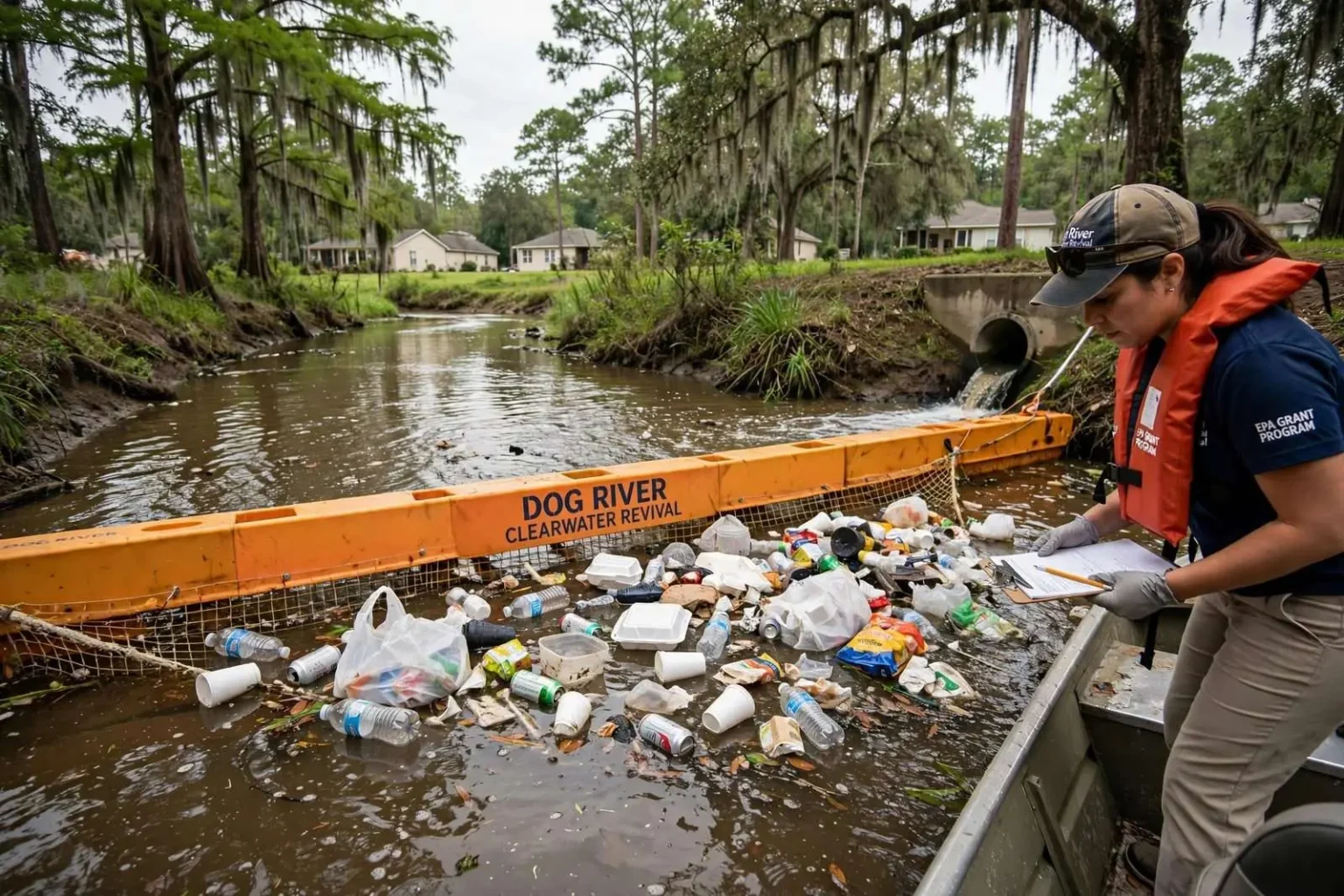
MOBILE, Ala. — Trash washing into Dog River has been a persistent problem for years, and a local group is poised to expand its cleanup work with the help of a federal grant. Dog River Clearwater Revival is awaiting final approval on a $328,000 grant from the Environmental Protection Agency to fund programs aimed at reducing litter in the watershed.
The organization says the money will support efforts to trace where the trash comes from and stop it before it ever reaches the water. Rather than simply pulling debris out of the river after the fact, the grant-backed work is aimed upstream — at the parking lots, drainage ditches and storm drains where a discarded bottle or bag begins its journey to the bay.
“At the end of the two year grant, there will be a 50% reduction in the amount of litter that comes down the Dog River watershed,” said Debi Foster, executive director of Dog River Clearwater Revival.
That target is ambitious for a watershed that has battled litter for decades. Dog River and its tributaries drain a broad swath of west Mobile before emptying into Mobile Bay, and every hard rain carries street litter into the network of creeks that feed the river. Residents who live along the water have long reported bottles, Styrofoam, plastic bags and construction debris collecting against their docks and bulkheads after storms.
How litter reaches the river
The litter travels from upstream, flowing from parking lots and storm drains into waterways such as Eslava Creek before reaching Dog River. The pattern is typical of urban watersheds: trash dropped on streets and parking lots gets moved by wind and rain into the storm drain system, and storm drains in older parts of Mobile discharge directly into creeks rather than passing through treatment of any kind.
Once litter enters that system, it moves fast. A cup tossed in a parking lot off Airport Boulevard can be in a creek within hours of a summer downpour, and in the river soon after. From there the current carries it toward the bay, snagging on overhanging limbs and collecting in the quiet coves where much of it stays until someone removes it by hand or by boat.
Three litter traps are already in place along Eslava Creek — a large one maintained by the city and two smaller ones designed and maintained by the Osprey Initiative. The devices work like floating booms stretched across a narrow point of the creek, funneling floating debris into a capture basket where it can be hauled out before it moves farther downstream.
“We like to put the little devices out. They’re a little high maintenance, but we feel that gives us a better tactical solution at the spot to keep it from ever getting into these urban waterways,” said Don Bates, owner of Osprey Initiative.
Bates’ operation has specialized in exactly that kind of in-stream interception across the Gulf Coast region, placing smaller capture units at trouble spots that large municipal equipment cannot reach. The tradeoff is maintenance: the traps must be emptied regularly, especially during the rainy season, or they fill, clog and stop working — which is why the smaller units demand more attention than the city’s large trap.
What the grant will fund
The EPA grant will fund additional litter traps placed after research identifies hotspots, meaning the new devices will go where the data says the trash is heaviest rather than where it is most convenient. Mapping where debris enters the system — which outfalls, which creeks, which neighborhoods — is the first step of the grant period, and the trap placements will follow the findings.
The money also supports a program at a local high school to teach students about litter issues, an educational component aimed at the next generation of watershed residents. Anti-litter education has a long tail: students who learn where storm drains lead tend to carry the lesson home, and school-based programs have proven to be among the most cost-effective pieces of debris-reduction work.
A third piece of the grant funds work on a device to keep trash from falling out of truck beds — one of the most common sources of roadside litter in the Mobile area. Unsecured loads shed cups, cans and debris on highways and city streets, where the next rain washes them into the drainage system. A practical retention device, if it proves workable, attacks the problem at its source.
Why the watershed matters
Dog River is one of Mobile’s most closely watched urban watersheds. The river and its tributaries thread through established residential neighborhoods in west Mobile, and much of the waterfront is lined with private homes whose residents see the litter problem daily. The river also feeds into Mobile Bay’s ecosystem, where floating debris threatens fish, birds, dolphins and sea turtles — animals that mistake plastic for food or become entangled in it.
Local groups like Dog River Clearwater Revival have spent years organizing volunteer cleanups, reporting illegal dumping and pressing for better stormwater management. The organization’s work grew out of concern from waterfront residents, and its approach has evolved from cleanup after the fact to interception and prevention upstream — the philosophy the EPA grant is designed to accelerate.
The grant also reflects a broader shift in how federal environmental funding treats urban litter. What was once dismissed as an aesthetic nuisance is now understood as a pollution problem with measurable costs: debris damages stormwater infrastructure, degrades habitat, lowers property values along affected waterways and adds to the cleanup burden on local government.
A strategy for the city
Beyond its own projects, Dog River Clearwater Revival plans to deliver a comprehensive trash strategy to the City of Mobile at the end of the two-year period. That deliverable may prove to be the grant’s most lasting product. A data-backed strategy — documenting where litter enters the watershed, which interception methods worked, and what ongoing investment would keep the numbers falling — gives city officials a template for expanding the program beyond the grant period and possibly to other watersheds in the city.
Mobile’s stormwater system, like those of most Gulf Coast cities, was built over decades and faces constant pressure from growth and heavy rainfall. Litter interception devices, public education and source-reduction measures represent a layer of defense that can be added without rebuilding drainage infrastructure, which is why cities across the country have adopted similar programs.
The two-year clock matters, too. Interception devices take regular maintenance, education programs take consistent staffing, and behavior change takes repetition. The 50% reduction target gives the organization a concrete benchmark to measure against, and the strategy document will capture what the effort taught along the way.
What residents can expect
For residents of the Dog River watershed, the most visible signs of the grant will be new traps appearing on area creeks, students working on litter projects at the partner high school, and ongoing reporting on what the devices capture. Volunteer cleanup efforts are expected to continue alongside the grant-funded work, since even a 50% reduction still leaves plenty of debris to remove.
The organization’s message to the community has been consistent: the trash in the river comes from the neighborhoods around it, and reducing it is a shared job. Every secured truck load, every piece of litter that makes it to a garbage can instead of a storm drain, is one less item for a trap to catch or a volunteer to haul out.
With federal funding in place pending final approval, the Dog River watershed is about to become one of the most closely studied and actively managed urban waterways on the Alabama coast — and if the program meets its target, a case study other Gulf Coast cities can follow.
The wider fight against litter on the Gulf Coast
Mobile’s effort mirrors work underway in other Gulf Coast cities, where stormwater litter has become one of the most stubborn pollution problems urban waterways face. Coastal communities from Louisiana to Florida have installed similar interception devices on drainage outfalls and creeks, and the results have been consistent: capturing debris at a few strategic chokepoints removes more trash than dozens of volunteer cleanups, and it removes the debris before it fragments into smaller, harder-to-collect pieces.
The fragmentation problem is a major reason prevention beats cleanup. A plastic bottle that floats downstream intact can be scooped out of a trap; the same bottle that spends months in the current breaks into smaller pieces under sunlight and wave action, eventually reaching a size that no boom can catch and that wildlife ingests easily. Interception near the source keeps plastic out of the water long enough to matter.
Local waterways have paid the price for decades of unchecked runoff. Coastal Alabama’s rivers and bays receive stormwater from a growing urban footprint, and studies of area waterways have repeatedly found plastics among the most common debris items collected. Groups such as Dog River Clearwater Revival, the Osprey Initiative and other regional organizations have built their programs around the reality that the trash problem starts on land.
The high school component of the grant fits that land-based approach. Watershed education programs that place students alongside working professionals — checking traps, sorting and weighing captured debris, mapping entry points — tend to produce the kind of lasting awareness that signs and slogans do not. The captured-debris data students help collect will also feed the hotspot research that determines where the new traps go.
For now, the organization is moving ahead while final approval is completed, with the two-year clock and the 50% reduction goal ahead of it. If the program performs as designed, Dog River’s next chapter could look markedly different from its last one — a river carrying half the litter it does today, and a city holding a tested strategy for keeping it that way.