

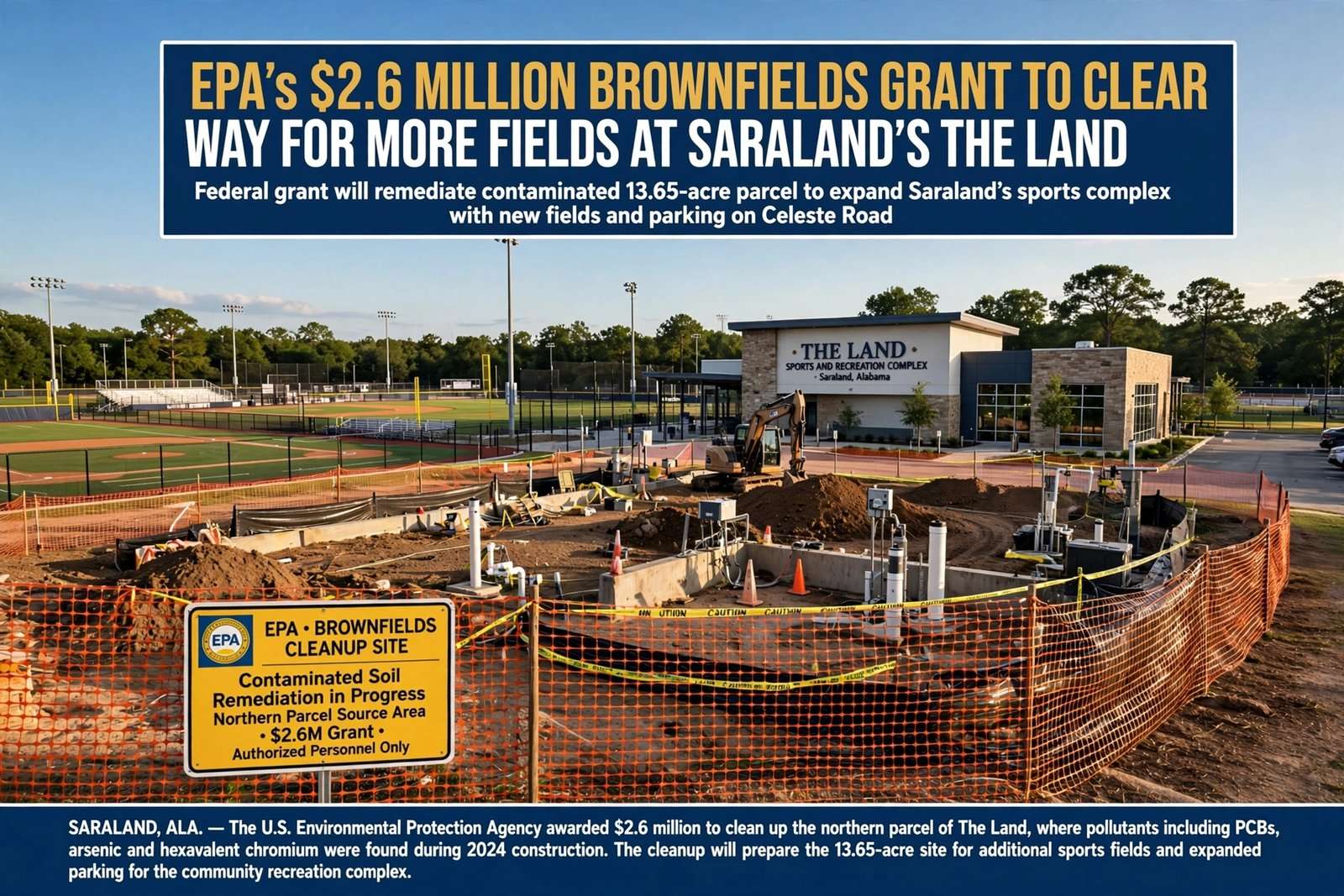
SARALAND, Ala. — A federal grant of $2.6 million will pay to clean up a contaminated corner of Saraland’s sports complex, a problem that surfaced when crews began grading the land and one that city leaders hope to turn into room for more fields and parking.
The U.S. Environmental Protection Agency awarded the City of Saraland a Brownfields Cleanup Grant for the northern portion of The Land Sports and Recreation Complex, where workers uncovered what city documents describe as “foreign material” during construction. The award was highlighted Sept. 30 at an event in Saraland with EPA Region 4 Administrator Kevin McOmber, U.S. Rep. Barry Moore, Saraland Mayor Joe McDonald and state environmental officials.
The South Alabama Regional Planning Commission also received $1.5 million to identify and assess other properties in the region that may be contaminated. Together, the two awards account for about $4 million of the $6.1 million in brownfields grants the EPA announced for Alabama this round.
“Words aren’t enough. We are so excited to get this done and get moving,” McDonald said.
What was found at The Land
The affected area sits on property that was surface-mined for sand and clay in the 1960s and 1970s. According to the city’s grant application to the EPA, unknown industrial fill was later deposited on the site after mining ended. The city bought the property in 2007, and the contamination came to light in 2024 when grading began for the sports complex.
The application describes a roughly 13.65-acre “Northern Parcel Source Area” inside the 100-acre complex on Celeste Road. Testing found several pollutants at levels above the EPA’s screening levels for residential use, including polychlorinated biphenyls, or PCBs, the wood preservative pentachlorophenol, hexavalent chromium and arsenic. The city estimated about 168,000 cubic yards of affected soil, extending as deep as 35 feet in places, and reported finding buried drums containing volatile organic compounds.
The city requested about $2.61 million for the cleanup. The affected area is fenced off from the rest of the complex.
A complex residents already use
The Land is Saraland’s signature recreation investment, a roughly $72 million, 100-acre project built in phases. Its indoor complex includes basketball, volleyball and pickleball courts, an indoor walking track and a fitness center, and the outdoor side includes a cluster of ball diamonds.
“We have eight ball fields that can be used for softball or baseball. We’re really very well utilized,” City Council President Natalie Moye said.
The recreation center and fields have been in use for more than a year, and Moye said the grant will let the city keep building on what it already has.
“As with all dreams, it takes funding to get there, and so, what this funding is going to allow the City of Saraland to do is just continue to expand on what we’ve already built here,” Moye said.
What could be built
Exactly what will go on the cleaned-up land has not been decided, but city leaders have plenty of ideas. Parks and Recreation Director Ashley-Nicole Flowers said she would like to see fields for sports that use a rectangular layout.
“Some rectangle multi-purpose fields, whether it was lacrosse, football and soccer,” Flowers said. “I would love to see even mega fields, which can include more diamond fields plus rectangle altogether.”
McDonald said parking is the most pressing need, followed by more space for programs.
“We’ve got to increase our parking and we’ve got some other issues, but hopefully once this is done and the financing is there, and we still have the money, we would like to see some of our fields grow and have more activities and sports,” he said.
The city’s grant application lists a planned reuse that includes ball fields, tennis, basketball, pickleball and volleyball courts and green space intended to serve regional sports tourism.
Cleanup tied to economic development
McDonald said the money matters for more than the property itself, because it lets the city recover value for residents from land that would otherwise sit unusable.
“That’s a lot of money, but being able to reimburse that money back in our community and future generations means the world to me and our council and our community,” he said.
Edward Poolos, director of the Alabama Department of Environmental Management, said the awards show how cleanup and growth can go together.
“It shows that we can combine environmental stewardship, environmental cleanup, and economic and community development,” Poolos said. “So, this is a tremendous thing for the community, south Alabama, and the state of Alabama.”
McOmber, the EPA regional administrator, described the grants as “opportunities to re-imagine contaminated properties as assets that meet community needs.”
How the brownfields program works
A brownfield is a property whose reuse or redevelopment is complicated by the presence, or potential presence, of hazardous substances or pollutants. Former mines, industrial sites, gas stations and dumps are common examples. The EPA’s Brownfields Program, launched in 1995, provides grants to local governments, regional agencies, tribes and nonprofits to assess and clean up such sites so they can be put back into productive use.
The program offers several types of grants:
- Assessment grants pay for inventories, environmental testing and cleanup planning at sites suspected of contamination.
- Cleanup grants fund the actual removal or containment of contamination at specific sites the applicant owns.
- Multipurpose grants combine assessment and cleanup work in a target area.
- Revolving loan fund grants let communities make low-interest loans and subgrants for cleanups.
According to the EPA, the program has provided more than $3 billion in funding over its history and has leveraged more than $45 billion in cleanup and redevelopment investment, with about $19.47 leveraged for each EPA grant dollar.
Regional assessment funding
The $1.5 million awarded to the South Alabama Regional Planning Commission is an assessment grant, which will be used to find and evaluate other properties in the region that could have environmental problems. SARPC serves Mobile, Baldwin and Escambia counties and helps local governments with planning, grants and economic development. Assessment work is often the first step toward cleanup, because developers and lenders are typically reluctant to invest in a site until its environmental condition is known.
What happens next
Beginning Oct. 1, the city and the EPA will work together to determine exactly how the money will be used. McDonald said funding is expected to become available at the end of the current fiscal year and continue into the following year.
Cleanup of contaminated soil on a site of this size typically involves additional sampling, a cleanup plan subject to regulatory review and public input, and then excavation, removal or capping of the affected material before construction can begin. Only after that work is completed will the city be able to move ahead with new fields, parking or other amenities on the northern parcel.