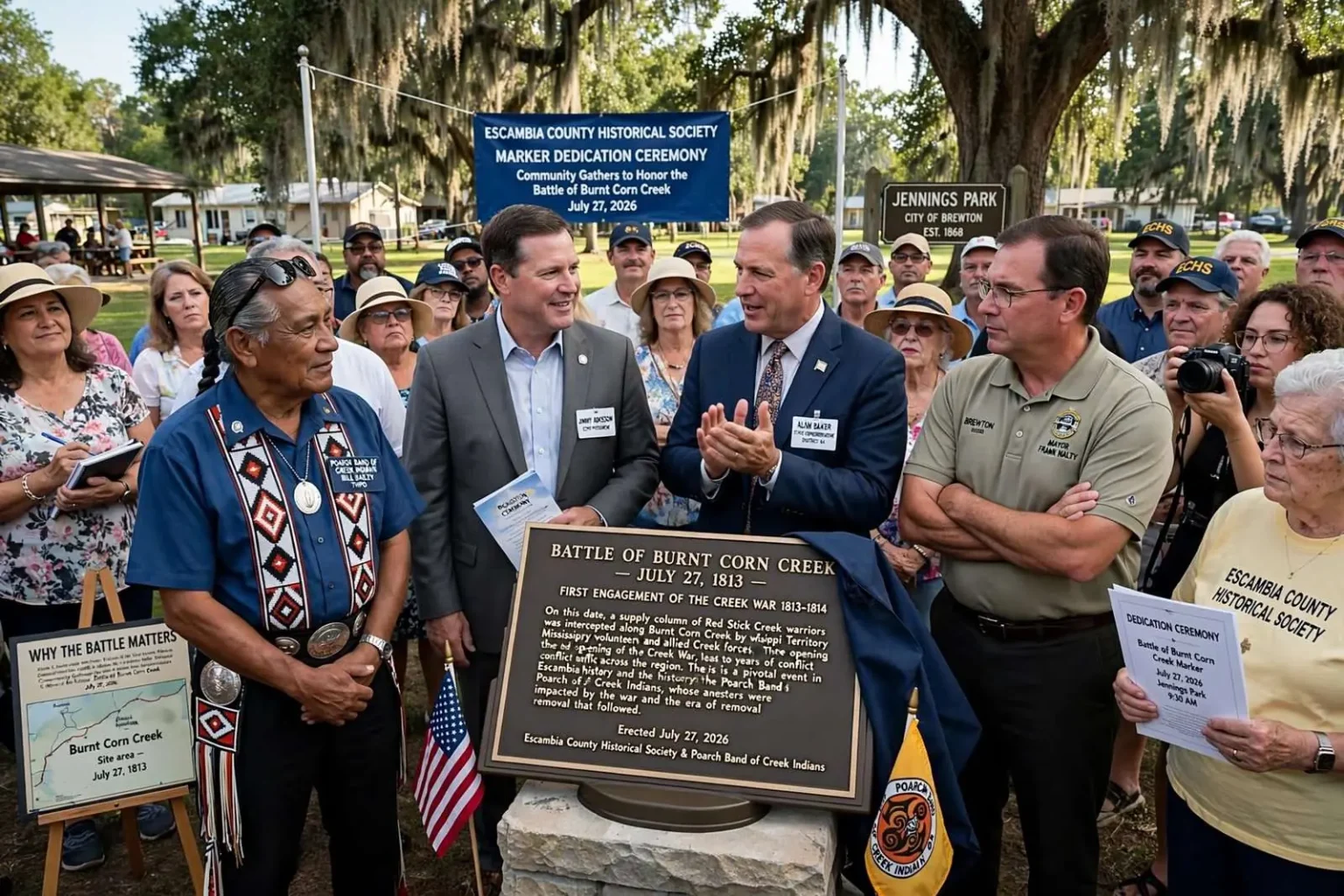
Update, July 27, 2026: The dedication ceremony went forward as scheduled at Jennings Park in Brewton, with community members gathering to see the new marker unveiled honoring the 1813 Battle of Burnt Corn Creek. Speakers highlighted the battle’s lasting impact on both Escambia County and the Poarch Creek Indians, whose ancestors were directly affected by the conflict and the broader Creek War that followed. The original preview of the ceremony continues below.
The Escambia County Historical Society will hold a dedication ceremony this weekend for a new plaque honoring the Battle of Burnt Corn Creek, one of the opening clashes of the Creek War of 1813-14. The ceremony is set for Saturday, July 25, beginning at 9:30 a.m., in the area behind Aunt Elsie’s Ice Cream Shoppe near Burnt Corn Creek. The event marks the anniversary of the battle, which took place on July 27, 1813. Organizers say a Poarch Creek Tribal leader and archivists are expected to speak at the ceremony, offering historical context and previously researched details about the battle and its aftermath. Local officials, including Brewton Mayor Frank Nalty and State Representative Alan Baker, are also expected to attend. Attendees are asked to park in the general public parking area along St. Nicholas Avenue, across from Provalus, before making their way to the ceremony site at Jennings Park.
Why the battle matters
Historians widely regard the Battle of Burnt Corn Creek as the first significant engagement of the Creek War, a conflict that pitted U.S. forces and allied Creek factions against Creek Indians resisting encroachment on their land. While the precise location of the skirmish has never been definitively pinned down, historical accounts place it at a bend along Burnt Corn Creek in what is now Escambia County. The battle unfolded amid escalating tension between white settlers and factions within the Creek Nation, tension that would soon erupt into broader violence across the region.
The engagement grew out of the turbulence sweeping the Creek Confederacy in the wake of Tecumseh’s campaign through the Southeast two years earlier, when a movement known as the Red Sticks had risen among the Upper Creeks vowing to resist American expansion and revive traditional ways. Volunteers from the Mississippi Territory, joined by allied Creek warriors, had intercepted a Red Stick supply column returning from Spanish Florida with gunpowder and lead, and the firefight that followed along the creek became the first armed clash of what would become a defining war of the Southeast. Though the attackers dispersed the supply party, the Red Sticks retained much of the ammunition — a detail historians note when explaining the confidence with which the movement struck next.
Its most immediate and devastating consequence came weeks later, when Creek warriors attacked Fort Mims, killing hundreds of settlers and allied Indians in one of the deadliest events in Alabama’s territorial history. The massacre at the Tensaw stockade, north of Mobile, stunned the frontier and drew state militias and federal armies into the war, culminating in Andrew Jackson’s victory at Horseshoe Bend in 1814 and the Treaty of Fort Jackson, which forced the Creek Nation to cede vast tracts of land — including much of what would become southern Alabama.
The wider war ultimately contributed to the forced removal of most Native Americans from the Southeast in the decades that followed, the era of dispossession the Poarch Creek’s preservation officers describe as the Trail of Tears. The Poarch Band of Creek Indians, whose reservation today sits in Escambia County, descends from Creek families who avoided removal in the 1830s and remained in their homeland along the Alabama River’s tributaries — a survival that makes the Burnt Corn story part of the tribe’s own account of how the war reshaped its people’s world.
A marker years in the making
Saturday’s dedication offered area residents a chance to learn more about that history directly from tribal representatives and historians, and to see the new marker installed at Jennings Park up close. The ceremony is free and open to the public. Historical markers of this kind require months of research, wording approval and casting, and the society’s decision to place the marker in Brewton rather than at the remote creek site reflects both the practical limits of access to the battlefield area and the park’s role as the county’s gathering place for civic observances.
The ceremony’s timing — on the weekend of the battle’s 213th anniversary — follows a tradition the society has built of marking Escambia County’s early history, from colonial-era settlements to the timber and railroad booms that created Brewton itself. County historians have long argued that Burnt Corn Creek deserves recognition alongside Alabama’s more famous war sites, noting that the engagement’s opening shots drew the frontier into a war whose consequences reached from the Gulf to the Tennessee line.
Update (Aug. 1, 2026): More details have emerged from Saturday’s dedication ceremony at Jennings Park, where a large crowd turned out to see the new marker unveiled. Jimmy Adkisson, president of the Escambia County Historical Society, told attendees the battle had a profound effect on later events in the county’s history, while ECHS Vice President Don Sales thanked Robert Smiley for his work on the marker’s wording and recognized the family of Tom McMillan, founder of the local historical society. Bill Bailey, Tribal Historical Preservation Officer for the Poarch Band of Creek Indians, called the battle a turning point that led to the Trail of Tears for many Creek ancestors. State Rep. Alan Baker also addressed the crowd along the dedication path on the banks of Burnt Corn Creek.
What comes next for the site
With the marker now standing in Jennings Park, the historical society plans to continue its work documenting the creek corridor, where the exact engagement site remains a matter of research rather than consensus. Archaeology and period accounts have narrowed the possibilities to a bend of the creek south of the modern community of Burnt Corn, but the society says it hopes future fieldwork — and the increased attention the dedication has drawn — will help resolve the question.
The inclusion of the Poarch Band’s preservation office in the ceremony marked a milestone for how the event is remembered. For generations, the battle was recounted almost entirely from the settlers’ perspective; the presence of the tribe’s historical preservation officer, and his framing of the battle as a turning point that set the removal era in motion, placed the Creek account at the center of the ceremony. Local educators have already indicated interest in the marker as a destination for history classes studying the Creek War, giving Brewton’s newest historical display a second life as a teaching resource. The Escambia County Historical Society maintains archives in Brewton and welcomes research inquiries from descendants of both settler and Creek families connected to the war’s events.
The road to the war’s opening battle ran directly through the settlement patterns of the early 1800s. Burnt Corn Creek took its name from a pioneer community that grew up at the crossing of the Pensacola and Old Federal roads, a junction that made the area a way station for travelers, mail riders and moving families between the Georgia interior and the Gulf. When the conflict arrived in 1813, the mixed settlement of the creek country — newcomers from the Carolinas and Georgia, allied Creek towns, and long-established trading families — found itself at the seam between two worlds heading for collision. The volunteers who marched to intercept the Red Stick supply column were organized from those very settlements, and the war that followed emptied and rebuilt them more than once.
For Brewton, the marker adds a chapter to a downtown already rich with preserved history. The city grew up as a timber town on Murder Creek and the Conecuh River’s tributary network, and its courthouse square and historic district record the lumber barons and railroad men of a later century. The Burnt Corn marker, a short drive from that district, ties the county seat’s story back to the frontier decades that preceded it — a span local historians like to describe as running from the first settlers’ log crossings to the sawmills that built the town.
The ceremony also demonstrated the reach of county historical societies in Alabama’s smaller counties, where volunteer researchers often produce the documentation the state’s marker program requires. The wording on the new plaque drew on archivists’ review of period correspondence, military reports and family papers, and the society credited local contributors for the research behind it. Societies in neighboring Conecuh, Monroe and Baldwin counties have pursued similar projects, part of a regional effort to mark the Creek War’s sites before firsthand knowledge of them fades entirely.
Residents who missed Saturday’s dedication can view the marker any time in Jennings Park, where the historical society plans a small interpretive display describing the battle and the war that followed. The society’s publications on Escambia County history, including its earlier work on the county’s pioneer communities, remain available through the Brewton public library, and the organization has indicated it will host further programs on the Creek War era as research continues along the creek corridor.