Fact check: Hightower’s claims about Carl and Schillinger Road project are misleading
A fact check found Bill Hightower's claims that Jerry Carl steered a Schillinger Road project to benefit his property were misleading; the work was planned.
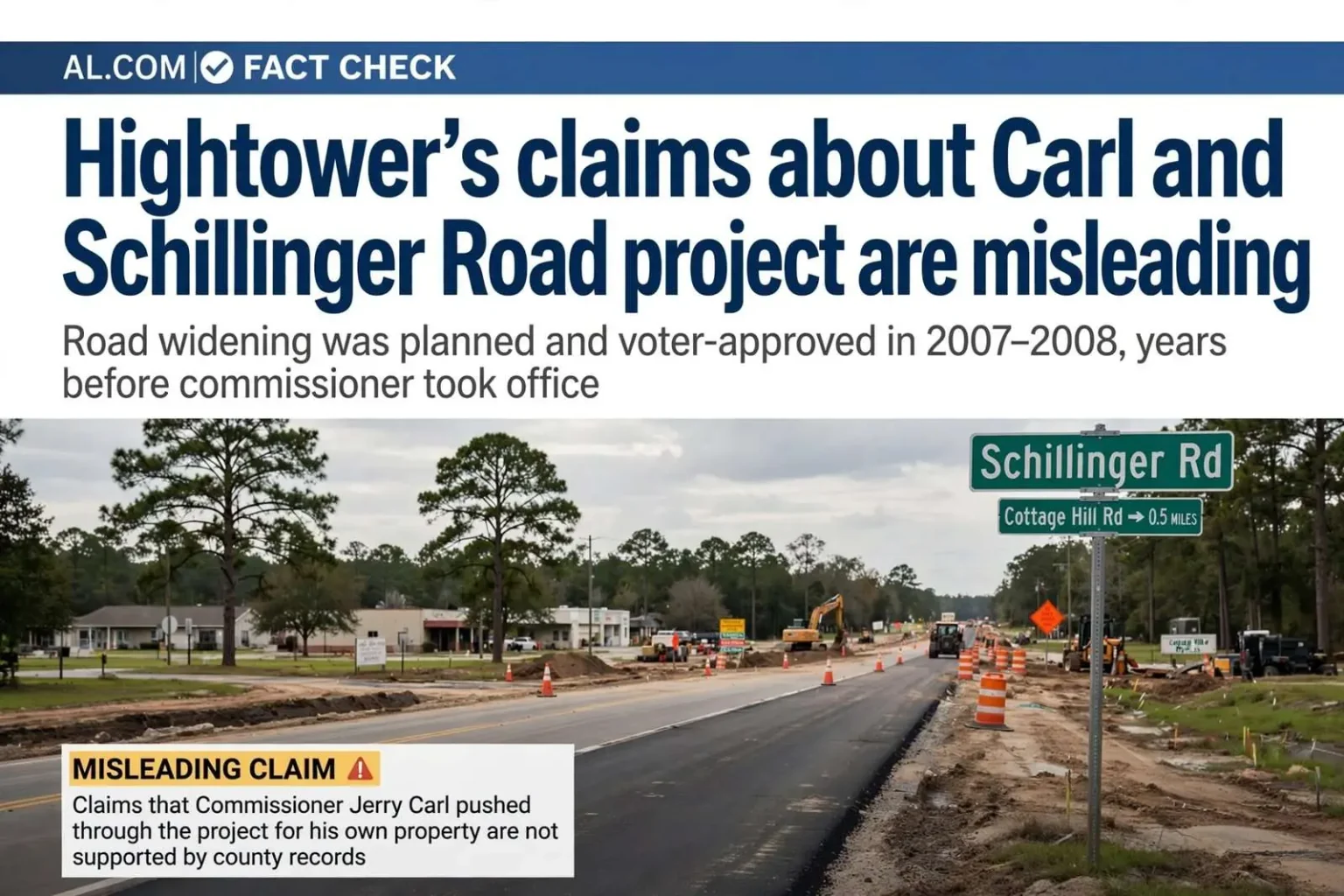
A fact check shows that former state Sen. Bill Hightower’s claims that Mobile County Commissioner Jerry Carl pushed through a road project to boost property he owns are misleading. Hightower and Carl were facing off in the July 14 Republican runoff for Lower Alabama’s congressional seat when Hightower made the claim in a press release. The race for the 1st Congressional District nomination had turned contentious in its final weeks, and the road project became the centerpiece of Hightower’s attack on his rival.
The press release alleged Carl “abused $10 million in tax dollars to expand a road adjacent to his property.” A mailer sent to voters made a similar charge, saying Carl “used his time as County Commissioner for a $9.6 million road project to benefit his own business.” The figures differed, but the accusation was the same in both versions: that a sitting county commissioner had steered public money toward pavement beside his own land.
The project in question is the widening of Schillinger Road south of Cottage Hill Road, a long-planned improvement to one of west Mobile County’s most congested corridors. Schillinger Road carries heavy commuter and school traffic through a rapidly growing part of the county, and the widening had been discussed by transportation planners for years as development pushed west of Highway 90. Carl does own property on West Side Park Drive, directly off that stretch of the road — a fact that made the attack line plausible-sounding and gave it traction in mailboxes and on social media.
But county records show the road work was planned in 2007 — five years before Carl took office and six years before he voted to allow construction bids. By the time Carl cast any vote touching the project, its route, scope and funding source had been set for more than half a decade by other officials, in meetings Carl did not attend. The chronology, documented in commission minutes and state records, undercuts the claim that he originated or steered the project.
Where the project actually came from
The road widening traces back to one of the biggest economic development deals in Alabama history: the ThyssenKrupp Steel mill in Calvert, in north Mobile County. To land the massive German steel plant, the state assembled an incentive package worth hundreds of millions of dollars. As part of that effort, the Mobile County Commission agreed in 2007 to cover $30 million in incentives, and the Alabama Department of Transportation committed to widening Schillinger Road in return — a trade of road improvements to accommodate the traffic and growth the mill would bring to the region.
Voters weighed in directly on that arrangement. They approved the ThyssenKrupp plan in a 2007 special election, and they approved the Schillinger Road project itself in a 2008 vote. The project’s funding, in other words, was not a budget line a county commissioner quietly inserted; it was a publicly voted commitment tied to the county’s share of the steel mill incentives, approved years before Carl’s political career in county government began.
Construction did not start until much later, which is where the timing gap opened that Hightower’s campaign tried to exploit. Major highway projects routinely sit between planning and construction for years while right-of-way is acquired, designs are completed and funds are staged. When the Schillinger project finally reached the point where the commission had to vote to allow construction bids, Carl was on the commission — and he voted yes. That vote, on a project conceived and voter-approved long before his tenure, is the factual hook on which the claim hangs.
How the campaign responded
Confronted with the records, Hightower’s campaign manager later shifted the argument, moving away from the claim that Carl created the project and toward whether Carl should have abstained from the bid vote, calling it a conflict of interest. That is a narrower critique than the one the press release and mailer made, and it is a familiar one in local government: officials who own property near a public project often face questions about whether they should recuse themselves from related votes, even when the project predates them.
Carl rejected both versions of the attack. “Either Bill Hightower is intentionally lying to the voters for political gain, or he is completely confused about the Schillinger Road project,” Carl said. His campaign argued that voting to advance a voter-approved, state-committed road widening that happened to pass near his property was ordinary commission business, not self-dealing, and that the commission routinely votes on infrastructure across a county where nearly every road passes someone’s land.
The episode is a study in how a true premise — a commissioner owns nearby property — can be wrapped around a false timeline to produce a misleading claim. The widening of Schillinger Road south of Cottage Hill is real, funded and underway because of a 2007 state incentive deal and two public votes in 2007 and 2008. Carl’s property sits off the affected stretch, and his vote to allow bids was part of moving a long-planned project forward. The pieces are all factual; the narrative assembled from them — that Carl pushed through the project for his own benefit — is not supported by the record.
Why the race sharpened the attack
The July 14 runoff decided the Republican nominee for the 1st Congressional District seat being vacated by longtime Representative Bradley Byrne, and with the district deeply Republican, the runoff was effectively the final contest. That dynamic encouraged both campaigns to go negative late, and opposition research on a county commissioner naturally turns to land ownership and voting records. Road projects are a fertile target: they involve millions of dollars, long timelines and votes that can be plucked out of context.
Schillinger Road itself made an appealing subject for a political mailer because voters know it. The corridor has borne years of congestion as subdivisions, schools and retail spread across west Mobile County, and commuters who sit in its traffic daily have strong feelings about when and how it gets fixed. A claim that the project existed to serve one property owner plays on a familiar suspicion about how government works, even where the paper trail says otherwise.
For Mobile County voters sorting the claims, the essential facts are these: the project was committed by ALDOT in 2007 as part of the ThyssenKrupp incentive package; the county’s $30 million share of that deal was approved by voters; the road project was separately approved by voters in 2008; Carl took office years later; and his vote concerned only the routine step of allowing construction bids on work already designed and funded. Hightower’s statements described a commissioner steering money to himself; the record describes a commissioner voting on a project the county had already promised to build.
The fact-check bottom line
Fact checks of campaign claims turn on whether the assertion, taken as a whole, leaves voters with an accurate impression. Here the impression created by the press release and the mailer was that a county commissioner identified a road next to his property and steered public money to it. The record instead shows a corridor selected by the state and county as part of a landmark industrial recruitment deal, ratified by voters twice, and inherited by Carl along with the rest of the commission’s agenda.
On the central question — did Jerry Carl push through a road project to benefit property he owns — the documented timeline says no. The widening of Schillinger Road south of Cottage Hill Road was planned, funded and voter-approved before Carl ever held county office, as part of the largest economic development project the county has ever pursued. His property on West Side Park Drive does sit near the corridor, but proximity established years after the project was conceived does not turn a commissioner’s routine bid vote into the origin of the project itself.
The narrower question — whether he should have abstained from the bid vote as a potential conflict of interest — is a legitimate matter of opinion about ethics practice, and reasonable people can weigh it differently. But it is a different claim than the one the press release and mailer delivered to voters, which asserted that Carl directed millions in tax dollars toward the road to enrich his own holdings. The records show the $30 million county incentive commitment, the ALDOT commitment to widen the road, the 2007 special election and the 2008 project vote all predating his service.
That distinction matters beyond one campaign. Schillinger Road is a genuine, long-needed infrastructure investment that west Mobile County residents voted to fund and have waited years to see built. Framing it as a personal boondoggle misrepresents both the project’s history and the county’s handling of it, and it risks teaching voters to distrust exactly the kind of publicly vetted, voter-approved infrastructure planning that brought the widening about. As the runoff headed to its conclusion, the fact check’s verdict stood: the claims were misleading, built on a kernel of fact — a nearby property and a yes vote — surrounded by a timeline that the record does not support.