Fairhope Seeks to Split Cost of $5 Million Roundabout, Road Project With Baldwin County
Fairhope's City Council has applied for $2.5 million from Baldwin County's cost-sharing program to fund a roundabout on the Twin Beech corridor.
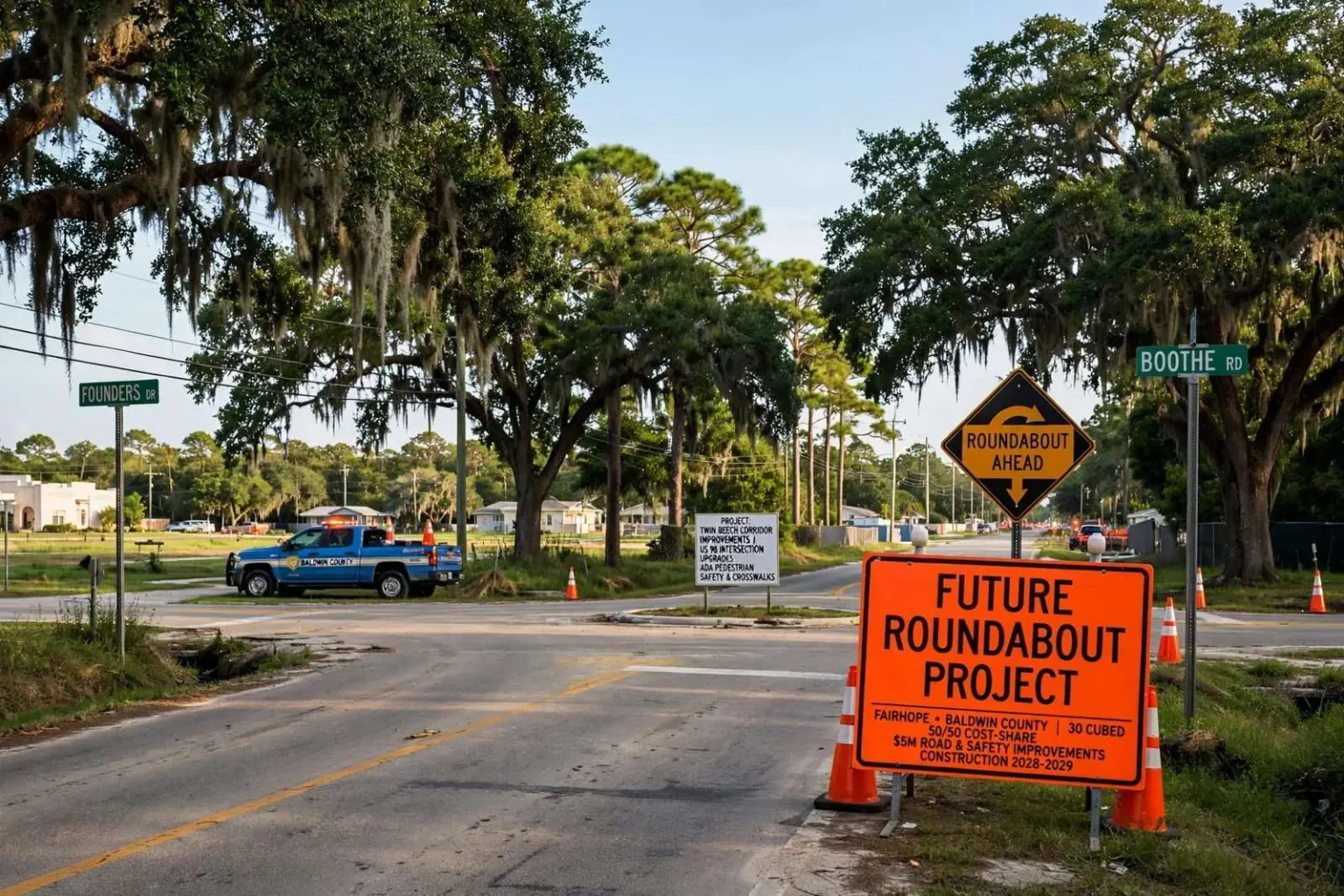
FAIRHOPE, Ala. — The city of Fairhope is moving forward with a $5 million road and roundabout project and wants Baldwin County to cover half the cost through the county’s infrastructure cost-sharing program. During its first August meeting, the Fairhope City Council voted to apply for $2.5 million in county funding under the “30 Cubed Project,” a program the county started last year that pairs cities and the county on shared road and bridge work.
The 30 Cubed program takes its name from the county’s goal of $30 million in local road and bridge projects by 2030, an initiative designed to multiply the effect of county infrastructure dollars by requiring municipal partners to match them. Baldwin County is one of the fastest-growing counties in Alabama and the nation, and its governing commission has wrestled for years with roads that were built for a small coastal county but now carry the traffic of one of the South’s most popular destination regions. The cost-sharing model spreads that burden while giving cities a seat in deciding which projects advance.
The county’s goal for the program, initially $60 million in road projects by 2030, has since doubled — a sign of how quickly needs have grown along the Eastern Shore and across the county. Commissioners have repeatedly cited growth pressures: subdivisions approved before infrastructure caught up, beach traffic funneled through two-lane roads, and commute patterns that push thousands of Baldwin County residents onto the same corridors each morning.
“The program funds local transportation and roadway improvements through a 50/50 cost-share partnership between Baldwin County and participating municipalities,” according to a memo on the application. “Unlike many state and federal transportation programs, these local funds do not carry the same administrative and compliance burden.”
What the $5 Million Project Includes
The project includes constructing a roundabout at Founders Drive and Boothe Road, identified as the preferred long-term fix; installing ADA-compliant curb ramps and pedestrian refuge improvements; upgrading crosswalk markings; and improving the U.S. 98 and Twin Beech Road intersection with signal upgrades and an added turn lane.
The package is a mix of capacity and safety work. Roundabouts have become Baldwin County’s preferred solution for busy intersections in growth corridors, replacing signalized junctions where crash rates and congestion have climbed. Traffic engineers favor them because they keep vehicles moving at lower speeds, eliminate the worst angle crashes, and handle growing volumes more gracefully than signals that cycle empty phases. Founders Drive and Boothe Road sit in the western growth belt of Fairhope, where new residential development has steadily added cars to roads designed decades ago.
The ADA-compliant ramps and pedestrian refuge improvements address a different kind of need. Baldwin County’s sidewalk network is thin outside its older cores, and pedestrian infrastructure — safe crossings, median islands where walkers can pause, high-visibility crosswalk markings — has lagged the boom. For a city like Fairhope, whose downtown draws walkers and whose residential areas feed school routes, the pedestrian pieces of the grant application signal attention to more than just car throughput.
“The Twin Beech Corridor serves as a vital east-west transportation route connecting residential neighborhoods, schools, recreational facilities, commercial areas, and US 98,” City Engineer Richard Johnson wrote in a letter recommending the move, adding that the corridor study identified safety and capacity needs to accommodate continued growth.
The Twin Beech Corridor’s Growing Load
Twin Beech Road cuts east-west across southern Fairhope, linking residential subdivisions on the city’s western side with the U.S. 98 commercial corridor and, ultimately, the schools and recreation facilities that draw traffic twice a day. As Fairhope’s population has grown — the city has been among Alabama’s fastest-growing municipalities for a decade — the corridor’s daily load has climbed with it. Corridor studies conducted by the city catalogued the predictable symptoms: peak-hour queues at signalized intersections, crash patterns at the U.S. 98 junction, and pedestrian conflicts where sidewalks end or crosswalks fade.
The U.S. 98 and Twin Beech intersection is the corridor’s pressure point. U.S. 98 carries through traffic between Fairhope, Daphne, and Point Clear, and its junction with Twin Beech Road mixes commuter volumes, school traffic, and beach-bound travelers in summer. Signal upgrades and an added turn lane are standard remedies: turn lanes remove slowing vehicles from through lanes, and modern signal timing can recapture capacity without widening the road right-of-way — an important consideration where commercial development lines both corners.
How the Money Would Be Spent Over Time
City officials expect the project to stretch across several fiscal years. Council President Jimmy Conyers said the city would need to work the expense into the 2028 and 2029 budgets. Multi-year phasing is the norm for road projects of this scale — design and engineering must precede right-of-way acquisition, which precedes bidding and construction — and splitting the city’s $2.5 million share across multiple budget cycles keeps any single year’s capital plan from being overwhelmed.
Councilman Jack Burrell asked whether the project could later be scaled back to just the roundabout if city funds grow tight; other council members raised questions about final design and cost as the project moves forward. The exchange reflects a familiar tension in cost-share programs: applications are submitted early, but revenues, priorities, and construction costs shift over the years a project takes to deliver. Baldwin County’s program has seen city and county partners adjust project scopes between application and award, and Fairhope’s council made clear it reserves the right to revisit scope as fiscal realities emerge.
The questions also preview the local debates that come with major intersections. Roundabouts require public education — Baldwin County drivers took years to warm to the county’s first modern roundabouts — and each phase of construction brings detours that businesses along the corridor watch closely. The council’s decision to move the application forward now, while flagging concerns for later, positions the city to capture county dollars while keeping its options open.
Why Fairhope Is Leaning on the County
Fairhope’s pursuit of 50/50 funding reflects arithmetic every Baldwin municipality faces. The city’s growth brings revenue, but it also brings road demands that can consume an entire capital budget on their own. The 30 Cubed program effectively doubles what a city can accomplish — a $5 million project costs the city half that — while the county gains coordinated improvements on corridors that carry countywide traffic regardless of municipal lines.
The lower administrative burden cited in the application memo matters, too. Federal and state transportation grants often require environmental reviews, procurement rules, and reporting requirements that add years and overhead costs. County local funds flow through simpler channels, letting cities move from design to construction faster — a meaningful advantage in communities where construction costs have risen sharply and waiting means paying more for the same work.
Baldwin County Engineer Frank Lundy did not respond to a request for comment. The application now moves into the county’s review process, where commissioners and program administrators weigh it against competing applications from municipalities across the county — from Gulf Shores to Daphne to the small towns of north Baldwin — each with its own list of roads the growth wave has outpaced.
Roundabouts on the Eastern Shore
If the project proceeds as recommended, the Founders Drive and Boothe Road roundabout would join a growing roster of modern roundabouts across Baldwin County. The county and its municipalities have installed them at intersections from Daphne to Gulf Shores in recent years, and experience has smoothed public acceptance: drivers who once dreaded them now cite the steady flow they provide at rush hour. Engineering studies nationwide consistently show roundabouts reducing serious-injury crashes by large margins compared with signals, because the design forces lower speeds and removes left-turn conflicts entirely.
Design questions the council raised — lane counts, truck accommodations, landscaping — will be settled during the engineering phase, with public input sessions typically held before construction. For a $5 million package, the roundabout will likely consume the largest share, with the pedestrian and signal improvements following as companion phases along the Twin Beech corridor.
What Happens Next
With the council’s vote to apply, Fairhope’s request enters the county’s 30 Cubed evaluation process. County staff and commissioners score applications based on need, safety data, traffic volumes, and readiness, and program rules require cities to commit their matching share. If Fairhope’s application is accepted, the city would then begin design work in earnest, with construction dollars flowing in the 2028-2029 budgets Conyers referenced. If it is deferred, the city can reapply in future program cycles — the program’s doubled goal of $120 million means additional funding rounds are expected as the 2030 target approaches.
The timeline gives Fairhope residents years of visibility before cones appear on Twin Beech Road. The council’s discussion made clear that the city intends to hold the county partnership to its promise — local dollars, local control, and less red tape — while keeping the door open to scaling the project if costs or revenues shift. Either way, the application marks the city’s most concrete step yet toward fixing one of its busiest east-west corridors, funded the Baldwin County way: half city, half county, and built for the growth already arriving.