Fairhope City Clerk Lisa Hanks Named Alabama’s 2026 Clerk of the Year
Fairhope City Clerk Lisa Hanks has been honored as Alabama's 2026 Clerk of the Year by the Alabama Association of Municipal Clerks and Administrators for her leadership and mentorship within the profession.
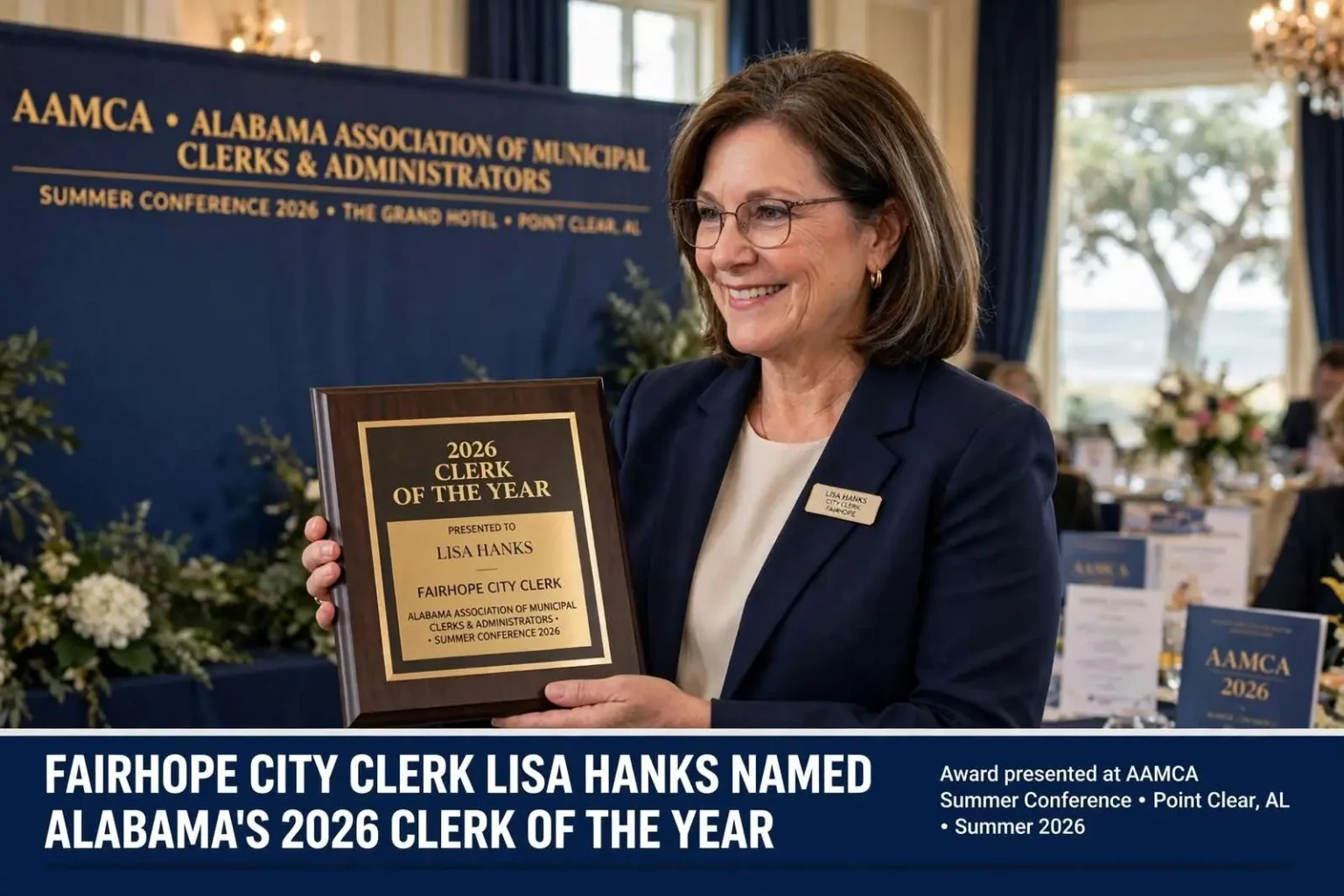
Fairhope City Clerk Lisa Hanks has been named Alabama’s 2026 Clerk of the Year by the Alabama Association of Municipal Clerks and Administrators. The organization presented the honor during its Summer Conference at The Grand Hotel in Point Clear, one of the state’s most storied resorts and a fitting gathering place for an association whose members keep Alabama’s city halls running.
The award places Hanks among the most respected municipal professionals in the state. AAMCA cited Hanks’ leadership, professionalism and commitment to excellence in municipal government, along with her willingness to share her knowledge and expertise with colleagues across the state — a combination of qualities that peers say defines the very best in the clerk profession.
Hanks holds the Master Municipal Clerk (MMC) certification and has spent the past 19 years serving as a mentor to fellow municipal clerks, helping strengthen professional development within the field. The MMC designation, administered through the International Institute of Municipal Clerks, represents the highest level of professional achievement in the field, requiring years of education, experience and demonstrated service beyond the Certified Municipal Clerk level.
A Lasting Impact Across the State
Association leaders said her guidance has had a lasting impact on both the profession and the communities served by Alabama’s municipal governments. Mentoring in the clerk profession takes many forms — advising new clerks through their first council meetings and elections, walking colleagues through open meetings and public records requirements, and sharing the institutional knowledge that only years in the role can build.
Municipal clerks serve as a central point of contact between residents and local government, working to ensure transparency, accountability and clear communication. The scope of the job is broader than most residents realize: clerks maintain the city’s official records and minutes, administer oaths, manage business licenses and permits, coordinate elections, post public notices, and answer the day-to-day questions that connect citizens to their government.
Clerks provide elected officials, municipal employees and the public with accurate information about municipal operations and community affairs, and their offices are considered essential to the daily functioning of city and town governments. In smaller municipalities, the clerk’s office may be the single administrative backbone of the city; in larger ones, it anchors compliance and record-keeping across every department.
Honored at Point Clear
The Summer Conference at The Grand Hotel brought clerks and municipal administrators from across Alabama for days of training, certification coursework and professional exchange. The Grand, a landmark on Mobile Bay’s eastern shore since 1847, has long hosted the association’s signature gatherings, and the Clerk of the Year presentation is traditionally among the conference’s most anticipated moments.
For Fairhope, the recognition reflects on a city government that has grown rapidly in both size and complexity. Baldwin County’s population boom has turned Fairhope — founded in 1894 as a utopian single-tax colony on the bluffs above Mobile Bay — into one of Alabama’s fastest-growing municipalities, with all of the records, licensing, meeting volume and public scrutiny that growth brings. The clerk’s office sits at the center of that churn, and Hanks’ stewardship has run through years of expansion, new facilities and evolving technology.
Her 19 years of mentoring work extend far beyond Fairhope’s city limits. Municipal clerks across Alabama rotate through the same challenges — elections, annexations, public records requests, council procedures — and the profession’s culture of sharing knowledge means a veteran clerk’s guidance multiplies through every city she advises. Colleagues credit mentors like Hanks with shortening the learning curve for new clerks and raising the standard of practice statewide.
The Master Municipal Clerk credential that Hanks holds requires sustained commitment: candidates must complete extensive IIMC-approved education, accrue years of professional experience and demonstrate ongoing service to the profession. Fewer than a fraction of clerks nationally reach the MMC level, making it the field’s mark of distinction — and pairing it with nearly two decades of mentoring is precisely the profile the Clerk of the Year award exists to recognize.
What the Profession Means for Residents
For residents, the significance of a strong clerk’s office shows up in ordinary ways: council agendas and minutes posted accurately and on time, business licenses issued without confusion, public records fulfilled promptly, and elections administered cleanly. Alabama’s open meetings and public records laws place heavy responsibilities on municipal clerks, who are the officials most often tasked with making government visible to the governed.
The profession also demands a rare combination of skills — part record-keeper, part parliamentarian, part election administrator, part diplomat. Clerks sit through every council meeting, manage the documents of every department, and field the questions of every citizen, often on the same afternoon. Those who excel, association leaders say, combine meticulous attention to detail with a genuine public-service ethic.
AAMCA congratulated Hanks on the recognition and thanked her for her years of service and ongoing commitment to advancing the municipal clerk profession throughout Alabama. The association, which provides education, certification support and professional networking for clerks and administrators across the state’s 460-plus municipalities, presents the annual honor to a clerk whose work embodies the profession’s highest standards.
The timing of the honor — presented at the height of summer at Point Clear — gave Alabama’s municipal clerks a moment to celebrate one of their own before returning to the fiscal year deadlines that mark the clerk’s calendar. Budget preparation, year-end reporting and audit coordination cluster around the summer months, making the conference both a professional reset and a working session for many attendees.
Hanks’ selection also underscores Fairhope’s visibility in Alabama municipal government. The city’s rapid growth has made its practices — from permitting to records management — a reference point for other municipalities navigating similar expansion, and its staff routinely serve in leadership roles in statewide associations.
Veteran clerks often describe the profession as the memory of a city. Elected officials come and go, department heads change, but the clerk’s vault — and the institutional knowledge behind it — carries the city’s legal and historical continuity across decades. Ordinances, annexations, franchise agreements, cemetery records, minutes from generations of council meetings: all of it passes through the clerk’s hands, and all of it depends on the care Hanks and her peers bring to the work.
A Career of Service and Mentorship
Those who have worked with Hanks describe the mentorship that AAMCA highlighted as characteristic of her career — the willingness to take a phone call from a clerk in any county, to review a problem document, or to talk a newcomer through a first election. In a profession where mistakes can carry legal consequences for a city, that kind of guidance is more than courtesy; it is infrastructure.
The Clerk of the Year award joins a tradition of Eastern Shore recognition in the profession. Baldwin County’s municipal clerks have been prominent in AAMCA leadership for years, and the association’s summer gatherings on the Eastern Shore give the region’s clerks a home-field stage for the profession’s best work.
For now, the recognition returns with Hanks to Fairhope’s City Hall, where the daily work continues — agendas to post, minutes to approve, licenses to issue, and the next generation of clerks to mentor, one phone call at a time.
Residents who wish to congratulate the city’s clerk can expect to find her where she has always been: at the counter and the council chamber, keeping the records of a growing city and answering its questions — the job Alabama’s municipal clerks have now formally recognized as the best in the state for 2026.
The Alabama Association of Municipal Clerks and Administrators has long served as the backbone of professional development for the state’s city and town clerks. Through its affiliation with the International Institute of Municipal Clerks, the association runs the certification pathways — from the entry-level coursework through Certified Municipal Clerk and up to Master Municipal Clerk — that turn a job into a profession. Its regional institutes and annual conferences provide the continuing education Alabama law and modern municipal practice demand.
The association’s membership spans every corner of the state, from tiny towns where the clerk is the city’s only full-time employee to cities like Fairhope, Huntsville and Mobile, where clerk-led departments manage dozens of staff. That range makes peer mentorship especially valuable: a small-town clerk facing a first annexation can call on colleagues in cities that have done it dozens of times, and the network Hanks has spent 19 years strengthening is the mechanism that makes those calls productive.
Municipal government observers note that the clerk’s role has expanded dramatically over the past generation. Digital records management, cybersecurity awareness, expanded public records obligations and increasingly complex election administration have all added layers to a job once defined largely by minutes and ledgers. Clerks today must be as comfortable with document management systems as with parliamentary procedure, and associations like AAMCA have adapted their training to keep pace.
Recognition Among Peers
Awards voted by one’s own profession carry a particular weight, and the Clerk of the Year designation is no exception — it is bestowed by colleagues who know exactly how difficult the job is, and who see the difference an exceptional clerk makes in their own interactions across the state. Association leaders’ citation of Hanks’ leadership and willingness to share expertise reflects the qualities her peers have experienced firsthand.
The Grand Hotel setting added its own significance to the presentation. The resort, now a Marriott property, has anchored Point Clear since the 19th century and remains one of the Eastern Shore’s defining landmarks — a location many conference attendees associate with the profession’s most meaningful milestones, including this one.
As Fairhope continues to grow, the work that earned the recognition continues as well — and the clerk Alabama honored this summer will keep doing what she has done for the past 19 years: serving her city, and teaching her profession.