Fairhope to Launch Two-Year Comprehensive Land Use Plan as Triangle Property Debate Continues
Fairhope will begin a two-year comprehensive land use plan funded with $650,000 in RESTORE Act money as debate continues over the Triangle property.
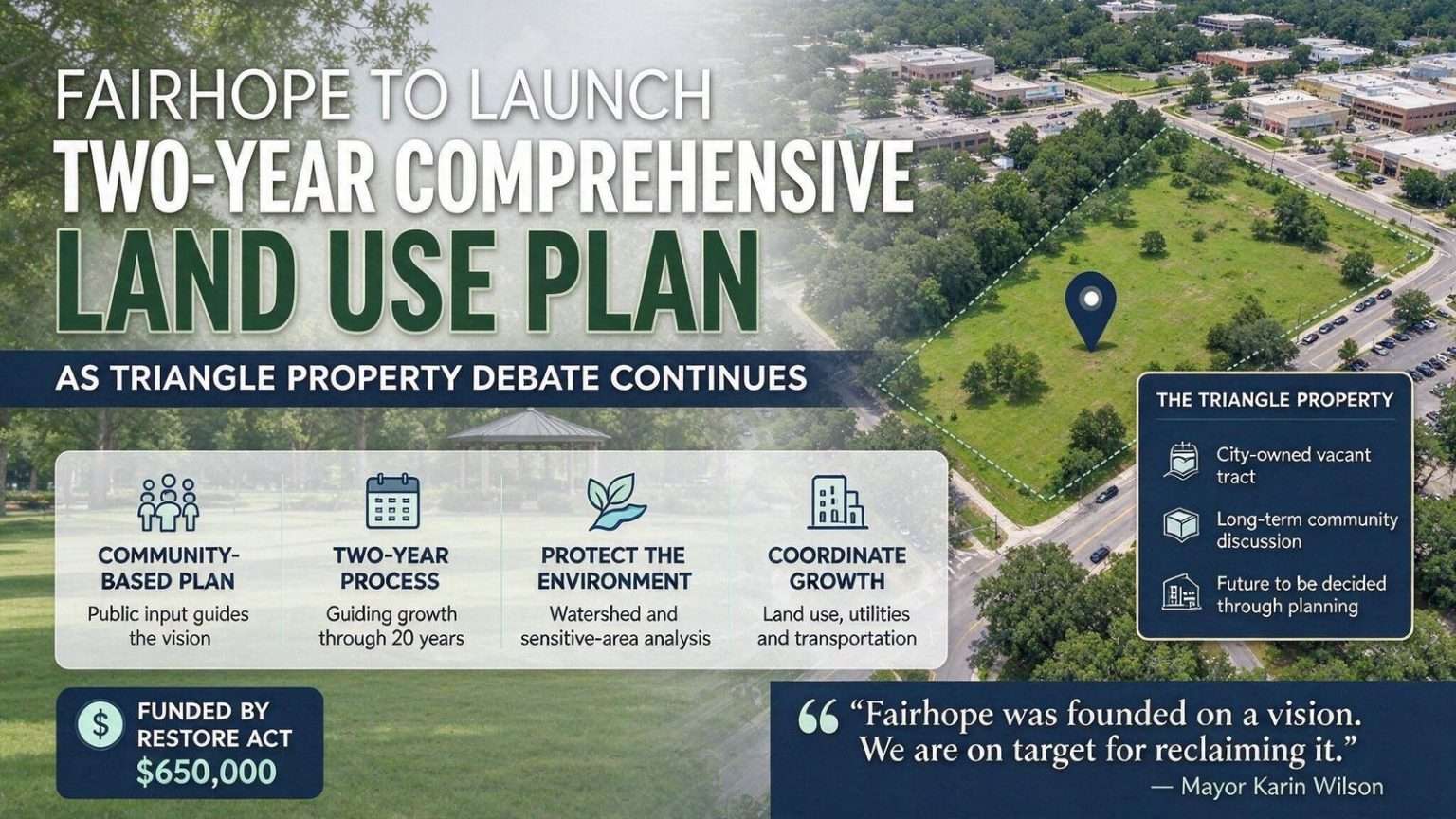
FAIRHOPE, Ala. — Fairhope will begin a two-year, community-based comprehensive land use plan funded with $650,000 in RESTORE Act money, Mayor Karin Wilson announced, as discussion continues over the future of the city-owned Triangle property.
The Triangle property
The Triangle, a vacant tract that was the subject of litigation on and off for more than 25 years, was purchased by the city as part of a legal settlement for $11.25 million, which included about $3 million in legal fees.
Council President Jack Burrell and Kevin Boone have advocated placing the Triangle property into a conservation easement or making it a park. Wilson has said the future of the property should be decided by the public through the comprehensive planning process.
RESTORE Act funding
The RESTORE Act funds come from BP. Under former Mayor Tim Kant, the city and council sought $49 million in RESTORE Act funding for a plan that included private property and the Fly Creek area.
What the plan will do
Wilson said the city will begin the Fairhope Area Community-based Comprehensive Land Use Plan by the end of the year and that it will guide future planning, ensure responsible growth and protect the environment.
According to Wilson, the plan will:
- Forecast population growth and project demand on utilities and transportation.
- Include urban design, with form-based codes in key areas, to set the city’s development vision for the next 20 years.
- Use watershed modeling and analysis of environmentally sensitive areas to ensure that areas targeted for growth are suitable.
- Coordinate land use development with infrastructure demands.
Wilson said the current comprehensive plan lacks clear goals and objectives and gives areas outside the city’s village centers little land-use guidance.
The new plan will first analyze the physical constraints of properties, including flood zones, environmental sensitivity, utility availability, transportation constraints and compatibility with existing neighborhoods, along with the community’s vision for growth. That analysis will then be coordinated with a long-range utility and public services plan.
Keeping the plan current
The city will produce a report every two years on how well the plan is being followed, and a formal amendment process will be put in place to address changing conditions, Wilson said.
“Fairhope was founded on a vision. We are on target for reclaiming it,” Wilson said, referring to the city’s founding on a utopian vision in 1894.