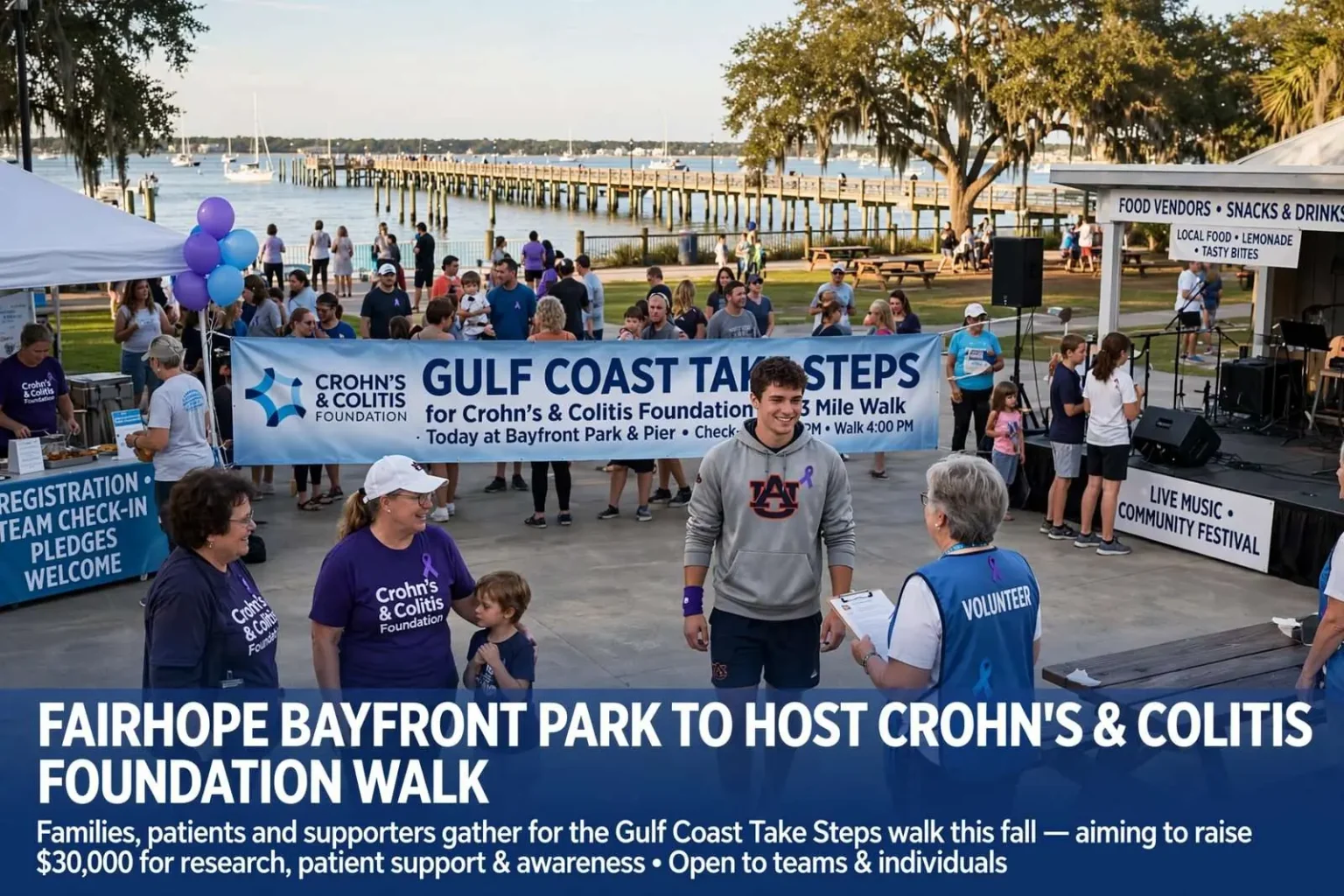
Participants gathering for a charity awareness walk along a bayfront parkCharity walks like the Take Steps event draw supporters to waterfront parks each fall.

Fairhope’s waterfront will host a walk for a cause this fall, as the Gulf Coast Take Steps for Crohn’s & Colitis Foundation event returns to Bayfront Park and Pier for another year of fundraising, fellowship and awareness.

Participants will be able to choose a walking distance of one to three miles, with check-in beginning mid-afternoon at the park and the walk itself starting an hour later. Organizers are hoping to draw families, patients and supporters from across Baldwin County and the wider Gulf Coast region for the event, which combines light exercise with a broader push to fund research into Crohn’s disease and ulcerative colitis.

The Alabama/Northwest Florida Chapter of the Crohn’s & Colitis Foundation of America organizes the walk locally, with a fundraising goal of $30,000 this year. Organizers say the majority of every dollar raised, roughly 80 cents, is directed toward research, patient support services and public and professional education about the two chronic digestive diseases, which affect the immune system and can cause lasting damage to the intestines if untreated.

Registration is open to both teams and individuals, and organizers are encouraging anyone who wants to support the cause without walking to make a direct donation instead. Every participant, whether walking solo or as part of a group, is asked to collect pledges ahead of the event to help the chapter reach its funding target.

This year’s Honored Hero for the Fairhope walk is Kelley Cutrell, a 23-year-old Mobile resident and former Auburn University track and field athlete. Cutrell was diagnosed with colitis at age 14 and underwent two years of treatment before ultimately having surgery. He went on to compete on his high school track team and later ran for Auburn, a comeback organizers are highlighting as an example of what patients can achieve with proper care and support.

Beyond the walk route along the bay, the event will include live music and entertainment aimed at younger attendees, along with food vendors on-site, giving the gathering the feel of a community festival as much as a fundraising walk. Organizers say the family-friendly atmosphere is meant to make the event approachable for people affected by Crohn’s and colitis as well as friends and neighbors who simply want to show support.

Anyone interested in registering, forming a team or learning more about Crohn’s disease and colitis can contact the Alabama/Northwest Florida Chapter of the Crohn’s & Colitis Foundation of America by phone, or find registration information online through the foundation’s Gulf Coast regional page. The foundation holds similar Take Steps walks in cities throughout the country each year as its signature fundraising event.

See also  South Alabama Hoops Schedule Set, Volleyball Postseason Begins Across Mobile, Baldwin Counties

For Baldwin County residents affected by inflammatory bowel disease, the Fairhope walk offers a rare chance to connect with others managing the same chronic conditions while enjoying an afternoon along the bay.

Baldwin County sits directly east of Mobile County across Mobile Bay and is the largest county in Alabama by land area. It encompasses the Eastern Shore communities of Daphne, Fairhope, Spanish Fort, and Foley and stretches south to the beaches of Gulf Shores and Orange Beach along the Gulf of Mexico.

Long among the fastest-growing counties in the state, Baldwin blends suburban development near the bay with tourism-driven coastal economies. Its proximity to Mobile and its position on the Eastern Shore make it a recurring subject of regional news covering growth, infrastructure, schools, and the balance between development and coastal preservation.

The Gulf of Mexico borders Alabama’s southern edge and defines much of the state’s coastal identity. Alabama’s Gulf coastline, centered on Dauphin Island, Gulf Shores, and Orange Beach, supports a tourism industry built around beaches, charter fishing, and marine recreation, while offshore waters host shipping lanes and energy interests.

The Gulf’s warm, shallow shelf and exposure to hurricanes make weather and disaster preparedness recurring concerns for communities from Mobile to Baldwin County. The marine environment also underpins commercial seafood harvests that have sustained Gulf Coast families for generations, tying the region’s economy and culture closely to the water.

Alabama is a state in the southeastern United States bordered by Tennessee, Georgia, Florida, the Gulf of Mexico, and Mississippi. Often called the Heart of Dixie, it spans Appalachian foothills in the north and flat coastal plains in the south. Its largest cities include Birmingham, Montgomery, Huntsville, and Mobile.

Alabama’s history encompasses Indigenous roots, Spanish and French colonial settlement, a cotton-plantation economy, the Civil War and Reconstruction, and the Civil Rights Movement of the 1950s and 1960s, followed by a shift toward manufacturing, aerospace, and technology. Local news across the state frequently reflects this mix of tradition and change.

Mobile is the county seat of Mobile County in southwest Alabama and the state’s only saltwater port. Situated where the Mobile River meets Mobile Bay near the northern Gulf of Mexico, the city has long served as a commercial and cultural gateway between Alabama and the wider Gulf Coast. Founded in 1702 as Fort Louis de la Louisiane and ruled in turn by France, Britain, and Spain before joining the United States in 1813, Mobile carries a layered heritage distinct from the rest of the state.

See also  Mary G. Montgomery Student First in Alabama to Earn Microsoft Office 2013 Master Certification

Today Mobile anchors a metropolitan area spanning Mobile County and neighboring Baldwin County, and it remains a center for shipping, aerospace, healthcare, and higher education in the region. Its downtown and waterfront have seen sustained revitalization, while historic neighborhoods preserve architecture from its colonial and antebellum past. The city’s identity is shaped as much by its working port and industrial base as by its festivals and food culture, making it a frequent focal point for news about growth and change in southern Alabama.

The natural environment is central to life on the Gulf Coast, where barrier islands, bays, rivers, and wetlands support fisheries, recreation, and storm protection. Coastal Alabama faces challenges common to low-lying regions, including hurricane exposure, erosion, and the management of fragile ecosystems.

The Mobile-Tensaw Delta, one of the largest river deltas in the country, is a particularly significant natural asset. Conservation efforts, fisheries regulation, and shoreline restoration are frequent points of collaboration among state agencies, federal bodies like the Army Corps of Engineers, and environmental groups.

How the region plans for growth while protecting its natural assets is a recurring theme in local reporting. The tension between development pressure and ecological stewardship plays out in zoning fights, infrastructure projects, and disaster-recovery decisions that shape the coast for generations.

The economy of the Mobile region is diversified across shipping and logistics, aerospace and shipbuilding, healthcare, tourism, and manufacturing. The Port of Mobile is one of the nation’s busiest seaports and a cornerstone of the local and state economy.

Major employers in aviation and defense contribute to a skilled workforce, while economic-development organizations aim to attract investment and jobs through incentives and infrastructure improvements. Small businesses, from restaurants to professional services, form the backbone of neighborhood commerce.

The health of the regional economy is a frequent subject of public discussion and reporting. Workforce development, recruitment of industry, and the fortunes of local retailers all feed into a broader picture of how the Gulf Coast competes and adapts in a changing national economy.

See also  State Investigators Treated 2009 Foley Roadside Death as Homicide

Collegiate athletics are a major part of life in southern Alabama, where the University of South Alabama in Mobile fields the Jaguars across a range of sports. The university’s football program, which began competition in the 2000s, has become a rallying point for students, alumni, and residents and a source of regional pride.

Beyond the campus, youth, high-school, and recreational leagues across Mobile and Baldwin counties sustain a deep local sports culture, and tailgating and game-day traditions reflect the social fabric of the community. Coverage of local teams regularly intersects with broader themes of economic impact, community engagement, and the role of athletics in mid-sized Southern cities.

Sports also serve as a lens on community investment. Stadium construction, scheduling, and the success of local programs ripple into nearby businesses and neighborhoods, making them a recurring and widely followed subject in regional reporting.

Healthcare in the Mobile area is anchored by several hospital systems and provider networks that serve patients across southwest Alabama, the Gulf Coast, and into parts of Mississippi and Florida. Large employers in the sector include regional health systems operating hospitals, clinics, and specialty centers, alongside university-affiliated providers.

Access to care, the financial health of nonprofit hospitals, and the integration of behavioral and physical health are ongoing priorities. As in many parts of the country, local healthcare institutions navigate workforce shortages, changing reimbursement models, and the particular demands of serving both dense urban neighborhoods and far-flung rural communities.

The ties between healthcare and the local economy are strong. Hospitals are among the region’s largest employers, and decisions about service lines, expansion, or closure reverberate through surrounding neighborhoods, making health-system news a staple of regional journalism.

Education in South Alabama spans public school systems in Mobile and Baldwin counties, a network of private and parochial schools, and institutions of higher learning including the University of South Alabama, Spring Hill College, and community colleges. Public-school governance rests with locally elected boards.