Fairhope Film Festival Returns for 2015 with Four Days of Award-Winning Cinema
The Fairhope Film Festival returned to downtown Fairhope, Alabama, Nov. 12-15, 2015, with four days of award-winning independent films and screenings.
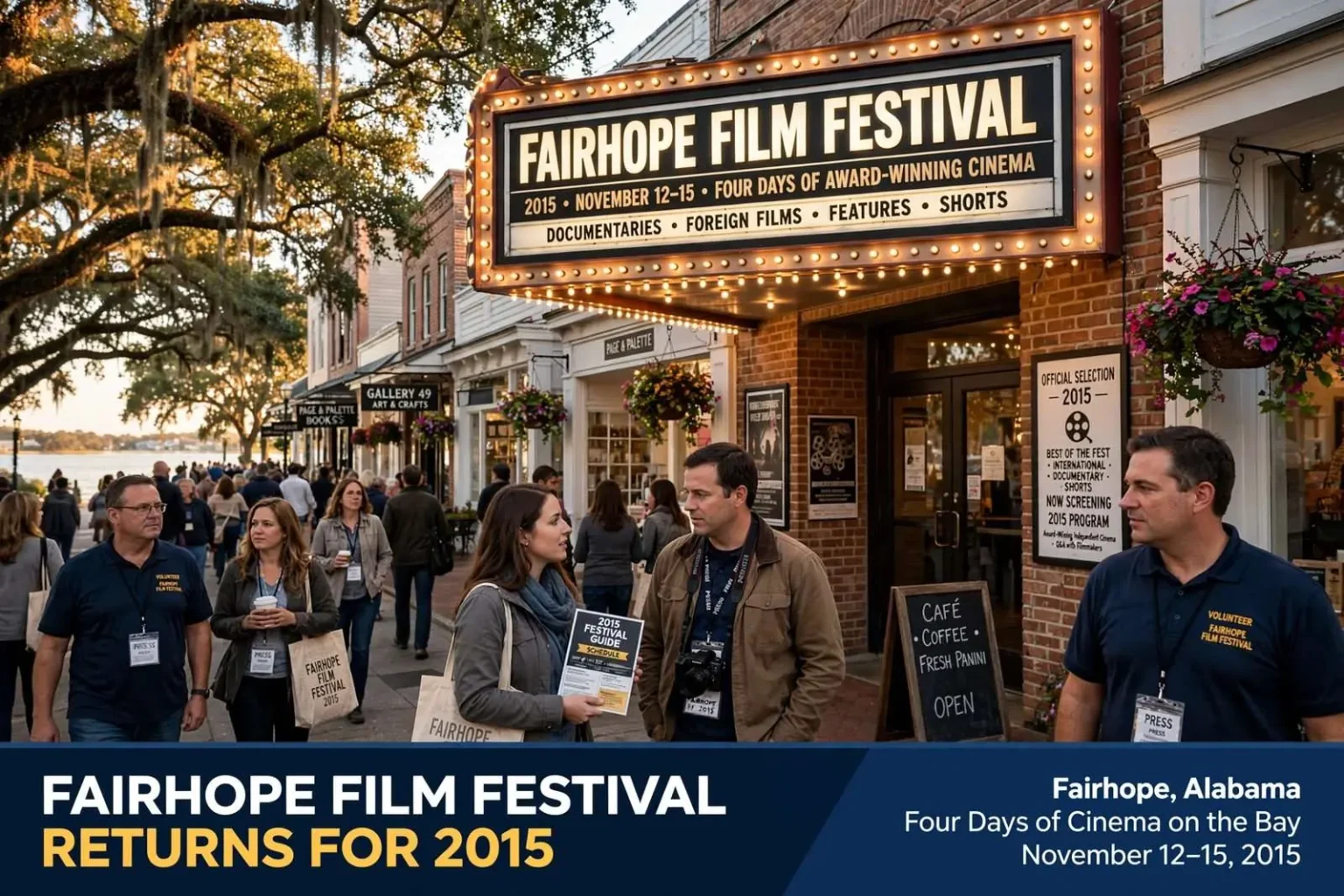
Fairhope, Alabama, the quaint bayside city long known as an arts community, played host once again to the Fairhope Film Festival in 2015. Set in the flower-filled downtown often called “Carmel by the Bay,” the festival’s five walkable venues put screenings within steps of restaurants, hotels and locally owned shops overlooking Mobile Bay.
The Fairhope Film Festival is built for film lovers, offering world-class, award-winning movies in a picturesque setting over four days. The focus falls on national and international festival competition finalists from the past year, the “best of the best” in cinema arts. Notable foreign and feature films, documentaries and shorts, many of which never reached big-box theaters or appeared only briefly, were selected for appreciative audiences.
That curation is the festival’s calling card. While multiplex audiences see only what the major studios distribute, festival-goers in Fairhope spent four days watching films that earned laurels at events around the world — works from directors whose names casual moviegoers may not know but whose films critics and juries have already singled out. For a small city on the eastern shore of Mobile Bay, the caliber of the lineup is remarkable, and it draws film lovers from across the Gulf Coast region each November.
A Town Built for a Festival
Fairhope’s downtown does much of the work itself. The city’s streets, lined with flower baskets and shaded by old oaks, sit on a bluff above Mobile Bay, and its shops, galleries, and restaurants have long sustained an arts identity that most towns ten times its size cannot claim. Founded in the 1890s as a utopian single-tax colony, Fairhope attracted artists, writers, and free thinkers from the start — a heritage that shows in its bookstore, its galleries, and its enduring reputation as a haven for creative people.
Comparisons to Carmel-by-the-Sea in California are not made lightly. Both communities pair a spectacular natural setting with a dense, walkable downtown built around the arts, and both have turned that combination into an identity that draws visitors year-round. The festival leverages that geography: five venues within walking distance means attendees park once, wander between screenings, and spend the intervals browsing shops or eating at locally owned restaurants with a view of the bay.
Walkability is rarer than it sounds in the festival world. Many regional film festivals scatter their venues across a metro area, forcing attendees to drive between screenings and lose the serendipitous encounters that make festivals sing. In Fairhope, the distance between a documentary and a foreign drama is a two-minute stroll past storefronts, which keeps the audience mixing between films and keeps the festival feeling like a single, continuous conversation.
The Program and the People
Directors, actors and screenwriters took part in screenings both in person and via live electronic transmission. The question-and-answer sessions that follow festival screenings are often where the experience lives — audiences in a small Alabama city getting to ask a documentary director why she spent five years on a subject, or hearing an actor describe how an independent film found its financing. The live-transmission format extends that access to filmmakers who could not travel to the bay, connecting Fairhope audiences to conversations happening in the industry’s centers.
Although the festival pulled out all the stops Southern-style for its opening and closing parties, the emphasis stayed on the art of filmmaking and the experience of seeing exceptional films. The parties bookend the event with Fairhope hospitality, but they frame rather than replace the core experience: darkened rooms, full screens, and films that audiences may never get another chance to see.
Mark Your Calendar: The 2015 edition ran Nov. 12 through Nov. 15, with four days of brilliant, entertaining and award-winning films screened throughout the downtown. The selection committee spent the year attending some of the world’s best film festivals and reviewing hours of innovative cinema as part of its mission to deliver the best of the best.
That scouting process is the invisible labor behind any festival of this kind. Committee members essentially chase the festival circuit — watching what wins at the major international events, tracking which films are earning audience and jury awards, and securing the rights to bring the standouts to Alabama. The work means Fairhope’s audience effectively borrows the judgment of the world’s most discerning festival programmers, filtered through a local committee that knows its own audience.
The payoff for attendees is density: four days in which nearly every screening is worth the price of admission. Casual film fans can build a weekend around the schedule with confidence, and serious cinephiles can fill every slot with films they would otherwise have to wait years — or pay for festival travel — to see.
Why It Matters for the Eastern Shore
The festival’s importance to Fairhope runs deeper than a busy November weekend. Cultural events of this caliber reinforce the city’s identity as the eastern shore’s arts capital, drawing visitors from Mobile, Baldwin County, and the broader Gulf Coast who then discover — or rediscover — the town’s shops, restaurants, and waterfront. The four-day run lands in mid-November, a shoulder season that benefits from the traffic, and the visiting crowds give the downtown’s locally owned businesses one of their strongest stretches of the fall.
The event also serves the region’s film community. Independent filmmakers in Alabama and along the Gulf Coast see what a curated festival program looks like up close, and the presence of working directors, actors, and screenwriters — in person or on screen — makes the craft feel reachable. Festivals like Fairhope’s function as both showcases and classrooms, and smaller cities that host them tend to see their own creative communities grow around the event.
For the films themselves, the festival offers something increasingly scarce: a attentive room. Many of the selected titles had never reached big-box theaters or appeared only briefly, meaning Fairhope audiences may be among the few in the country to see them on a big screen with an audience. In an era when distribution increasingly funnels everything to streaming queues, a packed small-town theater watching a subtitled documentary or an unheralded foreign drama is its own kind of statement.
Four Days on the Bay
The 2015 edition kept the formula that has made the festival a regional fixture. Opening-night festivities gave way to full days of programming, with the five venues cycling through features, documentaries, foreign films, and shorts, and the closing party sending attendees home after the final screening. Between films, the town itself did what it always does — fed visitors well, kept the flowers blooming, and put the bay in view.
As the credits rolled on Nov. 15, the festival had once again delivered on its mission: the best of the year’s festival cinema, four days of it, in one of the most charming settings a film lover could ask for. For the organizers and volunteers who spend a year assembling the program, and for the audiences who plan their Novembers around it, the 2015 edition was another proof that world-class cinema needs no big city — just a committee with taste, a town with character, and rooms full of people who love movies.
The shorts and documentary categories deserve particular mention in the festival’s makeup. Short films are where most working filmmakers cut their teeth, and festivals are their primary marketplace — the only venues where a ten-minute film finds an audience beyond the internet. Fairhope’s commitment to screening shorts alongside features gives the program variety, letting attendees sample a dozen voices in a single session. Documentaries, meanwhile, have become the backbone of the modern festival circuit, and the committee’s picks bring the year’s strongest nonfiction work to the bay.
Foreign cinema fills out the slate, and it is the category most hostage to distribution economics. Exceptional films from Europe, Asia, and Latin America routinely win awards abroad and never secure American theatrical releases, or open for a single week in a single city. A festival that deliberately seeks those titles out — as Fairhope’s committee does — offers Gulf Coast audiences a window they cannot get from the local multiplex under any circumstances.
The Volunteer Engine
A festival of this scope in a town of Fairhope’s size runs on community labor. Local volunteers staff the venues, manage the passes and schedules, and host the visiting filmmakers, and the city’s businesses — from the downtown restaurants to the hotels that fill on festival weekends — act as informal partners in the event. The Southern-style hospitality that the opening and closing parties showcase is not an add-on; it is the operating culture of the whole weekend.
The visiting filmmakers notice. Independent directors and producers regularly report that smaller regional festivals — the ones where a real audience watches the film and asks real questions afterward — are the most rewarding stops on the circuit, whatever their size. Fairhope has cultivated that reputation, and it pays off in the quality of films and guests the committee can attract year after year.
The result, once again in 2015, was a festival that outperformed its scale. Four days, five walkable venues, a program assembled from the world’s best festivals, and a bayside town doing what it does best — that is the Fairhope Film Festival formula, and November on the eastern shore would not be the same without it.