Fairhope Film Festival returns for its 5th year Nov. 9-12
The Fairhope Film Festival returns Nov. 9-12, 2017 for its fifth year, with films across walkable Baldwin County venues and shorts submissions still open.
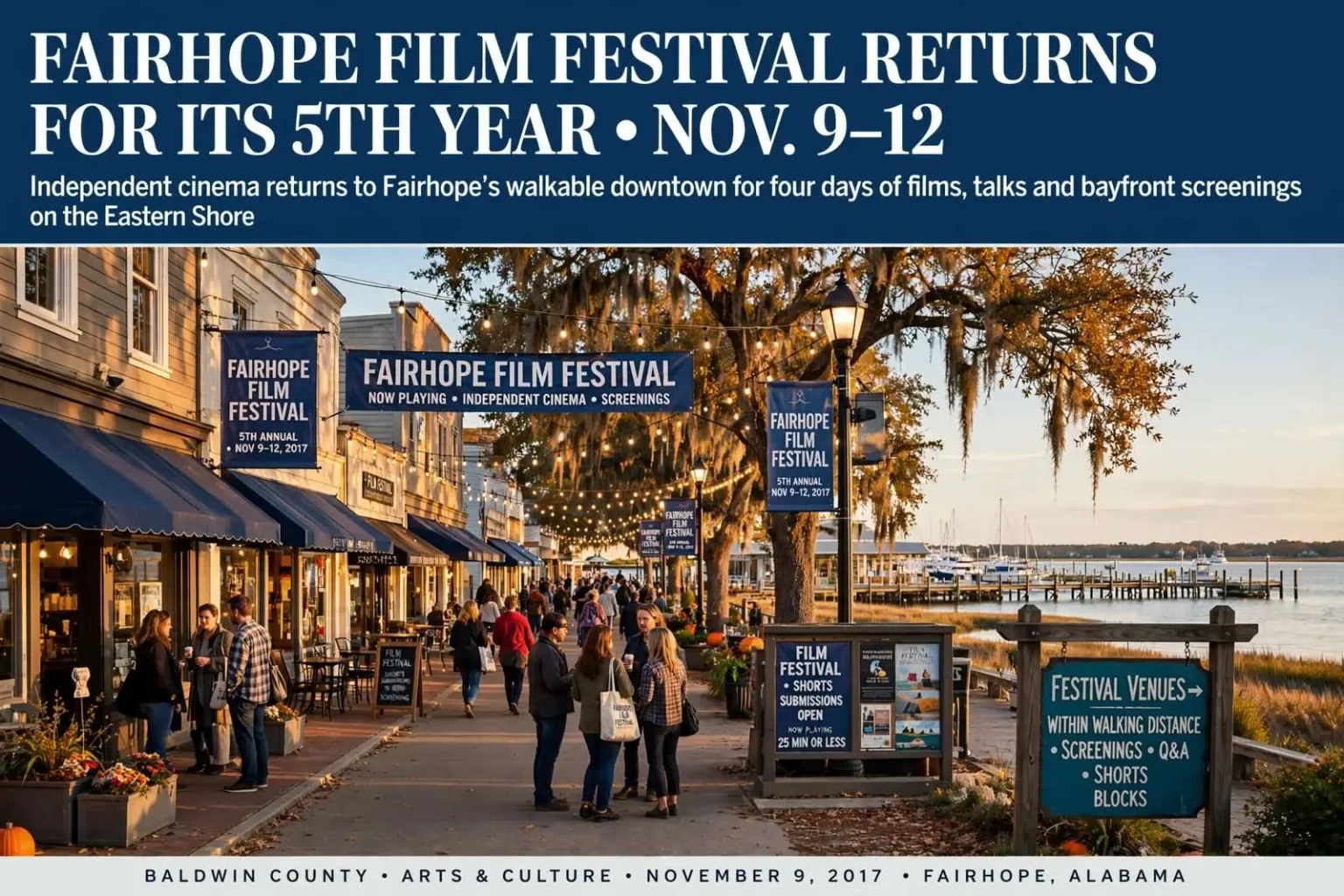
The Fairhope Film Festival returns for its 2017 edition Nov. 9–12, marking the event’s fifth year. Four autumn days across four to six walkable venues make the festival a centerpiece of the Baldwin County arts calendar, drawing filmmakers and film lovers to the Eastern Shore for a long weekend built around independent cinema.
Reaching a fifth year is a milestone for any regional festival. The first editions established the formula that has carried it since: a compact, walkable footprint; a carefully selected slate; and the setting of one of the Gulf Coast’s most picturesque towns. By year five, the festival had become one of the fixed points of Baldwin County’s cultural season — an event the community plans around and visiting filmmakers add to their circuit.
Fairhope itself is a large part of the draw. The town sits on a bluff above Mobile Bay, its streets lined with boutiques, galleries and gardens, its municipal pier and waterfront park among the most photographed views on the Gulf Coast. The location is about 30 minutes from the Gulf of Mexico and 2½ hours from New Orleans — close enough to the region’s cultural capital to draw its film community, far enough to have a character entirely its own.
A Festival Built for Walking
The festival’s four to six venues sit within walking distance of one another in downtown Fairhope, an arrangement that shapes the whole experience. Attendees move between screenings on foot, lingering in shops and cafes between films, and the town’s compact downtown becomes the festival grounds. Few regional festivals can offer that layout, and it is the feature returning attendees cite most — a festival where the walk between movies is part of the program.
The walkable scale also serves the filmmakers. Independent cinema thrives on contact between directors and audiences, and a compact venue footprint means a filmmaker whose shorts screens in the afternoon can walk to the evening block, take questions in both rooms, and be part of the conversation all day. The festival’s size makes those encounters routine rather than staged.
For the town’s businesses, the November weekend is a welcome shoulder-season lift. Between the beach season and the holidays, the festival fills hotels and restaurants with visitors who came for films and spend the rest of their time — and money — on the Eastern Shore.
The Setting and the Partners
The historic Grand Hotel among the festival’s partners is a headline attraction in its own right. The Grand — the storied resort at Point Clear, south of Fairhope along the bay — has hosted guests since the 19th century and ranks among the South’s classic destination hotels. Its partnership with the festival ties the event to one of Alabama’s most famous properties and gives attendees the option of a festival weekend framed by bayfront luxury.
The pairing of films and setting is the festival’s signature proposition. Attendees screen independent cinema through the day and watch the sun set over Mobile Bay in the evening — an experience that destination festivals sell and that Fairhope delivers naturally, without needing to build anything around it.
Past editions have drawn engaging films, lively parties, and notable judges including Talia Shire and Prudence Farrow Bruns. Shire — the Academy Award-nominated actress of the “Rocky” and “The Godfather” films — brought genuine Hollywood weight to the judges’ table, and Prudence Farrow Bruns, whose connection to the Beatles’ India era made her a cultural figure in her own right, added a different kind of renown. Names of that caliber on a fifth-year regional festival’s roster signal both the organizers’ reach and the event’s growing reputation.
Shorts Submissions Still Open
The festival is still open for shorts submissions — films that are current or no more than three years old and 25 minutes or less. The window gives working and aspiring filmmakers across the region — and beyond — a path onto the festival’s slate, and shorts have always been the lifeblood of festivals at this scale: the format where new directors prove themselves and audiences discover names they will see again.
The eligibility rules are straightforward by design. Requiring films to be current or no more than three years old keeps the slate fresh and gives new work its first audience rather than recycling films that have circulated for years. The 25-minute ceiling keeps programming flexible — shorts pack into themed blocks that fit a festival day’s schedule and hold an audience’s attention across a varied program.
For film students and independent directors along the Gulf Coast, a hometown festival with a genuine submission pipeline matters. Regional festivals are where regional filmmakers screen, meet one another, and build the portfolios that open bigger doors, and Fairhope’s fifth year made it a credible line on a growing filmmaker’s resume.
Why the Eastern Shore in November
November is arguably the Eastern Shore’s best month. The summer heat and humidity have broken, the light turns golden, and the bayfront towns settle into a pace that suits a festival — strolling, lingering, talking about films over coffee. Mobile Bay’s autumn also brings its own events calendar, and the festival slots into a season when the Eastern Shore shows visitors why it has become one of the Gulf Coast’s favorite weekend destinations.
The 2½-hour drive from New Orleans places the festival within reach of one of America’s great film cities, and the proximity has shaped the event’s draw. New Orleans audiences and filmmakers can make the trip for a weekend without air travel — the same accessibility that feeds the Eastern Shore’s tourism from the Crescent City year-round.
Organizers promise a beautiful setting and a strong slate of films for attendees who make the trip, and by the fifth year the promise had a track record behind it. The festival’s growth from a first-year experiment to a Baldwin County institution tracked the Eastern Shore’s broader rise as a cultural destination — galleries, festivals and the food scene that has made Fairhope a byword for small-town charm on the bay.
Planning the Weekend
Attendees planning for the Nov. 9–12 run have an easy logistics picture. Downtown Fairhope’s venues cluster within a few blocks, parking is manageable on a weekday-start schedule, and the town’s restaurants and shops absorb festival crowds without the lines bigger events produce. Visitors coming from Mobile cross the bay via the Battleship Parkway or the interstate loop; visitors from Pensacola and the Florida panhandle come up the coast highway; and New Orleans attendees find the drive an easy two and a half hours.
The four-day structure lets visitors set their own depth. A day-tripper can take in an afternoon block and an evening screening; a full-weekend attendee can work through shorts blocks, features, parties and the judges’ conversations; and the Sunday close leaves time for a bayfront brunch before the drive home.
For film lovers along the Gulf Coast, the Fairhope Film Festival remains one of the season’s most appealing reasons to spend a November weekend on the eastern shore — independent cinema, a walkable town on a bluff above the bay, and the fifth-year confidence of an event that has become part of the region’s cultural identity.
Fairhope’s Arts Identity
The festival’s success rests on ground Fairhope prepared long before 2013. The town has been an arts colony in spirit since its founding — a planned community built on ideals of cooperative living that attracted writers, artists and intellectuals from its earliest decades, and that identity never left. Its downtown galleries, its bookstore, its art center and its public gardens all feed the sensibility a film festival needs: a community that treats culture as part of ordinary life.
That heritage makes Fairhope a natural home for independent cinema in a way larger, busier cities sometimes are not. Festival audiences there arrive curious rather than jaded, and the town’s scale means a visiting filmmaker is a guest of the whole community rather than a name lost in a crowd. The lively parties the past editions drew were an expression of that — festival-going as a social event rather than a screening schedule to endure.
Baldwin County’s broader cultural growth has reinforced the foundation. The Eastern Shore’s population expansion, the proliferation of galleries and performance spaces in Fairhope and Daphne, and the region’s rising profile as a destination for creative professionals all give the festival an expanding base year over year.
What a Fifth Year Means
Regional film festivals survive on a narrow margin of volunteer labor, local sponsorship and community goodwill, and many fold before their third year. A fifth anniversary means the Fairhope festival cleared the hardest stretch — building an audience, proving the economics, and convincing filmmakers that a Gulf Coast town of its size deserves a slot on the submission calendar.
The judge roster tells the story of that credibility. Recruiting Talia Shire and Prudence Farrow Bruns required the kind of organizational reputation that only years of well-run events can build, and their presence, in turn, raised the festival’s profile for the filmmakers deciding where to submit. The cycle compounds: better-known judges attract stronger entries, stronger entries draw bigger audiences, and bigger audiences fund the next edition.
For the community volunteers and organizers who built it, the fifth year was also a validation of the founding bet — that a walkable bayfront town with a century of arts identity could sustain a film festival that stands alongside the region’s larger cultural events.
The Region’s Film Culture Grows Around It
The Fairhope festival operates in a region whose film culture has been expanding for a decade. Alabama’s film incentives have brought productions to the state, Mobile and Baldwin County venues screen independent cinema year-round, and university film programs across the Gulf Coast feed a steady stream of new short films — much of it flowing toward festivals like Fairhope’s, which give regional work a first audience.
Each year’s slate becomes part of that ecosystem: the shorts that screen in Fairhope reappear at other regional festivals, the connections made between blocks become collaborations, and the Eastern Shore earns a place on the map that touring filmmakers remember. A festival’s fifth year is when that compounding becomes visible — when returning attendees can measure the event’s growth against their own history with it.
Nov. 9–12, 2017 offered the region that measure: five years in, the Fairhope Film Festival had turned a picturesque bayfront town into a legitimate stop on the independent film calendar — and given the Gulf Coast one more reason to be in Fairhope in November.