Fairhope fire department crash at Greeno Road intersection under police review
A Fairhope volunteer fire vehicle heading to a pedestrian emergency collided with another vehicle at Fairhope Avenue and Greeno Road. Police are investigating.
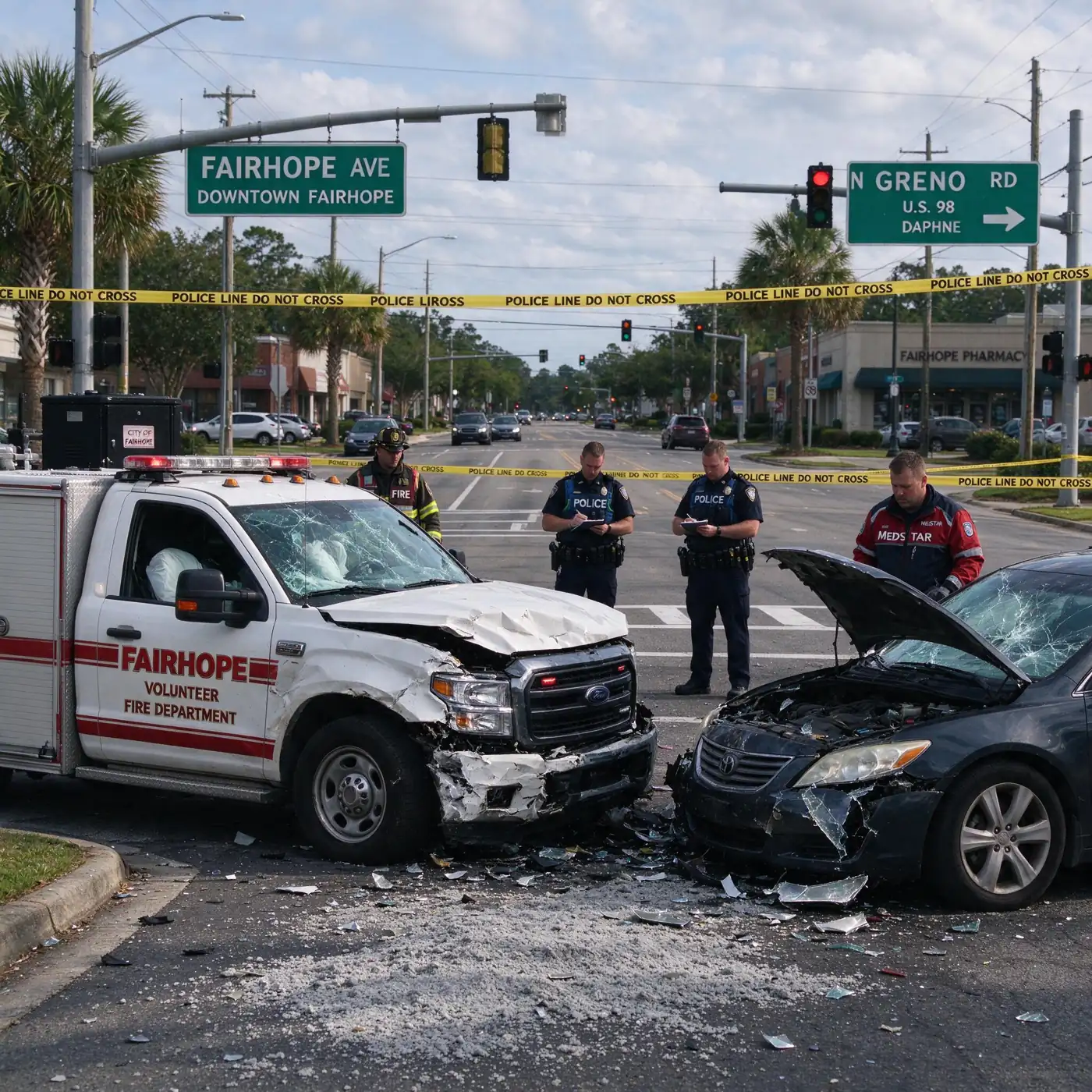
FAIRHOPE, Ala. — Police are investigating a Fairhope fire department crash that happened Sunday afternoon at the intersection of Fairhope Avenue and North Greeno Road, where a volunteer fire vehicle on its way to an emergency collided with another vehicle. Both vehicles were badly damaged, an airbag deployed and minor injuries resulted, though officials did not say how many people were hurt.
The wreck took place at about 12:45 p.m. on Nov. 22, 2026. A supervisor with the Fairhope Volunteer Fire Department was driving the emergency vehicle at the time and was headed to a call involving several pedestrians who had been hit by a motor vehicle, officials said.
Two key questions remain open as the inquiry gets underway. It was not immediately clear whether the fire vehicle was running its emergency lights and siren, or whether the other driver failed to give way to it as the law generally requires.
Fairhope fire department crash: what to know
Here is a quick summary of the facts local authorities have made public so far. Officials have not identified the supervisor, the other driver or anyone who was hurt.
- When: Sunday, Nov. 22, 2026, around 12:45 p.m.
- Where: The Fairhope Avenue crossing of North Greeno Road in Fairhope.
- Who was involved: A vehicle from the Fairhope Volunteer Fire Department, with a department supervisor at the wheel, and one other vehicle.
- Why the fire vehicle was on the road: It was answering a call in which several people on foot had been hit by a vehicle.
- Damage and injuries: Heavy damage to both vehicles, one airbag that went off and some minor injuries.
- Responders: Fairhope police, the Fairhope fire department and Medstar.
- Status: The Fairhope Police Department is investigating.
No further details were made public about the earlier pedestrian emergency the supervisor had been heading toward. The number of people hurt in that incident, their conditions and how it happened had not been made public.
The questions investigators will try to answer
The central issue in a collision like this one is who had the legal right to proceed through the intersection at that moment. That answer often depends on whether an emergency vehicle was giving clear warning with lights and an audible siren, and on whether other drivers could reasonably see and hear it coming.
Officials said they could not yet confirm whether the supervisor had switched on the vehicle’s emergency lights and siren. It also remained unconfirmed whether the motorist in the other vehicle gave way to the fire vehicle, which Alabama law generally requires drivers to do when an emergency vehicle approaches with its warning equipment on.
Those two points can cut in different directions. If warning devices were in use and plainly visible and audible, the expectation would generally fall on other drivers to clear the way. If they were not, the emergency vehicle would typically be expected to obey ordinary traffic rules like any other motorist.
Investigators have not announced any findings, citations or conclusions about fault. Until they do, no one involved should be presumed responsible for the collision.
How Alabama rules of the road treat emergency vehicles
Like other states, Alabama gives authorized emergency vehicles certain privileges when they are answering an emergency call. In general terms, a driver of such a vehicle may be allowed to proceed past a red light or stop sign after slowing down as needed for safety, exceed the speed limit, or disregard certain movement and turning rules.
Those privileges come with conditions. They generally apply only when the vehicle is using its required warning signals, and state law does not excuse an emergency driver from the duty to drive with due regard for the safety of everyone else on the road.
Other motorists have obligations as well. When an emergency vehicle approaches using its lights and siren, Alabama drivers are generally required to give up the right of way, pull over to the right-hand edge of the road clear of any intersection, and stop until the emergency vehicle has passed, unless a police officer directs otherwise.
Alabama also has a move-over law aimed at protecting first responders who are stopped along the roadway. Drivers approaching a stopped emergency vehicle with flashing lights are expected to change lanes away from it when it is safe to do so, or to slow down if they cannot move over.
How a crash investigation usually unfolds
Traffic crash investigations follow a fairly standard path. Officers document the scene, noting where the vehicles came to rest, the damage to each one, road markings, traffic signals and any debris that might show the point of impact.
Investigators typically speak with the drivers, passengers and any witnesses who saw the collision. They may also look for video from nearby businesses, traffic cameras or vehicle-mounted cameras, since footage can show signal status, speed and whether emergency lights were flashing.
Many modern vehicles also carry event data recorders, sometimes called black boxes, that capture information such as speed, braking and seat belt use in the seconds before an airbag deploys. When that data is available and relevant, crash investigators may retrieve it as part of their work.
When a public safety vehicle is involved, the agency that operates it often conducts its own internal review as well. That kind of review generally looks at whether department policies on emergency driving were followed, separate from any traffic findings by police.
Depending on the evidence, a police investigation can end with a citation, a finding that no violation occurred, or a determination that fault cannot be clearly established. Fairhope police had not indicated how long their review would take.
A busy corridor on the Eastern Shore
Fairhope sits on the eastern shore of Mobile Bay in Baldwin County, one of the fastest-growing counties in Alabama. As the area’s population has climbed, so has traffic on its main roads, which makes safe driving around emergency vehicles an everyday concern.
Greeno Road is part of U.S. Highway 98 and serves as the main north-south commercial route through Fairhope. It carries a mix of local shoppers, commuters and through traffic moving between the Eastern Shore communities in Baldwin County.
Fairhope Avenue is one of the city’s principal east-west streets and leads west toward downtown Fairhope and the bayfront. The junction of the two roads is a well-known crossing point for residents and visitors alike.
Intersections along heavily traveled routes pose particular challenges for emergency drivers. Vehicles may be stopped in several lanes, drivers may have music playing or windows closed, and a siren can be harder to locate when buildings and other traffic block sight lines.
The role of volunteer firefighters
The Fairhope Volunteer Fire Department, as its name indicates, relies on volunteer members to answer calls. Volunteers in departments like Fairhope’s respond to fires, vehicle crashes, medical emergencies, rescues and other incidents around the clock.
Fire departments commonly send personnel to crashes involving pedestrians because those scenes can involve serious injuries, traffic hazards and the need for extra hands. Firefighters may assist with patient care, protect the scene from passing traffic and help medical crews. They can also help with lighting, cleanup of fluids and debris, and other tasks that let police and paramedics focus on their own duties.
Driving to an emergency is widely recognized as one of the more hazardous parts of the job for firefighters and other responders. National fire-safety organizations have long encouraged departments to train members in emergency vehicle operation and to stress full stops at controlled intersections when the way is not clear.
Tips for drivers when sirens approach
Sunday’s crash is a reminder that every driver plays a part in getting help to people who need it. Safety officials across the country offer similar advice for sharing the road with emergency vehicles.
- Keep music at a reasonable volume and check mirrors often so you notice lights and sirens early.
- When an emergency vehicle approaches with warning devices on, signal, pull to the right edge of the road and stop.
- Do not stop inside an intersection. Clear it first, then pull over.
- Avoid sudden moves, such as slamming the brakes in a travel lane or swerving left.
- After the vehicle passes, look for additional responders before pulling back into traffic, since more units often follow.
- Never follow an emergency vehicle closely or try to use its path to get through traffic.
- On a highway, move over or slow down for any emergency vehicle stopped on the shoulder with its lights flashing.
Holiday travel typically brings heavier traffic, and Thanksgiving falls on Thursday, Nov. 26. Extra attention behind the wheel this week can help keep both travelers and first responders safe.
What comes next in the Fairhope fire department crash review
The Fairhope Police Department is handling the investigation into the Fairhope fire department crash. Officials had not made public the identities of the people involved, the number of people hurt or further information about their injuries.
Key findings to watch for include whether the fire vehicle’s lights and siren were on and whether the second driver gave way as required. Any decision on citations would come from that work, and the findings could also inform any internal review by the fire department.
Anyone who witnessed the collision or who has video of the intersection from around 12:45 p.m. on Sunday may be able to assist investigators by contacting the Fairhope Police Department. Updates are expected to come from city officials as the review moves forward.