Fairhope Launched Its First Film Festival in 2008
A 2008 WKRG report previewed Fairhope's first film festival, a three-day showcase of independent movies, documentaries and shorts.
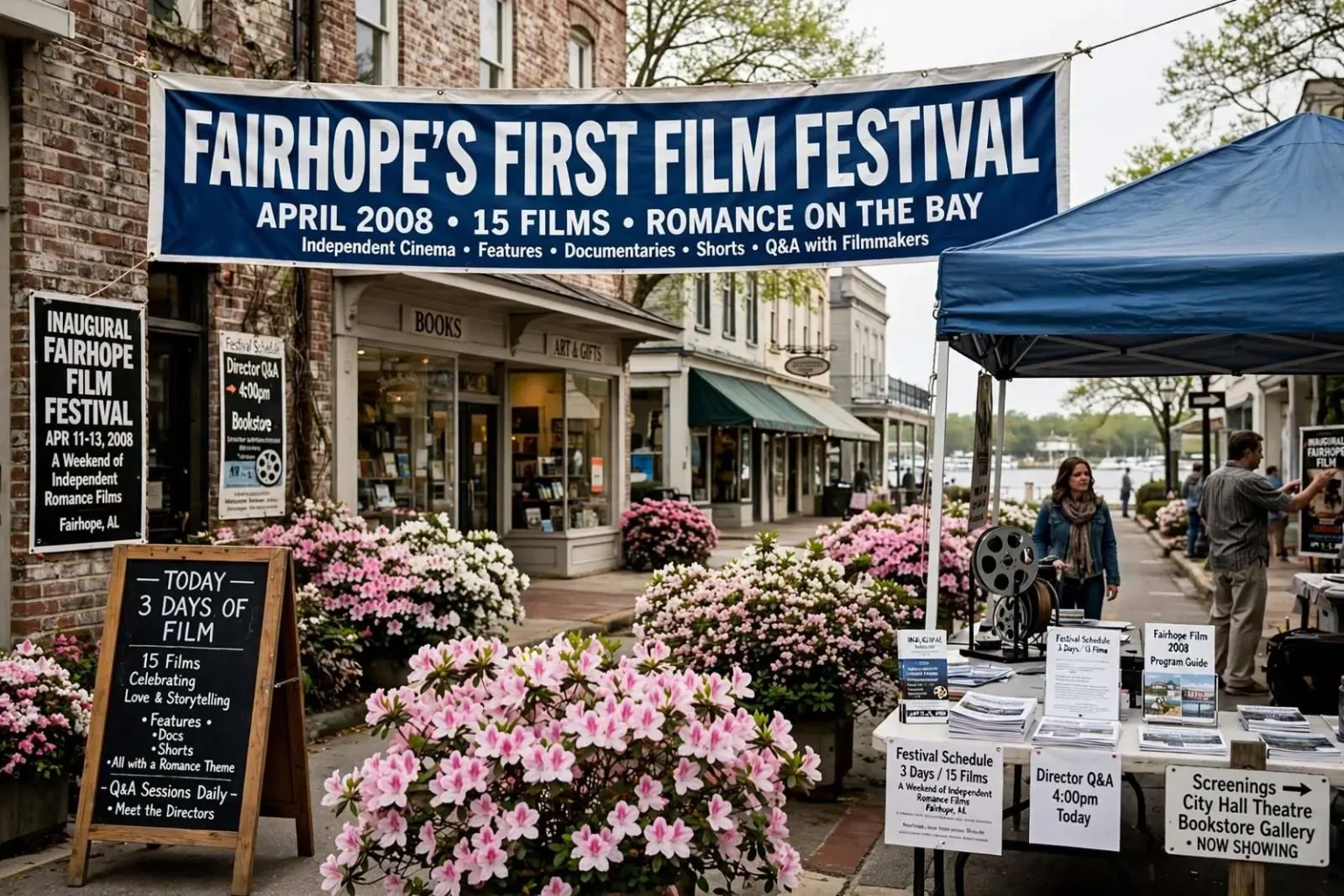
Fairhope launched its first film festival in April 2008, according to a local station, bringing three days of independent cinema to one of Baldwin County’s most artistically minded communities.
The three-day event planned to show 15 movies, each selected for a romance element — a unifying theme that gave the inaugural festival a distinct identity among the region’s growing list of film events.
Festival director Ryan Robinson said organizers sought well-made independent films, including features, documentaries and shorts. The selection emphasized craft over commercial pedigree, giving audiences a chance to see work that rarely reached Alabama screens through mainstream distribution.
Screenings included question-and-answer sessions with creators, and the festival offered local audiences a rare opportunity to see independent work with the filmmakers themselves in the room. This is a historical summary of a 2008 local arts report; festival programming and operations may have changed in the years since.
A Festival Finds Its Home in Fairhope
Few Gulf Coast towns seem as naturally suited to a film festival as Fairhope. Founded in 1894 as a utopian colony, the city on the eastern shore of Mobile Bay built its identity around the arts from the beginning, drawing writers, painters and free thinkers to its bluff-top streets for more than a century. The Fairhope Single Tax Colony’s founders intended the town to be a place where creative and independent spirits could flourish, and generations of artists have obliged.
By 2008, Fairhope already had an established cultural calendar — art walks, gallery shows, author events at its well-known bookstores, and the annual arts and crafts festival that draws crowds to the pier area each spring. A film festival fit the mold: a three-day event, staged in April when the weather along the Bay is at its mildest, positioned to draw both residents and visitors from across Baldwin County and from Mobile just across the water.
The choice of a romance theme for 15 films gave the inaugural event a cohesive identity. Themed festivals can punch above their weight in attracting attention, because they give programmers a lens for selecting work and give audiences a reason to sample films they might otherwise skip. For a first-time festival working to establish itself, that coherence mattered.
The Independent Film Landscape of 2008
The timing of the launch placed the festival in a particular moment for independent film. The mid-2000s had seen a boom in low-budget digital filmmaking, as cameras became cheaper and editing software put professional-grade tools within reach of first-time directors. Festivals across the country had multiplied to meet the supply, and by the late 2000s a filmmaker without studio backing could realistically hope to screen work in a dozen regional festivals in a single year.
For audiences in a community like Fairhope, though, the supply rarely reached them. Independent features, documentaries and shorts circulated through a circuit of festivals and art-house theaters in larger cities, and without a local event, residents who wanted to see the films outside the mainstream had to travel. The festival’s promise — 15 films over three days, selected for quality — addressed that gap directly.
The mix of features, documentaries and shorts reflected standard festival programming logic. Shorts fill gaps between longer works and give emerging filmmakers a stage; documentaries broaden an audience beyond drama fans; and features anchor the schedule and give the program its marquee moments. A slate of 15 films across three days is a manageable count — enough to feel substantial, small enough that a dedicated attendee could see nearly everything.
Question-and-Answer Sessions With the Creators
The question-and-answer sessions that followed screenings set the event apart from a night at the multiplex. When a filmmaker stands in front of the audience after the lights come up, the film becomes a conversation: how the story was found, how it was shot on a limited budget, what the director was trying to say and whether the audience heard it. Those exchanges are what festival regulars come for, and they are nearly impossible to replicate in ordinary theatrical release.
For the filmmakers, the value runs in the other direction. Independent directors spend years making films seen by only a handful of people; a festival screening with a live audience and a question session offers immediate, unfiltered feedback and the chance to build word of mouth. Organizers who bring creators to the room are serving both sides of the screen at once.
Ryan Robinson’s description of the selection criteria — well-made films first — suggested the festival intended to compete on curation rather than celebrity. That approach is common among successful regional festivals, which rarely land Hollywood premieres and instead build reputations on the quality of the films they find and the hospitality of the town that hosts them.
April on the Eastern Shore
The April timing gave the festival seasonal advantages that Gulf Coast event organizers know well. Spring along Mobile Bay brings some of the year’s most reliable weather — warm afternoons, cool evenings and, usually, the azaleas that make Fairhope’s streets famous in bloom. Visitors who crossed the bay from Mobile or drove down from points north could walk between venues, browse downtown shops between screenings and experience the town the way its founders intended: on foot, outdoors, at an unhurried pace.
Festivals of this kind also carry economic weight for a small city. Attendees eat in local restaurants, shop in downtown stores and fill rooms in area inns during what is, in most years, a shoulder season between spring break and summer. Baldwin County’s coastal towns had spent years building event calendars around exactly this dynamic, and a film festival added a new kind of draw to the mix — one that reached a somewhat different audience than the arts-and-crafts crowds.
The “local station” report that documented the launch also illustrates how regional festivals get their coverage. Small events rarely draw state or national media, but local television and community papers fill the role, and those reports are often the only contemporaneous record a young festival leaves behind. Preserving what that 2008 report says — 15 films, three days, a romance theme, a director named Ryan Robinson — is part of keeping the event’s history accurate.
Why Romance as a Theme
A romance element as the selection criterion is a distinctive choice for a festival’s founding year. Romance as a genre travels well across formats: a love story can anchor a feature, drive a documentary about real people, or distill into six minutes of short film. The theme gave programmers freedom across the slate while still offering a unified promise to ticket buyers — every film, whatever its form, would have love at its center.
Themed festivals also create marketing hooks that general festivals lack. A romance-themed event in a bayside town built on picturesque streets gives visitors an experience that extends past the theater doors. And for local coverage, the theme writes its own angle: a festival about love, in a town founded by idealists, in the season when the azaleas bloom.
The risk of a theme, of course, is that it narrows the possible slate. Fifteen well-made films that share a romantic element is a real programming challenge for a first-year event, and meeting it suggests the organizers were able to draw on the depth that independent film production had built up by the late 2000s. Regional festivals commonly report hundreds of submissions for slots in the dozens, which makes a slate of 15 from any genre feasible.
Fairhope’s Broader Arts Tradition
The festival joined an arts tradition in Fairhope that long predates it. The city’s downtown galleries, its longtime bookstores, its arts center and its public spaces steeped in the Single Tax Colony’s history have made the town a destination for creative culture on the Gulf Coast for decades. Writers from the region and beyond have lived there or passed through, and the city’s commitment to public art and beautification has been a civic signature since its earliest years.
In that context, a film festival in 2008 was less a novelty than a natural extension — a new medium added to an old calendar. Baldwin County’s population was growing quickly in those years, and the Eastern Shore communities were working to build cultural infrastructure to match the growth. Events like the festival helped the area’s identity keep pace with its numbers.
For Mobile-area audiences, the festival also strengthened the bay’s role as a shared cultural space. The drive across the Mobile Bay causeway or the Blakeley River bridge is short enough that a three-day festival in Fairhope functions as a regional event, drawing the two sides of the bay into the same audience.
What the 2008 Report Established
Because the account of the festival comes from a local station’s report rather than a comprehensive archive, it is worth being precise about what the record shows and what it does not. The report establishes the essentials: the festival was Fairhope’s first, it launched in April 2008, it ran three days, it showed 15 films selected for a romance element, and it featured question-and-answer sessions with the filmmakers. It also preserves the voice of festival director Ryan Robinson, whose description of the selection standard — well-made independent films, across features, documentaries and shorts — remains the clearest statement of what the event aimed to be.
What the report does not preserve are the individual titles, the venues, the attendance figures or the festival’s fate in later years. That is typical for small regional events, whose histories survive in scattered local coverage rather than formal records. The absence of those details is worth noting for anyone researching the festival’s history: the summary here reflects exactly what the 2008 report said, and no more.
Readers should also note the caveat that accompanies any historical summary of a local arts event: programming and operations may have changed since 2008. Festivals move, rebrand, pause and restart with regularity, and any current information about film events in Fairhope should come from present-day sources rather than this account.
The Value of Preserving Local Arts History
Reports like the one this summary is drawn from do more than chronicle a weekend of screenings. Local arts coverage records how a community saw itself at a moment in time — what it wanted to host, what its organizers believed would draw an audience, and how a small city on Mobile Bay positioned itself in the wider world of independent film in 2008.
For Fairhope, the record shows a community confident enough in its cultural identity to launch a film festival and thoughtful enough to give it a theme. For the Gulf Coast, it shows the region’s participation in a national movement that had made independent film one of the most accessible art forms of its era — an art form whose creators would travel to a town of a few thousand residents to answer questions after their screenings.
And for the filmmakers who came, the festival offered what every artist ultimately wants: a room full of people, watching closely, asking afterward what the work meant. Fifteen films, three days, one theme — a modest slate by industry standards, but a genuine piece of Fairhope’s cultural history, preserved here as the 2008 report recorded it.
A Look Back, Nearly Two Decades On
Nearly two decades later, the details from April 2008 read like a snapshot of a particular moment: a first-time festival with 15 films on a romance theme, a director describing curation in terms of craft, and audiences being promised something rare — independent work presented by the people who made it.
Whatever the festival’s subsequent path, its founding report documents the essentials of how it began and why. Fairhope’s first film festival grew from the same soil as the rest of the town’s cultural life: a community that has always believed the arts belong at the center of things, and that a small city on the eastern shore of Mobile Bay could draw interesting work from anywhere.