Fairhope Health and Rehabilitation Ranks Third Among Baldwin County Nursing Homes
Fairhope Health and Rehabilitation ranks third among Baldwin County nursing homes with 131 beds and a two-star CMS rating for late 2023.
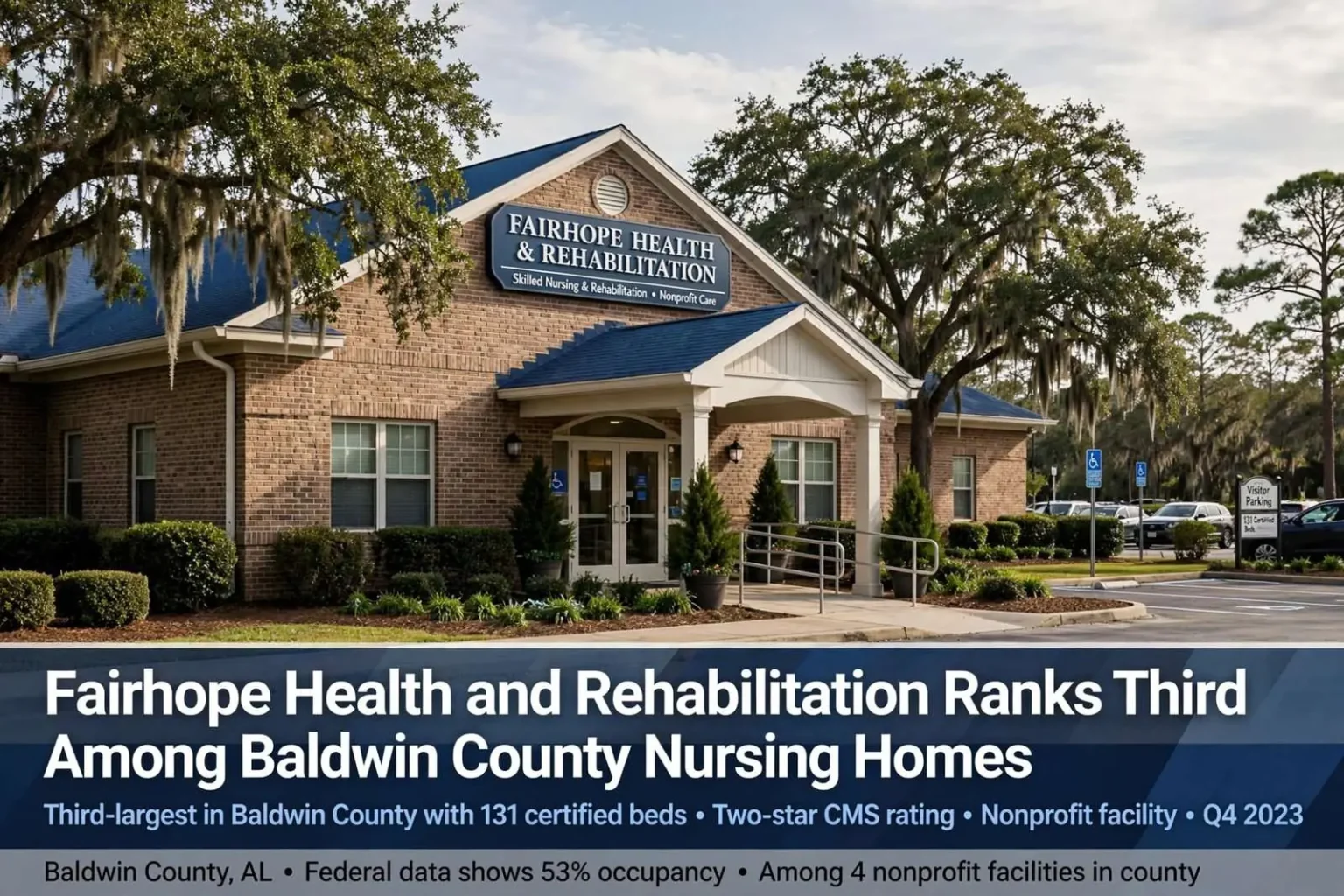
Fairhope Health and Rehabilitation ranked as the third-largest nursing home in Baldwin County as of the fourth quarter of 2023, operating 131 certified beds — roughly 21 more than the countywide average — according to federal data.
The nonprofit facility, which served an average of nearly 70 residents per day during the quarter, trailed only Diversicare of Foley, the county’s largest home with 154 beds, and Robertsdale Rehabilitation and Healthcare Center in second place with 152 beds.
Ratings and Enforcement Record
Fairhope Health and Rehabilitation carried an overall rating of two stars from the Centers for Medicare & Medicaid Services for the period, slightly below the statewide Alabama average of roughly 2.9 stars. CMS bases its scores on health inspection results, staffing levels, and quality-of-care measures.
Federal penalty records reviewed for the quarter showed a single fine totaling $650 against the facility.
The home was one of four nonprofit nursing facilities operating in Baldwin County, where the rest of the market is dominated by a handful of for-profit operators from Fairhope to Foley and Robertsdale.
The two-star rating that Fairhope Health and Rehabilitation carried for the quarter places it in CMS’s below-average band — a notch above the one-star facilities that populate the bottom of the national distribution, and close to but under the state’s own modest average. The rating system’s design means that a two-star facility’s story is told in its component scores: a home can hold that overall rating with strong inspection results dragged down by staffing, or with adequate staffing offset by quality-measure flags, or with middling performance across all three domains. Families reading the rating are advised to pull apart the components on CMS’s Care Compare portal, where each domain’s stars are shown alongside the inspection narratives that explain them.
The $650 penalty recorded against the facility in the quarter sits at the low end of the enforcement scale — two orders of magnitude below the six-figure fines that immediate-jeopardy deficiencies produce. Small civil monetary penalties attach to deficiencies at the lower scope-and-severity levels, where surveyors document noncompliance that has not caused actual harm: care-plan lapses, documentation gaps, dietary or activity violations. A fine of that size describes a routine survey finding, corrected as part of the standard review process, rather than an enforcement event. In the quarter’s countywide comparison, where the same period’s records show a $107,556 penalty at Robertsdale Rehabilitation, the contrast illustrates the range of inspection outcomes a single county’s facilities can produce.
The occupancy figure — roughly 70 residents per day in a 131-bed facility — describes a census near 53 percent, well below the Robertsdale facility’s 80 percent and noticeably lighter than the industry’s typical operating targets. Occupancy rates this light tell several possible stories: a facility with a lower-acuity mix of short-stay rehabilitation patients who cycle through quickly; a capacity built for demand that has shifted toward home-based and assisted-living alternatives; or a reputation effect in a competitive county market. The distinction matters for reading the quality data, since census affects everything from staffing ratios to revenue: a facility running half-empty faces the fixed costs of its beds with fewer residents’ reimbursements to cover them, which pressures the staffing budgets that CMS’s ratings measure.
Fairhope itself — the bayside city where the facility operates — frames the facility’s market position. Eastern Shore communities have aged in place as the county’s original population grew older, and Fairhope’s identity as a retirement destination dating back a century has produced a senior population that supports the full spectrum of long-term care. The facility’s place among the county’s four nonprofit homes connects to that community history: nonprofit facilities in Baldwin County typically trace to church, civic, or community-founder origins — institutions established to serve local families before the for-profit chains consolidated much of the industry. For families weighing options, nonprofit status is one input among many, but its statistical association with higher staffing and fewer deficiencies — documented across national ownership studies — makes the county’s nonprofit/for-profit split a meaningful feature of its care landscape.
The countywide ranking that gives the story its frame — third largest of Baldwin County’s nursing homes — situates the facility in a market of growing demand. Baldwin County’s population growth has been among Alabama’s fastest for two decades, and its age distribution is aging with it: the retirees drawn to the coast in the 1990s and 2000s are now entering the years when long-term care decisions arrive. The county’s facilities — from Fairhope’s bayside campus to Foley’s and Robertsdale’s inland operations — form the capacity that growth will increasingly call upon, and the federal data that ranks them by size also makes their comparative performance public: stars, staffing hours, penalties, and inspection histories all searchable side by side.
The practical use of that data is the same consumer discipline the CMS system was built to enable. Families considering Fairhope Health and Rehabilitation — or any facility — can read the quarter’s two-star rating alongside the inspection reports behind it, the staffing hours per resident day, the quality measures for falls, pressure injuries, and rehospitalization, and the facility’s trajectory across recent quarters. A single quarter’s fine of $650 and a two-star overall rating describe a facility performing near the middle of Alabama’s distribution; the direction of travel — improving, stable, or declining — is what the multi-quarter record shows, and what the family’s own visit will either confirm or question. The federal system publishes the record so that the choice of a nursing home, among the most consequential decisions a family makes, can rest on evidence rather than marketing.
The inspection cycle that produced the quarter’s single small penalty runs continuously beneath the ratings. State surveyors working under CMS contract arrive unannounced roughly annually at each certified facility — with additional visits triggered by complaints — and their findings are coded by scope (how many residents affected) and severity (how serious the harm or potential harm). The lowest-level deficiencies generate citations and required corrections; the higher levels generate the civil monetary penalties that enforcement records log. A quarter with a $650 fine and no higher-level penalties describes surveys that found technical noncompliance — the kind of finding that most facilities accumulate somewhere in their inspection history — rather than the care failures that dominate enforcement headlines.
The facility’s nonprofit ownership also shapes how its finances and governance work, which in turn shapes what its numbers can mean. Nonprofit nursing homes typically reinvest surplus revenue into operations rather than distributing it to owners, often carry mission-driven governance through boards drawn from the community, and frequently maintain donor relationships and endowment support that for-profit operators lack. The financial cushion can fund the staffing levels that CMS’s ratings reward — or, in facilities where census and reimbursement fall short, the absence of an owner’s capital can leave aging plants unimproved. The research literature’s finding that nonprofits average better staffing and quality outcomes describes the national tendency; the county’s own four nonprofit facilities each carry their own record, which the CMS database makes as visible as any for-profit competitor’s.
Reading the quality-measure domain — one of the three stars that compose the overall rating — requires understanding where its data comes from: the facility’s own clinical assessments, submitted through the federal reporting system. The measures include the clinical outcomes families ask about most — the share of residents experiencing falls with injury, pressure ulcers, unplanned weight loss, antipsychotic medication use, and hospital readmissions — calculated from resident assessments across the facility’s census. Because the measures are self-reported, CMS audits them against hospital and claims data, and surveyors verify them on-site; discrepancies feed the inspection domain. For families, the quality measures are best read as trends across quarters — a facility’s fall rate or readmission rate compared against state and national benchmarks, and against its own history — rather than as single-quarter snapshots.
The short-stay rehabilitation side of a facility’s business, which drives much of its census cycle, deserves particular attention in a facility of this size. Medicare-covered rehabilitation stays — following joint replacement, stroke, or hospitalization — fill nursing facilities’ beds for stays measured in weeks, and these patients’ outcomes — successful discharge home, readmission to hospital — form a distinct quality profile from long-term residents’. A facility running a large short-stay census alongside its long-term residents operates two businesses with different rhythms: the turnover, therapy staffing, and discharge planning of rehabilitation, and the sustained daily care of long-term residency. The county’s facilities differ in their mix, and the CMS database reports their short-stay quality measures separately — data that surgical patients planning a post-hospital stay can consult with the same rigor that families of long-term residents apply to the long-stay measures.
The quarterly data that ranks Fairhope Health and Rehabilitation third in the county is, in the end, one quarter’s version of a record that updates continuously. The facility’s position — a two-star rating, a minor penalty, a light census, nonprofit ownership, and a top-three capacity in a growing county — describes a facility operating near the center of Alabama’s nursing home landscape. What families choosing among the county’s options will want to know is the direction: whether the next quarters’ ratings rise or fall, whether the inspection history stays clean, and whether the visit they make — at mealtime, on a weekend, unannounced — finds the care that the numbers imply. The federal data exists to start that conversation with evidence; the conversation is the family’s to continue.