Fairhope’s Jack Burrell Marks 10 Years Representing the City on the Energy Southeast Board
Fairhope City Councilman Jack Burrell has been recognized for a decade on the board of Energy Southeast, the Alabama capital improvement cooperative district that secures and manages wholesale electricity for 11 member cities.
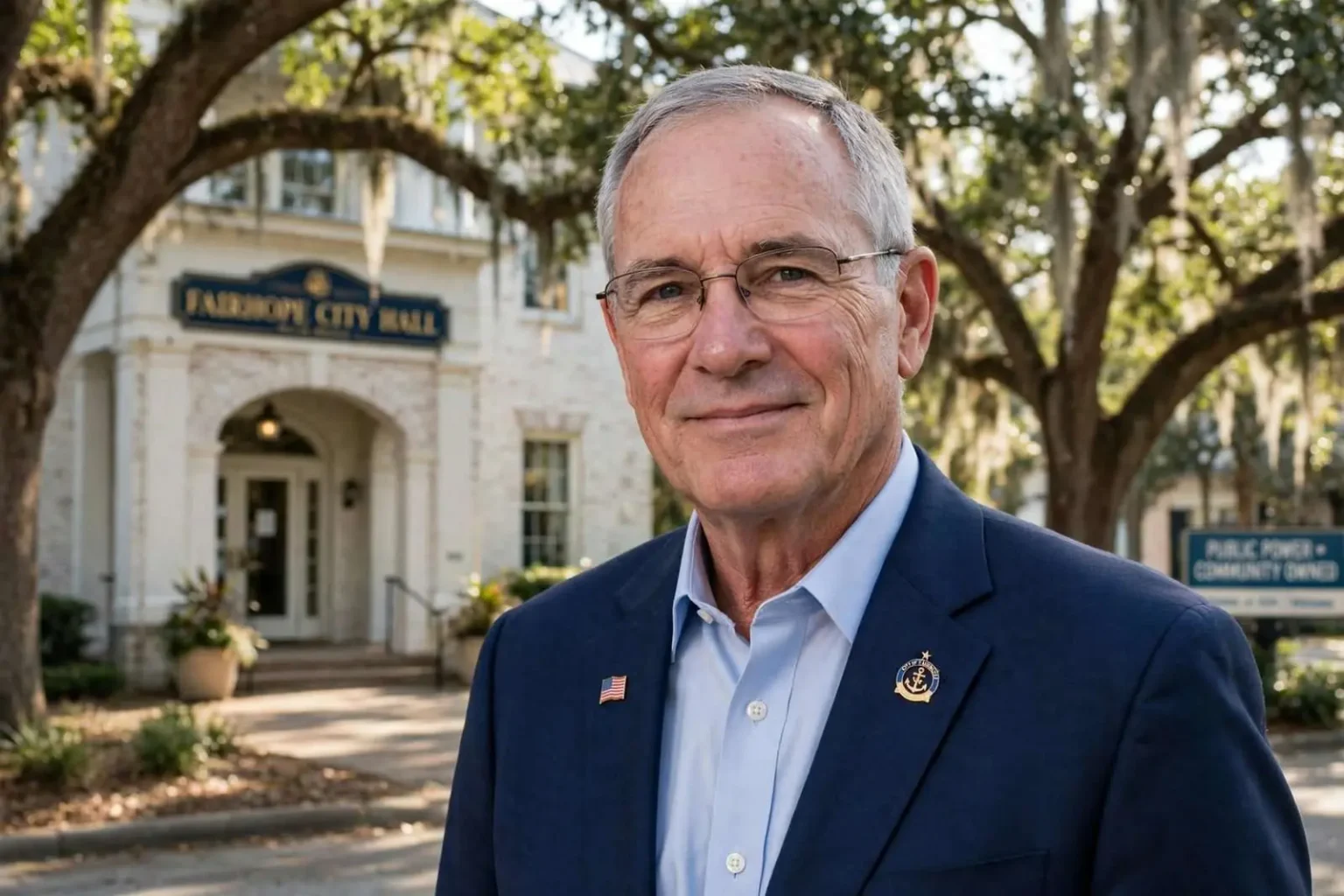
FAIRHOPE, Ala. — Fairhope City Councilman Jack Burrell has been recognized for a decade of service on the Energy Southeast Board of Directors, according to a news release from the city.
Energy Southeast is a capital improvement cooperative district of the State of Alabama that works with publicly owned utility systems to secure and manage wholesale electricity. Fairhope is one of the organization’s member cities, and Burrell has represented it on the board for 10 years.
During that tenure, Burrell has represented Fairhope’s interests as the board has addressed power supply, public power, infrastructure and long-term energy planning.
“Serving on the Energy Southeast Board has given me the opportunity to continue making sure Fairhope has a voice in providing affordable, reliable electric service to our community,” Burrell said in the release. “The partnership with the other 10 member cities, along with the staff and leadership at Energy Southeast, is valuable because it helps us work together to keep electricity affordable and reliable now and well into the future.”
The City of Fairhope congratulated Burrell on the recognition and thanked him for 14 years of service to the city, including 10 years as Council President. The city also recognized his service to Alabama’s public power community.
What Public Power Means in Fairhope
The recognition is easy to skim past, but the underlying arrangement is unusual enough to be worth explaining, because it directly affects what residents pay every month.
Most Americans buy electricity from an investor-owned utility — a private company, regulated by a state commission, answerable to shareholders. A minority buy from a municipal utility: a system owned by the city itself, governed by the city’s elected officials, operated on a not-for-profit basis. Fairhope is in that minority. The city runs its own electric distribution system, and it has for a very long time.
That structure has real advantages. Rates are set by a body residents elect. There is no shareholder return built into the cost. Restoration priorities after a storm are decided locally. Revenue that exceeds cost stays in the community rather than leaving it.
It also creates a specific and serious problem: a city of Fairhope’s size does not generate its own power. It has to buy it wholesale, in a market built for entities far larger than a single municipality.
Why Cities Pool Their Purchasing
That is the problem Energy Southeast exists to solve.
A joint action agency — the general category to which an organization like this belongs — aggregates the load of multiple municipal utilities and buys on their combined behalf. Eleven cities buying together are a meaningfully different counterparty than one city buying alone.
The advantages compound:
- Scale. A larger, more predictable load commands better wholesale pricing and access to contracts that would not be offered to a small single buyer.
- Expertise. Wholesale power procurement involves long-dated contracts, hedging, transmission arrangements and regulatory compliance. No small city can justify hiring that expertise on its own; eleven cities sharing a staff can.
- Risk smoothing. Individual municipal loads are volatile. Aggregated across a region, peaks and troughs partly offset, which improves the terms a supplier will offer.
- Capital access. Structured as a capital improvement cooperative district of the state, the organization can finance infrastructure in ways that would be difficult for a small city acting alone.
The trade-off is governance. When a city joins a purchasing cooperative, decisions that affect its residents’ bills are made in a room with ten other cities in it. Whoever sits in Fairhope’s chair is the mechanism by which Fairhope’s interests reach that table.
That is what a decade on a board like this actually amounts to, and it is why the tenure matters more than the title. Wholesale power contracts run for years and sometimes decades. Infrastructure planning runs longer. Board members who rotate off every two or three years never see a contract cycle through from negotiation to expiration. A member with ten years of continuity has institutional memory of decisions that a newer member has to take on faith.
Affordability and Reliability
Burrell’s framing — affordable, reliable electric service — names the two variables that dominate this work, and they pull against each other.
Reliability on the Gulf Coast is not an abstraction. This is a hurricane-exposed coastline where distribution systems face wind, salt air and falling trees, and where a multi-day outage in September carries genuine health consequences. Hardening a system — undergrounding, stronger poles, vegetation management, redundant feeds — costs money that ultimately shows up in rates.
Affordability pulls the other direction. Every dollar spent on resilience is a dollar collected from ratepayers, many of whom are on fixed incomes.
Long-term energy planning, the third item in the city’s description of the board’s work, is where those tensions get resolved — or deferred. Decisions about generation mix, contract duration and transmission commitments made this decade determine what a member city’s power costs in the next one.
Burrell’s Broader Role
The Energy Southeast recognition is one piece of a longer public record. Burrell has served Fairhope for 14 years, including 10 as Council President, and he also chairs the Eastern Shore Metropolitan Planning Organization — the body that coordinates regional transportation planning on the eastern side of Mobile Bay.
In that role he has been among the most visible local voices on the Interstate 10 Mobile River Bridge and Bayway project, and he told this newsroom in the same week that Alabama expects to finalize the project’s financing in mid-September, with construction expected to begin before the end of the year.
Utilities and transportation are the two categories of infrastructure that most directly shape whether a growing city functions, and they operate on similar timelines: decisions made now, consequences visible in a decade. Fairhope’s population and development pressure have both climbed steadily, which raises the stakes on both fronts.
The City’s Statement
The City of Fairhope congratulated Burrell on the recognition, thanked him for his 14 years of service to the city, and acknowledged his contribution to Alabama’s public power community.
Fairhope’s Utility, in Context
Fairhope is unusual even among Alabama municipalities in the range of utilities it operates. The city runs its own electric, natural gas, water and sewer systems — a combination that relatively few cities of its size maintain.
That structure traces to the city’s founding as a single-tax colony at the end of the 19th century, an experiment in Georgist economics that shaped how Fairhope thought about publicly held assets from the beginning. The Fairhope Single Tax Corporation still exists and still holds land within the city.
The practical legacy is a municipal government with a much larger operational footprint than a city of comparable population elsewhere. It owns infrastructure, employs the crews that maintain it, sets the rates, and answers for outages. When a storm knocks out power in Fairhope, residents call the city.
That arrangement concentrates both accountability and risk. It also means that decisions about wholesale power purchasing — the work done on the Energy Southeast board — land directly on a city budget rather than being absorbed by a distant utility holding company.
What Wholesale Power Procurement Involves
The phrase “secure and manage wholesale electricity” covers a considerable amount of technical work.
A municipal utility has a load: the aggregate demand of its customers, varying by hour, day and season, with peaks driven by summer air conditioning. That load has to be matched with supply, continuously, and the supply has to be contracted in advance.
The instruments involved include long-term power purchase agreements with generators, shorter-term market purchases to cover the gap between contracted supply and actual load, transmission service arrangements to move the power, and hedging to limit exposure to fuel price volatility. Each involves judgment about future demand, future fuel costs and future regulation.
Get it right and rates stay stable. Get it wrong — over-contract at high prices, or under-contract and buy short into a spike — and ratepayers feel it.
No small city has the staff to do this well alone. That is the entire rationale for an organization like Energy Southeast, and it is why the seat Burrell has held for a decade is more consequential than a board appointment typically sounds.
Growth Pressure on Both Fronts
Fairhope’s population and development pressure have climbed steadily for years, and growth affects a municipal utility in ways that are easy to overlook.
New subdivisions require distribution extensions, transformers and eventually additional substation capacity. Load growth changes the demand profile the city has to contract for. Commercial development adds different load shapes than residential. And the resilience question — how much the system can absorb before it fails in a storm — scales with the number of customers depending on it.
Those are capital decisions with long lead times, made by people the city elects, funded by rates the city sets. It is a considerable amount of responsibility for a body most residents think of primarily in terms of zoning votes.
The Recognition
The City of Fairhope congratulated Burrell on the Energy Southeast recognition and thanked him for 14 years of service to the city, including 10 as Council President, along with his contribution to Alabama’s public power community.