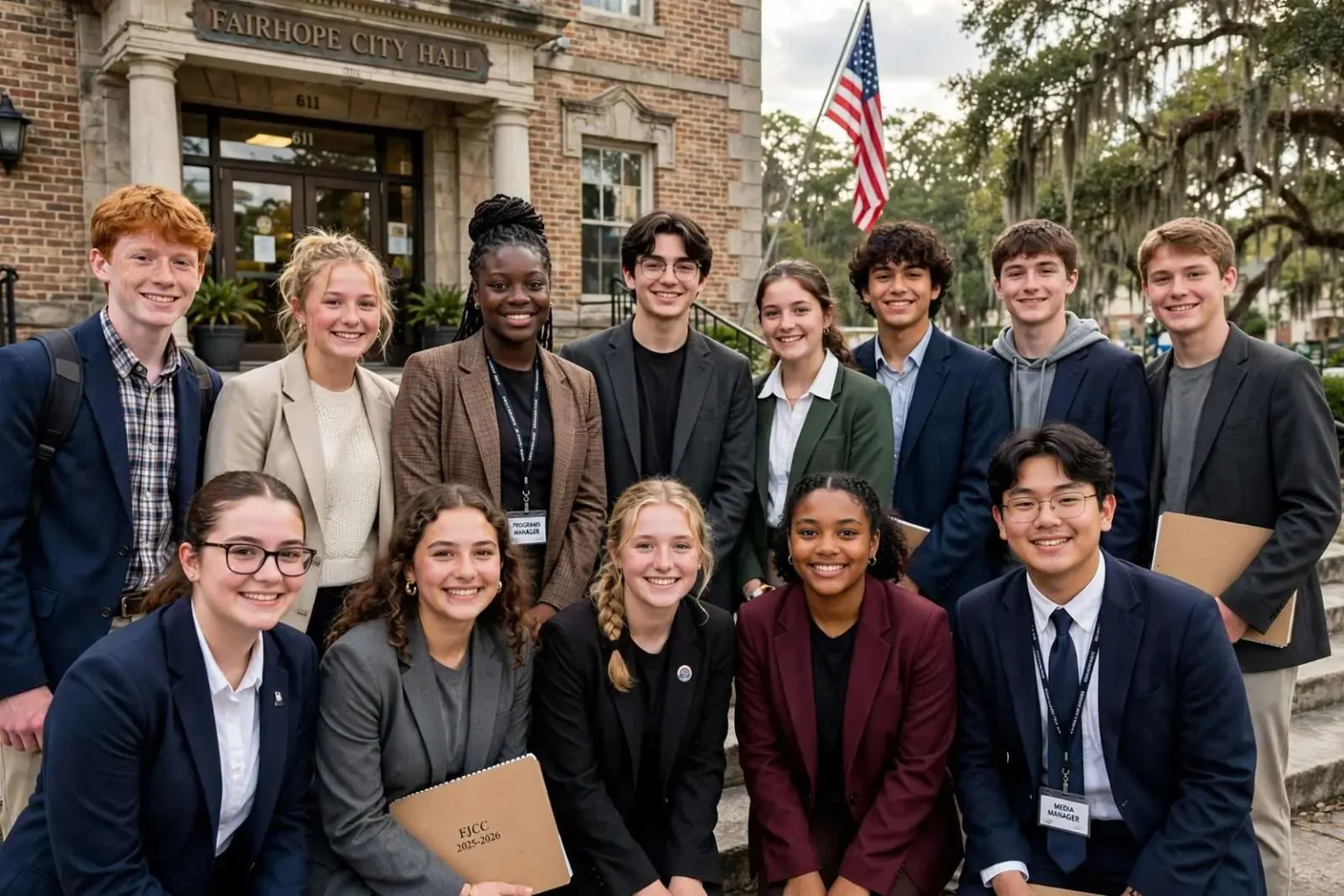
For Fairhope teens interested in public service, the Fairhope Junior City Council (FJCC) offers a hands-on introduction to how city government works. The program, which exists to serve as a youth voice within the city, brings together thirteen students from across the area each year to observe and participate in the workings of local government. Members spend a year alongside the city’s elected leaders, learning how an agenda becomes an ordinance and how a small city balances growth, budgets and the expectations of the people who live in it.
What the Junior City Council does
Members of the FJCC are expected to attend City Council meetings when necessary to observe government in action, giving them a firsthand look at how decisions affecting Fairhope are made. Council meetings in Fairhope follow the standard rhythm of Alabama municipal government, with agendas published in advance, public comment periods, and votes on everything from routine contracts to zoning decisions that shape the city’s future. For a high school student, sitting through that process in person is a very different education from the civics classroom version, because it shows the negotiation, the public input and the occasional friction that textbooks tend to leave out.
The group also makes presentations to the City Council during work sessions and serves as a youth outreach arm of city government, engaging other young people through projects throughout the community. Work sessions are where the real deliberation happens, when council members and department heads talk through proposals before they reach the formal meeting, and a junior councilor presenting there is presenting to the people who actually decide. The outreach role runs in the other direction, taking city government to younger audiences and making sure students in Fairhope’s schools hear about the issues the city is wrestling with rather than reading about them after the fact.
The thirteen members are appointed by Mayor Sherry Sullivan, working alongside a committee of community and city professionals who help select the roster each year. The selection model is deliberate: a mayor’s appointment ensures the junior council has an official channel into city hall, while the screening committee brings in educators, civic leaders and city staff who know the applicants and can evaluate which students are ready for a year of service. The result is a body that mirrors, in miniature, the way the city itself fills its boards and committees.
Meet the 2025-2026 members
This year’s council draws students from several area schools, a spread that reflects the range of educational choices in the Fairhope area. Camille Hausman of Fairhope High School serves as president, with Mary Elizabeth Owens, also of Fairhope High School, serving as vice president. Bethany Pierce of Fairhope High School serves as secretary, Fisher Key of St. Michael Catholic High School serves as programs manager, and Jackson Wade of Bayshore Christian School serves as media manager.
Wright Wilcoxon and Zaylee Bradley, both of Fairhope High School and serving respectively as Student Government Association president and vice president, hold ex officio positions on the council. Their seats recognize that the students already elected to lead Fairhope High’s student body have a direct stake in the junior council’s work, and their presence creates a standing bridge between student government at the school and municipal government at city hall. Rounding out the roster are Isabelle Daniell of Bayside Academy, Virginia Guilian of Fairhope High School, Epsie Dorman of Fairhope High School, Gunnar Kowal of Fairhope High School, Ezra Langley of Baldwin Preparatory Academy and Sharon Smith of Fairhope High School.
The mix of schools matters to the program’s purpose. Fairhope High School is the city’s public high school, while St. Michael Catholic High School, Bayshore Christian School, Bayside Academy and Baldwin Preparatory Academy draw students from across the eastern shore and central Baldwin County. A junior council that seats students from all of them speaks for the whole generation of young people who call Fairhope home, whatever school they attend, and the projects the group takes on reach across those same lines.
A program for future leaders
City officials describe the FJCC as a fit for teens who show a desire for leadership and public service, offering them a structured place to practice both. The description is more than a slogan; the year is built around real obligations, from attending meetings and preparing presentations to managing programs and communications within the group itself. The officer structure, with a president, vice president, secretary, programs manager and media manager, gives members genuine responsibility for the body’s work rather than ceremonial titles, and the students who hold them finish the year with experience that translates directly to student government, college applications and the early stages of civic careers.
Junior city councils have become a common feature of municipal government across Alabama and the Southeast, and Fairhope’s version reflects lessons those programs have collectively learned. The most successful ones give students a real advisory role, asking them for input on issues that affect young people, such as parks, recreation, libraries, traffic around schools and events, rather than limiting them to observation. They also rotate membership annually, so that each cohort of seniors passes the experience to the next class while the city builds a widening circle of alumni who understand how local government functions.
For the city, the return is equally practical. Fairhope, a city of roughly twenty thousand on the eastern shore of Mobile Bay, has grown rapidly in recent decades, and the questions its council faces, from development pressure to infrastructure spending to the character of its downtown, are exactly the questions the next generation will inherit. A program that teaches future residents and, perhaps, future council members how the city’s budget works, how zoning shapes growth and how public meetings operate is an investment in the quality of that eventual conversation.
Fairhope’s civic tradition
The program fits a city with an unusually strong civic identity. Fairhope was founded in 1894 as a single-tax colony, established by settlers from Iowa who came looking for a place to test the economic ideas of Henry George, and the community’s cooperative, participatory roots have shaped its public life ever since. The city’s parks, its pier and waterfront, its library and its long tradition of active civic organizations all trace back to that founding culture, in which residents expected to take part in governing the place they lived.
That heritage makes a junior council a natural extension rather than an import. Fairhope residents vote, attend meetings and volunteer at rates that smaller cities often envy, and city government has historically offered numerous channels for public involvement, from boards and committees to the public comment periods at council meetings. Putting thirteen high school students into that ecosystem each year connects the city’s oldest habit, citizens showing up, to its youngest participants.
The appointment of the 2025-2026 roster by Mayor Sherry Sullivan, working with the selection committee, continues a practice that has outlived individual administrations, and the members themselves represent the diversity of the eastern shore’s schools. For the students, the year ahead holds council meetings, work session presentations and community projects; for the city, it holds another group of young people who will leave the program knowing how their government works, who made the decisions and why, and how to be part of it when their turn comes.
The year ahead for the thirteen members
The calendar a junior councilor keeps is not symbolic work. Meetings of the Fairhope City Council are held regularly at city hall, and members of the FJCC attend when the agenda or their own projects call for it, filing in alongside the residents, business owners and reporters who make up the usual audience. Between meetings, the group organizes its own business: the programs manager plans the outreach and service projects, the media manager handles communications, and the officers set the agenda for the body’s own sessions. It is a schedule layered on top of coursework, athletics and everything else that fills a high school year, which is part of what the selection committee is screening for when it chooses the roster.
Presentations during work sessions give the members their most direct influence. When the junior council has studied an issue or surveyed their peers, the work session is where that research reaches the people who can act on it, and city officials have historically treated such presentations with attention, since they carry information the council rarely gets any other way: what young residents actually think about parks, safety, events and the pace of change in their hometown. A well-received junior council presentation can shape how a project is designed or raise an issue onto the city’s agenda at all.
The community projects the group undertakes through the year extend the program beyond the council chamber. Whether the projects involve service, awareness campaigns or events aimed at other students, they teach the practical mechanics of getting something done in a city: finding a venue, coordinating with departments, recruiting volunteers and inviting the public. Those skills are the unadvertised curriculum of the FJCC, and they are the reason alumni of such programs often move seamlessly into college government, civic boards and, eventually, elected office.
What the program asks and what it gives
The expectations are stated plainly by city officials: the program suits teens who show a desire for leadership and public service. Thirteen seats are limited, and the application process run under the mayor’s appointment with the committee’s screening is competitive. Students who apply are asked to show not just achievement but follow-through, because a junior council that loses members mid-year cannot fulfill its role as the city’s youth voice. In return, members get access that few teenagers anywhere receive, standing relationships with the mayor, council members and city staff, and a year of watching close up how a real government makes real decisions.
The experience also reframes how students see their city. Fairhope’s rapid growth, its debates over development and its careful management of its waterfront and downtown all look different from inside the process than they do from a classroom desk. Members learn that the issues are rarely simple, that budgets constrain every good idea, and that public meetings are where compromise gets built. Several cohorts of similar programs across Alabama have seen their alumni return years later as planning commissioners, committee volunteers and candidates, which is the long game such bodies are designed to play.
For the 2025-2026 term, the thirteen appointed students, from Camille Hausman at the gavel to the members at large from Fairhope High, Bayside Academy and Baldwin Preparatory Academy, now carry that assignment. The city gets a youth voice it has structured into its government; the students get a civic education no classroom can replicate; and Fairhope, a town that has always expected its residents to participate, gets another generation prepared to do exactly that.