Rows of small American flags planted in green grassAmerican flags, symbolizing the City of Fairhope 2026 Veteran of the Year Award honoring local military service.

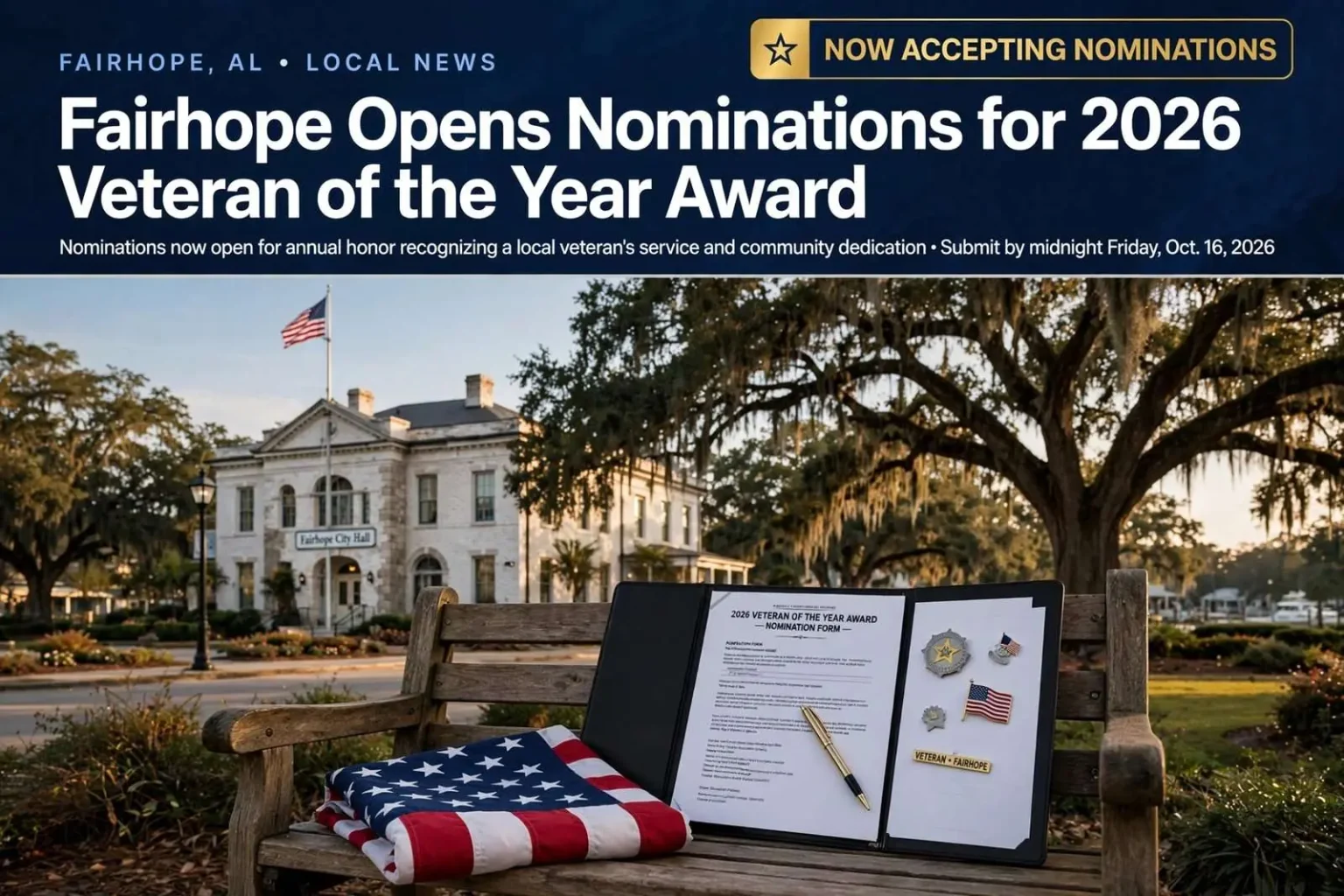
The City of Fairhope is now accepting nominations for its 2026 Veteran of the Year Award, an annual honor recognizing a local veteran whose military service continues to be matched by dedication to the community.

The award goes to a living veteran who has shown outstanding leadership, patriotism and a strong record of volunteerism and civic involvement. Nominees can be recognized either for a single extraordinary act of service or for a sustained history of giving back to the Fairhope community over time.

Who Can Be Nominated

To be eligible, a nominee must be a living veteran of one of the five branches of the U.S. Armed Forces, which includes the Army, Navy, Air Force, Marine Corps and Space Force, as well as the National Guard, Reserves or U.S. Merchant Marine. Nominees must also have a tie to Fairhope: they must live in the city, work in Fairhope, or belong to American Legion Post 199, VFW Post 5660 or another recognized veterans organization based in the city. Previous Veteran of the Year recipients are not eligible to be nominated again, though nominations that are not selected remain active for two years, giving those candidates a chance to be considered in future award cycles.

How to Submit a Nomination

Nomination forms are available at Fairhope City Hall, American Legion Post 199 and VFW Post 5660, as well as online at the city’s website. Completed nominations must be submitted, or postmarked, by midnight on Friday, Oct. 16, 2026. Forms can be delivered in person to the Mayor’s Office at Fairhope City Hall, located at 161 N. Section Street, or mailed to the Veteran of the Year Committee at P.O. Drawer 429, Fairhope, AL 36533. Residents with questions can contact the City of Fairhope at 251-929-1474.

Past Honorees and Recognition

The 2026 Veteran of the Year will be honored during the final Fairhope City Council meeting in October. Past recipients of the award include Frank McArdle, Dr. Tonya Butler, Edwin Lessard Jr., Larry Bridges and Doug Mansmann, whose recognition reflects a range of service across the branches of the military and years of continued civic engagement in Fairhope.

The nomination period gives residents, veterans organizations and fellow service members an opportunity to publicly recognize local veterans whose contributions might otherwise go unnoticed, whether through mentorship, volunteer work, fundraising or other community efforts carried out long after their military service ended.

See also  Trip Pittman Enters the Race for Baldwin County's Vacant Senate Seat

Baldwin County sits directly east of Mobile County across Mobile Bay and is the largest county in Alabama by land area. It encompasses the Eastern Shore communities of Daphne, Fairhope, Spanish Fort, and Foley and stretches south to the beaches of Gulf Shores and Orange Beach along the Gulf of Mexico.

Long among the fastest-growing counties in the state, Baldwin blends suburban development near the bay with tourism-driven coastal economies. Its proximity to Mobile and its position on the Eastern Shore make it a recurring subject of regional news covering growth, infrastructure, schools, and the balance between development and coastal preservation.

Local government in the Mobile area operates through a combination of mayor-council or commission structures at the municipal level and a county commission in Mobile County, with elected officials handling budgets, public safety, infrastructure, and zoning. Baldwin County has its own commission and a collection of incorporated municipalities.

Decisions made in council chambers and commission meetings affect roads, school funding, economic development, and quality of life, which is why coverage of local government is a staple of regional journalism. The interplay between city, county, and state authorities often determines how effectively the area can address shared challenges.

Because many services residents rely on are delivered at the local level, the choices of elected officials have direct, everyday consequences. Budget priorities, in particular, reveal a community’s values and shape the trajectory of growth and public welfare for years to come.

Charitable and nonprofit organizations form a vital safety net across South Alabama, addressing needs from hunger and homelessness to disaster relief and holiday assistance. Groups such as The Salvation Army operate local corps that provide shelter, food, and seasonal programs funded largely by community donations.

The generosity of Gulf Coast residents, often mobilized after hurricanes and economic hardship, underscores how tightly knit many of these communities are. Local philanthropy also relies on volunteers and corporate partners, and the progress of fundraising efforts is a recurring subject of regional news because it reflects the community’s capacity to care for its most vulnerable members.

Holiday campaigns in particular reveal the scale of need and the reach of volunteer networks. The rhythm of annual giving, from food drives to toy distributions, is woven into the regional calendar and into the coverage that keeps residents informed about how to help and where support is most needed.

See also  2011 Offshore Earthquake Was Felt Along the Alabama Coast

The economy of the Mobile region is diversified across shipping and logistics, aerospace and shipbuilding, healthcare, tourism, and manufacturing. The Port of Mobile is one of the nation’s busiest seaports and a cornerstone of the local and state economy.

Major employers in aviation and defense contribute to a skilled workforce, while economic-development organizations aim to attract investment and jobs through incentives and infrastructure improvements. Small businesses, from restaurants to professional services, form the backbone of neighborhood commerce.

The health of the regional economy is a frequent subject of public discussion and reporting. Workforce development, recruitment of industry, and the fortunes of local retailers all feed into a broader picture of how the Gulf Coast competes and adapts in a changing national economy.

The history of South Alabama is shaped by its position at the crossroads of cultures and waters. Indigenous peoples, including the Muscogee (Creek) and Choctaw, lived in the region for centuries before European colonization by French, British, and Spanish powers.

The cotton economy and the Civil War left deep imprints, as did the Civil Rights Movement, in which Alabama played a defining role. Understanding present-day debates in the region often requires appreciating this layered past, in which port commerce, racial history, and coastal geography have long intertwined.

That inheritance is visible in the architecture, street names, and institutions of the area. Public memory of the past informs contemporary conversations about growth, equity, and identity, and it frequently surfaces in coverage of local events and policy.

Mobile is the county seat of Mobile County in southwest Alabama and the state’s only saltwater port. Situated where the Mobile River meets Mobile Bay near the northern Gulf of Mexico, the city has long served as a commercial and cultural gateway between Alabama and the wider Gulf Coast. Founded in 1702 as Fort Louis de la Louisiane and ruled in turn by France, Britain, and Spain before joining the United States in 1813, Mobile carries a layered heritage distinct from the rest of the state.

Today Mobile anchors a metropolitan area spanning Mobile County and neighboring Baldwin County, and it remains a center for shipping, aerospace, healthcare, and higher education in the region. Its downtown and waterfront have seen sustained revitalization, while historic neighborhoods preserve architecture from its colonial and antebellum past. The city’s identity is shaped as much by its working port and industrial base as by its festivals and food culture, making it a frequent focal point for news about growth and change in southern Alabama.

See also  Bay Minette City Council Confirms Al W. Tolbert Jr. as New Police Chief

Mobile Bay is a shallow estuary in southern Alabama where freshwater from the Mobile, Tensaw, and other rivers mixes with saltwater from the Gulf of Mexico. It is among the largest estuarine systems in the United States and supports commercial and recreational fishing, shipping through the Port of Mobile, and wetlands that buffer the coastline from storms.

The bay’s Eastern Shore, in Baldwin County, includes Daphne, Fairhope, and Spanish Fort, while the Western Shore lies in Mobile County. Its ecology and economy have guided settlement for centuries, and the bay figures in regional debates over development, navigation, and conservation. Events on either shore are routinely covered as part of the interconnected life of the Mobile metro area.

The Gulf of Mexico borders Alabama’s southern edge and defines much of the state’s coastal identity. Alabama’s Gulf coastline, centered on Dauphin Island, Gulf Shores, and Orange Beach, supports a tourism industry built around beaches, charter fishing, and marine recreation, while offshore waters host shipping lanes and energy interests.

The Gulf’s warm, shallow shelf and exposure to hurricanes make weather and disaster preparedness recurring concerns for communities from Mobile to Baldwin County. The marine environment also underpins commercial seafood harvests that have sustained Gulf Coast families for generations, tying the region’s economy and culture closely to the water.

Alabama is a state in the southeastern United States bordered by Tennessee, Georgia, Florida, the Gulf of Mexico, and Mississippi. Often called the Heart of Dixie, it spans Appalachian foothills in the north and flat coastal plains in the south. Its largest cities include Birmingham, Montgomery, Huntsville, and Mobile.

Alabama’s history encompasses Indigenous roots, Spanish and French colonial settlement, a cotton-plantation economy, the Civil War and Reconstruction, and the Civil Rights Movement of the 1950s and 1960s, followed by a shift toward manufacturing, aerospace, and technology. Local news across the state frequently reflects this mix of tradition and change.